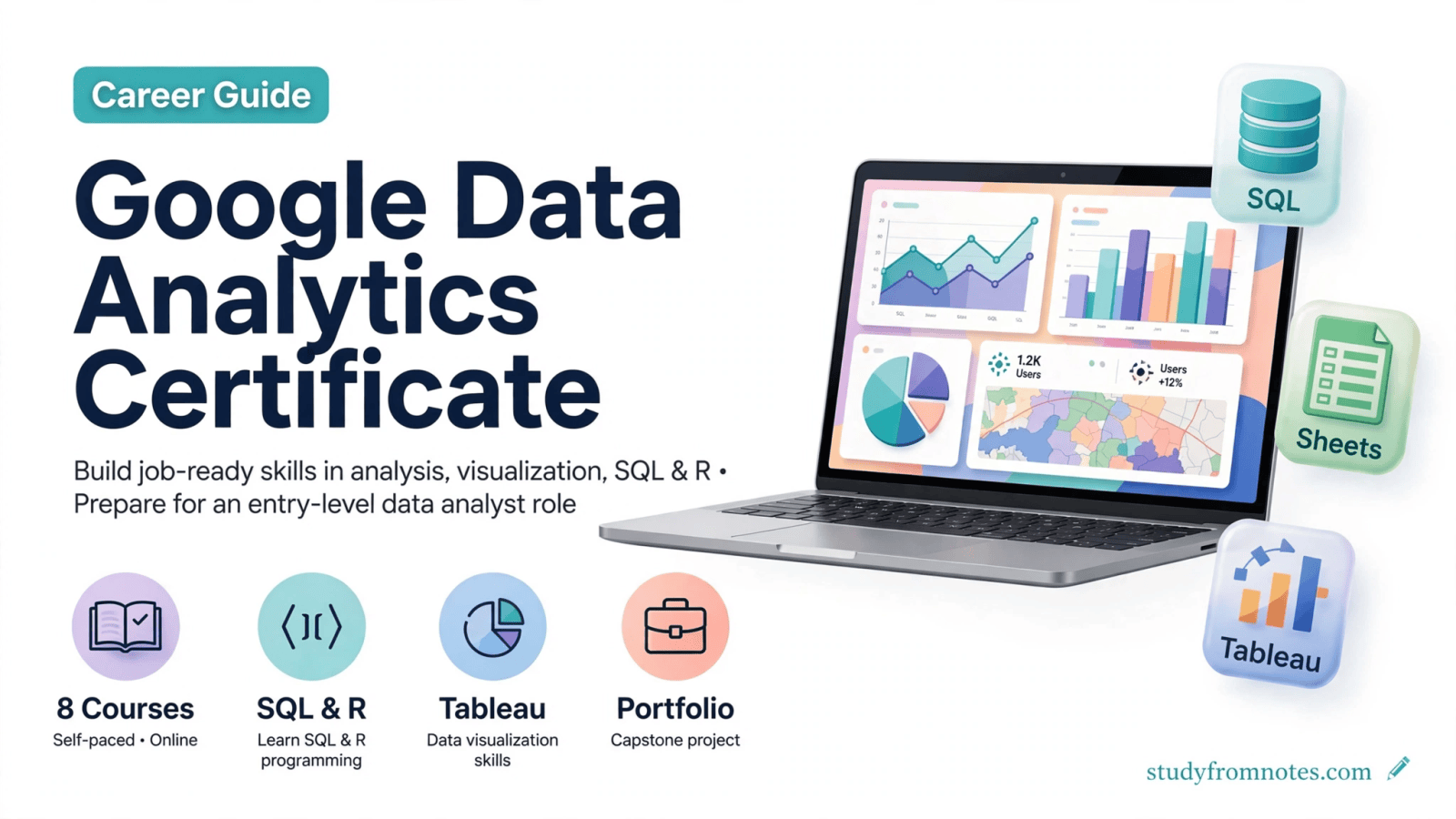
What Is the Google Data Analytics Certificate?
The Google Data Analytics certificate is an eight-course online program that teaches the foundations of data analytics: spreadsheets, SQL, Tableau, and R programming. Designed for complete beginners, it is the most popular of Google’s Career Certificates and is hosted on Coursera.
Data analyst roles consistently rank among the most accessible entry points into tech, and this certificate is the most recognized credential for breaking in without a degree. This guide covers all eight courses, a study plan, and how to turn the certificate into a job.
Table of Contents
- The 8 Courses Explained
- How Long the Google Data Analytics Certificate Takes
- Your Study Plan: Course by Course
- The Portfolio: What Actually Gets You Hired
- Skills Employers Test in Interviews
- Common Mistakes
- After the Certificate: Getting Hired
- Frequently Asked Questions
The 8 Courses Explained
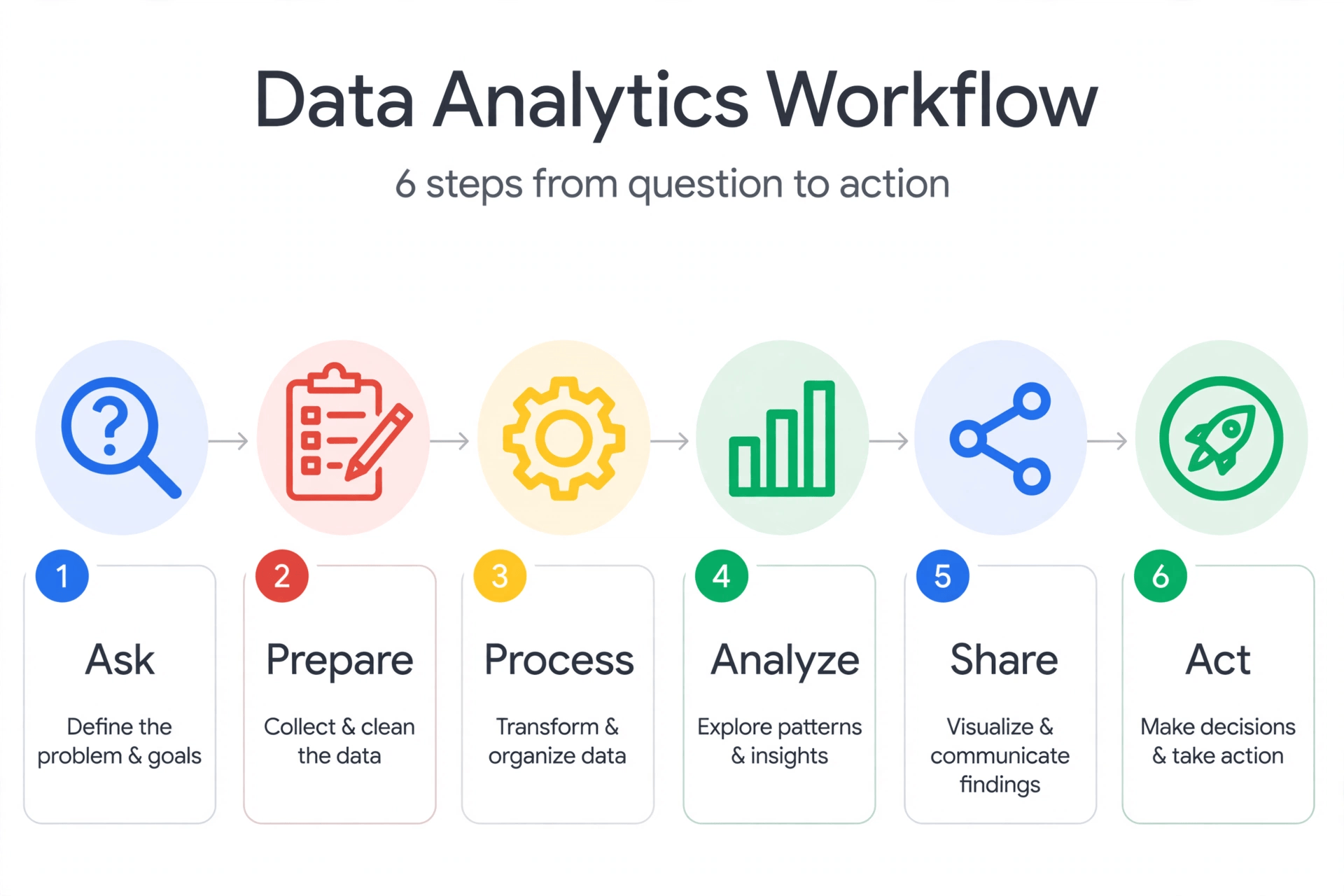
- Foundations: Data, Data, Everywhere. What data analysts do, the data life cycle, and the toolbox you will learn.
- Ask Questions to Make Data-Driven Decisions. Problem framing, stakeholder communication, and scoping analysis.
- Prepare Data for Exploration. Data formats, cleaning basics, and verifying data integrity.
- Process Data from Dirty to Clean. Hands-on data cleaning with spreadsheets and SQL: the unglamorous skill behind every analysis.
- Analyze Data to Answer Questions. Sorting, filtering, and summarizing data to find patterns.
- Share Data Through the Art of Visualization. Building dashboards and presentations in Tableau.
- Data Analysis with R. Programming fundamentals in R for statistical analysis.
- Capstone: Complete a Case Study. An end-to-end project for your portfolio.
How Long the Google Data Analytics Certificate Takes
- Full-time (20+ hrs/week): 2 to 3 months
- Steady (10 hrs/week): 4 to 6 months
- Evenings (5 hrs/week): 6 to 8 months
Courses 4 through 7 are the most time-intensive because they are hands-on. Budget extra time there rather than rushing through.
Your Study Plan: Course by Course
Courses 1-2 (weeks 1-2): Move quickly. These are conceptual foundations. Take notes on the data life cycle and problem-framing frameworks; you will reference them throughout.
Courses 3-4 (weeks 3-6): Slow down. Data cleaning is where most learners struggle and where real analyst work happens. Practice every technique on a messy public dataset, not just the course exercises.
Courses 5-6 (weeks 7-10): Build as you learn. Create one dashboard per week in Tableau on topics you care about. These become portfolio pieces.
Courses 7-8 (weeks 11-14): Learn R basics, then pour your energy into the capstone. A strong capstone outweighs everything else on your resume.
Organize your schedule with our free study timetable generator.
The Portfolio: What Actually Gets You Hired
The certificate alone rarely gets interviews; the portfolio does. Build three projects: one data cleaning project (showing before/after), one SQL analysis (with well-commented queries), and one Tableau dashboard (telling a clear story). Publish them with write-ups explaining your process, your decisions, and what you would do differently. Hiring managers spend more time on portfolios than on credential lists.
Skills Employers Test in Interviews
- SQL: joins, aggregations, subqueries, and window functions. Practice on real databases, not just tutorials.
- Spreadsheets: pivot tables, VLOOKUP/XLOOKUP, and data cleaning functions.
- Visualization: choosing the right chart for the message, not just making pretty dashboards.
- Communication: explaining findings to non-technical stakeholders. This is tested in every interview.
Common Mistakes
- Watching without doing. Data skills only stick through practice. Code along with every lesson.
- Skipping the capstone. It is the single most valuable part of the program for job seekers.
- Learning tools without business context. Employers hire analysts who solve problems, not technicians who know functions.
- Stopping at the certificate. Keep building: one portfolio project per month after finishing.
After the Certificate: Getting Hired
Completing the Google Data Analytics certificate is the midpoint, not the finish line. The job search phase needs its own plan. Start applying while building your portfolio, not after: early applications teach you what employers actually ask for, and you can target your remaining projects to fill those gaps.
Tailor your resume around projects, not coursework. Each portfolio project should appear as a bullet-point achievement with a measurable outcome (cleaned a dataset of 50,000 records, built a dashboard tracking 12 KPIs, identified a trend that suggested a specific business action). Join data communities online where analysts share job leads and portfolio feedback. Many junior analyst roles are filled through community referrals before they are widely advertised. Consider stacking the certificate with SQL practice on real databases and one statistics course to round out the profile employers expect.
Frequently Asked Questions
Is the Google Data Analytics certificate worth it?
It is the most popular Google Career Certificate and is recognized by Google’s employer consortium of 150+ companies. Its value multiplies when paired with a strong portfolio.
Do I need math skills?
Basic statistics suffice for entry-level roles. The program teaches what you need; advanced math comes later if you move into data science.
Can I get a job with just this certificate?
Candidates who combine the certificate with a portfolio of 3+ projects and SQL proficiency do get hired. The certificate opens the door; the portfolio walks through it.
Should I learn Python or R?
The certificate teaches R. For job hunting, SQL matters more than either for analyst roles. Learn Python later if you move toward data science.
Start Your Data Analytics Journey
Plan your certificate with our study timetable generator, retain technical concepts with spaced repetition, and document your learning with effective notes.

Lauren Brooks is a finance professional writing on professional exams, study strategies, and finance careers.
Leave a Reply