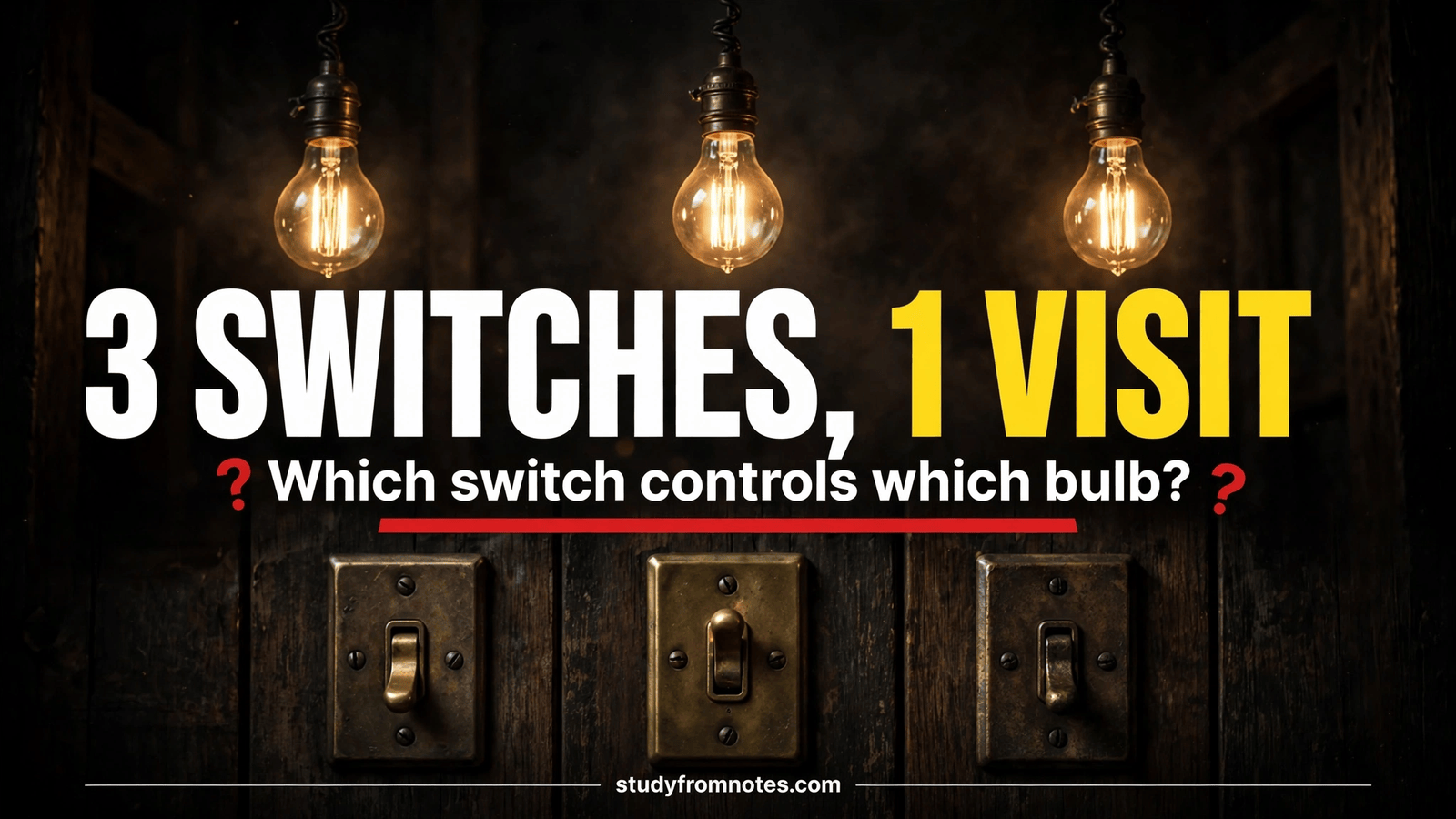
The answer to the McKinsey light bulb puzzle: turn Switch 1 ON and leave it for 10 minutes, then turn it OFF and turn Switch 2 ON. Walk into the room once. The lit bulb is on Switch 2. The unlit bulb that is warm to the touch is on Switch 1. The unlit bulb that is cold is on Switch 3. Heat is the second signal hiding in plain sight.
The Question
Three switches sit outside a closed room. Inside the room are three light bulbs, each wired to exactly one switch. All switches start off. You can flip the switches as many times as you like, but you are allowed to enter the room only once. How do you figure out which switch controls which bulb?
This McKinsey light bulb puzzle is one of the most reported brain teasers in consulting interviews, and candidates report versions of it at investment banks too. At first glance it looks impossible: one visit gives you only one snapshot, but you need three answers. The trick is that the room gives you more than one kind of information on that single visit. A lit bulb is a signal. A warm bulb is also a signal. Once you see both, three switches and three bulbs become easy.
Step-by-Step Solution to the McKinsey Light Bulb Puzzle
Give each switch a name: Switch 1, Switch 2, Switch 3. Do the same for the bulbs: Bulb A, Bulb B, Bulb C. Your plan has three moves before you enter the room, and three observations once you are inside.
Step 1: Turn Switch 1 ON and wait
Flip Switch 1 to ON and leave it on for about 10 minutes. You are not looking at the room, so you cannot see the bulb it controls, but that bulb is heating up the whole time. An incandescent bulb that has been on for 10 minutes gets noticeably warm. This is the move most candidates miss, because they assume the puzzle only cares about on and off. It does not. It cares about on, off-and-warm, and off-and-cold.
Step 2: Turn Switch 1 OFF, turn Switch 2 ON
After the 10 minutes, flip Switch 1 back to OFF. Immediately flip Switch 2 to ON and leave it there. Do nothing with Switch 3; it stays off the entire time. Now three things are true at once: Switch 1’s bulb is off but warm, Switch 2’s bulb is on, and Switch 3’s bulb is off and cold. You have encoded all three answers into the state of the room.
Step 3: Enter the room and read the three signals
Walk into the room and look at the bulbs. The one that is glowing is wired to Switch 2, the one you just turned on. That answer takes one second. Now touch the two bulbs that are off. One of them will be warm from the 10 minutes it spent lit. That warm-but-dark bulb belongs to Switch 1. The remaining bulb, off and cold, belongs to Switch 3. Three switches mapped, one visit, zero guesswork.
Why the McKinsey Light Bulb Puzzle Solution Works
The solution works because it turns one binary signal into a three-state signal. With only “lit” and “dark,” you get one bit of information per visit, which can only separate two outcomes, not three. Heat adds a second dimension: every bulb is now lit or dark AND warm or cold. Lit and warm means Switch 2. Dark and warm means Switch 1. Dark and cold means Switch 3. Two independent signals per bulb is more than enough to label all three, and that is the whole mathematical skeleton of the McKinsey light bulb puzzle.
There is also a hidden assumption you should say out loud in the interview: the bulbs must be the old incandescent kind that heat up. If the room used LEDs, the heat trick would fail, and a sharp interviewer might ask what you would do then. That is a good sign. It means you have understood the puzzle so well that you can see its boundaries. In the real world of consulting interviews, they ask these questions to watch you find the hidden variable, not to watch you memorize a trick.
What the Interviewer Is Testing
Consulting firms ask this question because the work is full of problems that look like they have too little data. A client hands you three months of noisy sales numbers and asks what happened. A supply chain breaks and you get one shipment manifest. The McKinsey light bulb puzzle tests whether you respond to scarce information by asking for more visits (more data you will never get) or by extracting more information from the single visit you have. Heat was free. Nobody hid it. It was sitting there the whole time, waiting for a candidate who treats every observable as data.
It also tests your communication under pressure. The best candidates do not blurt out the heat trick. They restate the constraints, name the signals available, and walk through the three moves in order, the way this post did. The interviewer is deciding whether they could put you in front of a client. A calm, numbered walkthrough says yes. If you want to practice that style on another classic, try the burning rope puzzle, where the hidden variable is time instead of heat.
Try This One Next
If the McKinsey light bulb puzzle clicked for you, here is your next interview brain teaser: two ropes, each burning exactly 60 minutes but never evenly. Measure exactly 45 minutes. The burning rope puzzle, solved. And if you want to train your weighing logic, the 8 balls puzzle and the Goldman Sachs 4 cars puzzle are waiting.

Lauren Brooks is a finance professional writing on professional exams, study strategies, and finance careers.



Leave a Reply