What Is the PRINCE2 Foundation Exam?
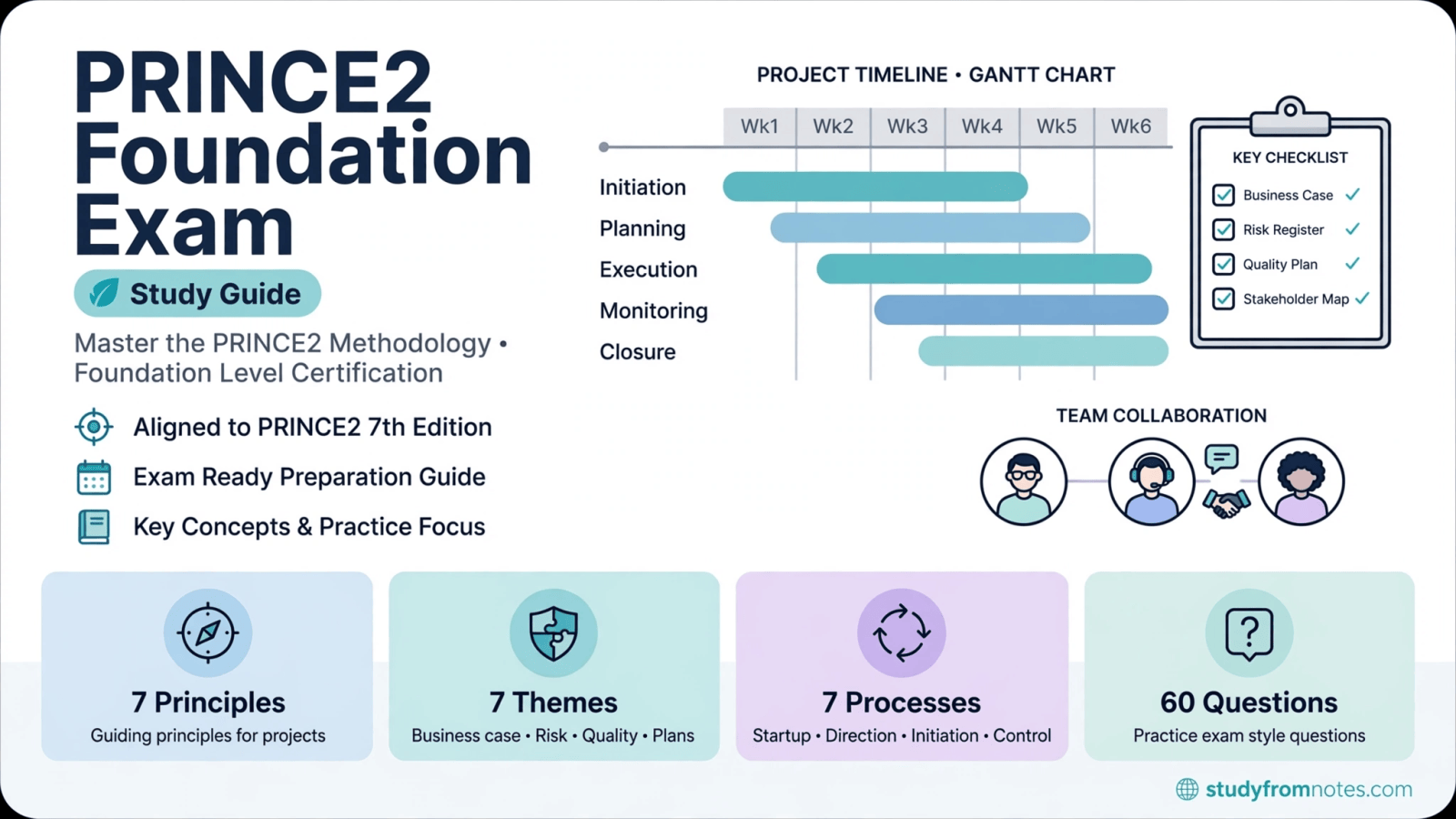
The PRINCE2 Foundation exam is the entry-level certification for the PRINCE2 project management method, widely used across the UK public sector and private industry. It tests your knowledge of the 7 principles, 7 themes, and 7 processes that make up the PRINCE2 framework, through a 60-question multiple-choice exam.
PRINCE2 appears in more UK job postings than any other project management certification. If you want project management roles in the UK, this is the credential employers ask for by name. This guide covers the full framework and how to pass.
Table of Contents
- The PRINCE2 Framework at a Glance
- The 7 Principles
- The 7 Themes
- The 7 Processes
- How the PRINCE2 Foundation Exam Works
- Your Study Plan
- Common Mistakes
- How PRINCE2 Compares to Other Methods
- Frequently Asked Questions
The PRINCE2 Framework at a Glance
PRINCE2 (PRojects IN Controlled Environments) is a process-based method for managing projects. The Foundation exam tests whether you understand the method’s components and vocabulary. The Practitioner exam (the next level) tests whether you can apply it. Learn the framework as three interlocking sets of seven:
The 7 Principles
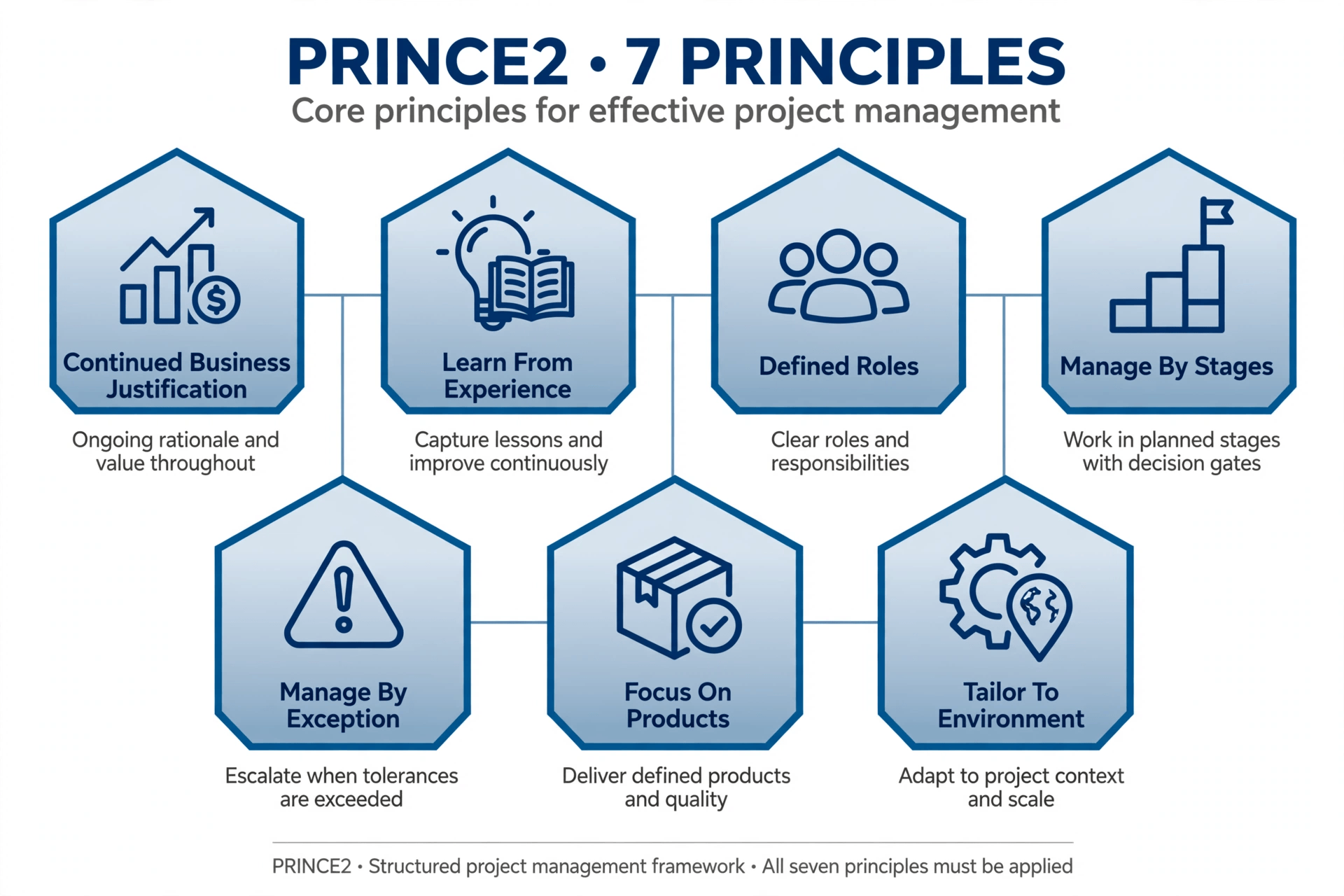
The principles are the non-negotiable foundations. A project is only a PRINCE2 project if it follows all seven:
- Continued business justification: the project must have a valid business case throughout its life, not just at the start.
- Learn from experience: teams must capture and apply lessons from previous projects.
- Defined roles and responsibilities: everyone knows who decides what, from the Project Board to Team Managers.
- Manage by stages: the project is divided into management stages with review points between them.
- Manage by exception: the Board sets tolerances for time, cost, and scope; the Project Manager only escalates when tolerances are threatened.
- Focus on products: define what will be delivered (and to what quality) before planning the work.
- Tailor to suit the project: the method adapts to the project’s scale, complexity, and context.
The 7 Themes
Themes are the aspects of project management that must be addressed continuously:
- Business Case: why the project exists and whether it remains worthwhile.
- Organization: who is involved and accountable.
- Quality: what good looks like and how it will be verified.
- Plans: how, when, and at what cost the products will be delivered.
- Risk: identifying, assessing, and controlling uncertainty.
- Change: managing issues and changes to the baseline.
- Progress: tracking where things stand against the plan.
The 7 Processes
Processes are the chronological journey from pre-project to project closure:
- Starting Up a Project: does the idea merit investigation.
- Directing a Project: the Board’s oversight activities.
- Initiating a Project: building the full business case and plans.
- Controlling a Stage: day-to-day management within a stage.
- Managing Product Delivery: the team producing the products.
- Managing a Stage Boundary: reviewing progress and planning the next stage.
- Closing a Project: formal handover and lessons learned.
How the PRINCE2 Foundation Exam Works
- Format: 60 multiple-choice questions, 60 minutes
- Pass mark: 36 out of 60 (60 percent)
- Book: closed book (no manual allowed)
The exam tests recall and understanding, not application. Questions ask for definitions, sequences, and responsibilities. If you can state each principle, theme, and process accurately and place them in the right context, you will pass.
Your Study Plan
Week 1: Principles and themes. Memorize all 7 principles and 7 themes with their definitions. Use spaced repetition for the terminology.
Week 2: Processes. Learn the 7 processes in order, with their key inputs and outputs. Draw the process flow from memory until you can reproduce it.
Week 3: Practice exams. Take timed practice papers. The exam is generous with time (1 minute per question), so focus on accuracy. Review every wrong answer against the manual.
Schedule your preparation with our free study timetable generator.
Common Mistakes
- Confusing themes with processes. Themes are continuous concerns; processes are sequential steps. The exam loves testing this distinction.
- Ignoring tailoring. Candidates memorize the method rigidly and miss questions about adapting it.
- Skipping practice papers. The question style (especially “which” and “what” questions about responsibilities) needs familiarization.
How PRINCE2 Compares to Other Methods
Candidates often ask how PRINCE2 differs from PMP and Agile. PRINCE2 is a prescriptive method: it tells you exactly what to do and in what order, which suits regulated environments and large organizations. PMP is a broader body of knowledge covering predictive, agile, and hybrid approaches. Agile methods (like Scrum) suit product development with evolving requirements. Many UK project managers hold both PRINCE2 and PMP, using PRINCE2 for governance-heavy projects and agile techniques for delivery. For the Foundation exam, you only need PRINCE2 itself, but understanding its position helps you answer context questions confidently.
Frequently Asked Questions
How long does PRINCE2 Foundation take to study?
Most candidates need 2 to 3 weeks of part-time study, or one intensive week.
Is PRINCE2 worth it in the UK?
Yes. It is the most requested project management certification in UK job postings, particularly in the public sector, consulting, and IT.
What is the difference between Foundation and Practitioner?
Foundation tests knowledge of the method. Practitioner tests application through scenario-based questions and is open-book.
Does PRINCE2 expire?
PRINCE2 certifications now require renewal every 3 years through continuing professional development or re-examination. Confirm current requirements with PeopleCert.
Plan Your PRINCE2 Preparation
Build your study schedule with our study timetable generator and master the terminology with effective note-taking methods.

Lauren Brooks is a finance professional writing on professional exams, study strategies, and finance careers.
Leave a Reply