What Is Spaced Repetition?
Spaced repetition is a study technique where you review each topic at gradually increasing intervals instead of all at once. You learn something today, recall it tomorrow, then after three days, then after a week, then after a month. Each successful recall makes the memory stronger and the next interval longer.
Most students study by rereading. They go over the same chapter three times in one evening, feel confident, and forget most of it within a week. Spaced repetition flips this: you review briefly but at carefully timed intervals, and you remember more while studying fewer total hours. This guide covers the science, a five-step method you can start this week, and a ready-made schedule to copy.
Table of Contents
- Spaced Repetition Technique: The Science in 60 Seconds
- How to Use Spaced Repetition in 5 Steps
- A Ready-Made Spaced Repetition Schedule
- 3 Mistakes That Kill the Technique
- Spaced Repetition vs Active Recall
- Frequently Asked Questions
Spaced Repetition Technique: The Science in 60 Seconds
In the 1880s, Hermann Ebbinghaus measured how fast we forget: without review, recall of new material drops sharply within the first 24 hours, then levels off. Every time you successfully recall something, the forgetting curve flattens. Review too early and you gain little; review too late and you are relearning from scratch. Spaced repetition times each review for the sweet spot, when recall takes effort but still succeeds.
Modern research keeps confirming it. Across hundreds of studies, spaced practice beats massed practice for long-term retention in almost every subject tested, from vocabulary to medicine to mathematics. It is one of the most replicated findings in learning science. A landmark 2013 review by Dunlosky and colleagues rated distributed practice as one of only two study strategies with high utility.
How to Use Spaced Repetition in 5 Steps
Step 1: Learn the topic properly first. Spaced repetition is a review technique, not a learning technique. You cannot space what you never understood. Study the topic once, properly, using good study notes. The first review comes later.
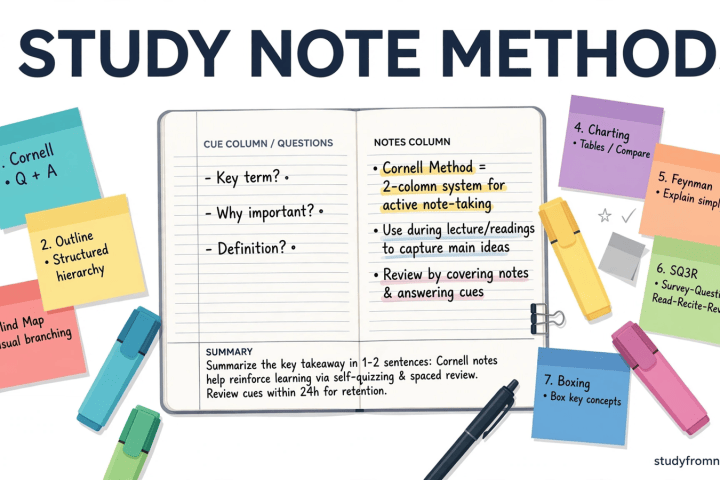
Step 2: Turn the topic into recall prompts. Convert your notes into questions, not statements. Flashcards, Cornell cue columns, and the blurting method all work. One idea per prompt.
Step 3: Do the first recall after one day. Tomorrow, answer every prompt from memory. Mark each one: remembered or forgotten. This first session is the most important; it catches the steepest part of the forgetting curve.
Step 4: Expand the intervals. For prompts you remembered, wait longer before the next review: three days, then a week, then two weeks, then a month. For prompts you forgot, reset to the one-day interval.
Step 5: Keep sessions short and honest. A review session should take 15 to 25 minutes. If you cannot answer a prompt, do not stare at it: flip it, read the answer, and mark it forgotten.
A Ready-Made Spaced Repetition Schedule
Suppose you learn Topic A on Monday. Here is the full review plan:
| Review | When | What to do |
|---|---|---|
| 1st | Tuesday (1 day later) | Recall all prompts. Mark remembered or forgotten. |
| 2nd | Friday (3 days later) | Recall again. Forgotten items reset to daily. |
| 3rd | Next Friday (1 week later) | Recall again. Drop items remembered three times in a row. |
| 4th | Two weeks later | Quick pass over remaining prompts. |
| 5th | One month later | Final check before the exam season. |
3 Mistakes That Kill the Technique
- Reviewing by rereading. Reading your notes again is not a review; it is exposure. Every review must be a recall attempt.
- Skipping the hard prompts. The prompts you dread are the ones the technique exists for.
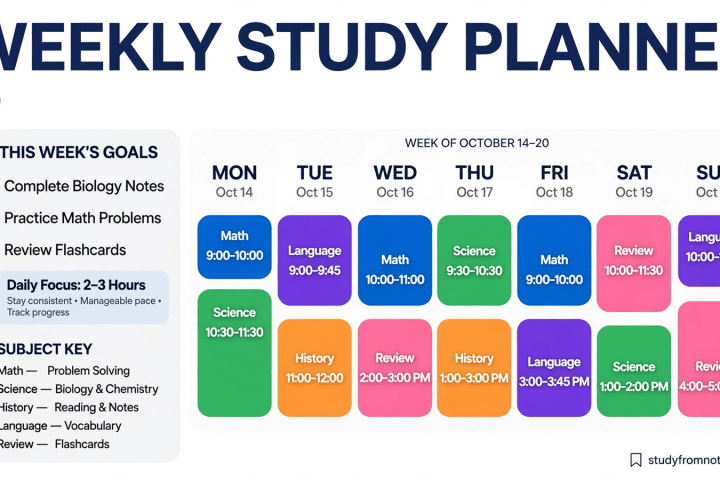
- Spacing without a system. Put the review dates in your weekly study planner and treat them like classes you cannot skip.
Spaced Repetition vs Active Recall
These two techniques are often confused, but they do different jobs. Active recall is the act of retrieving information from memory. Spaced repetition is the scheduling system that decides when each retrieval happens. They work as a pair: recall is the exercise, spacing is the training plan.
Frequently Asked Questions
How is spaced repetition different from active recall?
Active recall is retrieving information from memory. Spaced repetition is the scheduling system for when each retrieval happens. They work as a pair.
Does the spaced repetition technique work for every subject?
It works best for anything with facts, definitions, procedures, and problem types. It helps less with pure skill practice like essay writing.
How much time does spaced repetition take each day?
About 15 to 25 minutes once the habit is running.
Can I use spaced repetition for professional exams like the CPA or ACCA?
Yes, it suits them well. Professional syllabi are large and studied over months, which is exactly where spacing beats cramming.
Do I need an app like Anki?
No. Apps automate the scheduling, but a simple dated list works just as well.
Start Spacing Your Reviews Today
Pair spaced repetition with active recall for the complete evidence-based study system, and plan it all with our free study timetable generator.

CA L Awrak is a Chartered Accountant writing on CA exams, tax and finance careers.
[…] study hours, and exam date for a printable week-by-week plan. Then lock in what you learn with spaced repetition and active […]