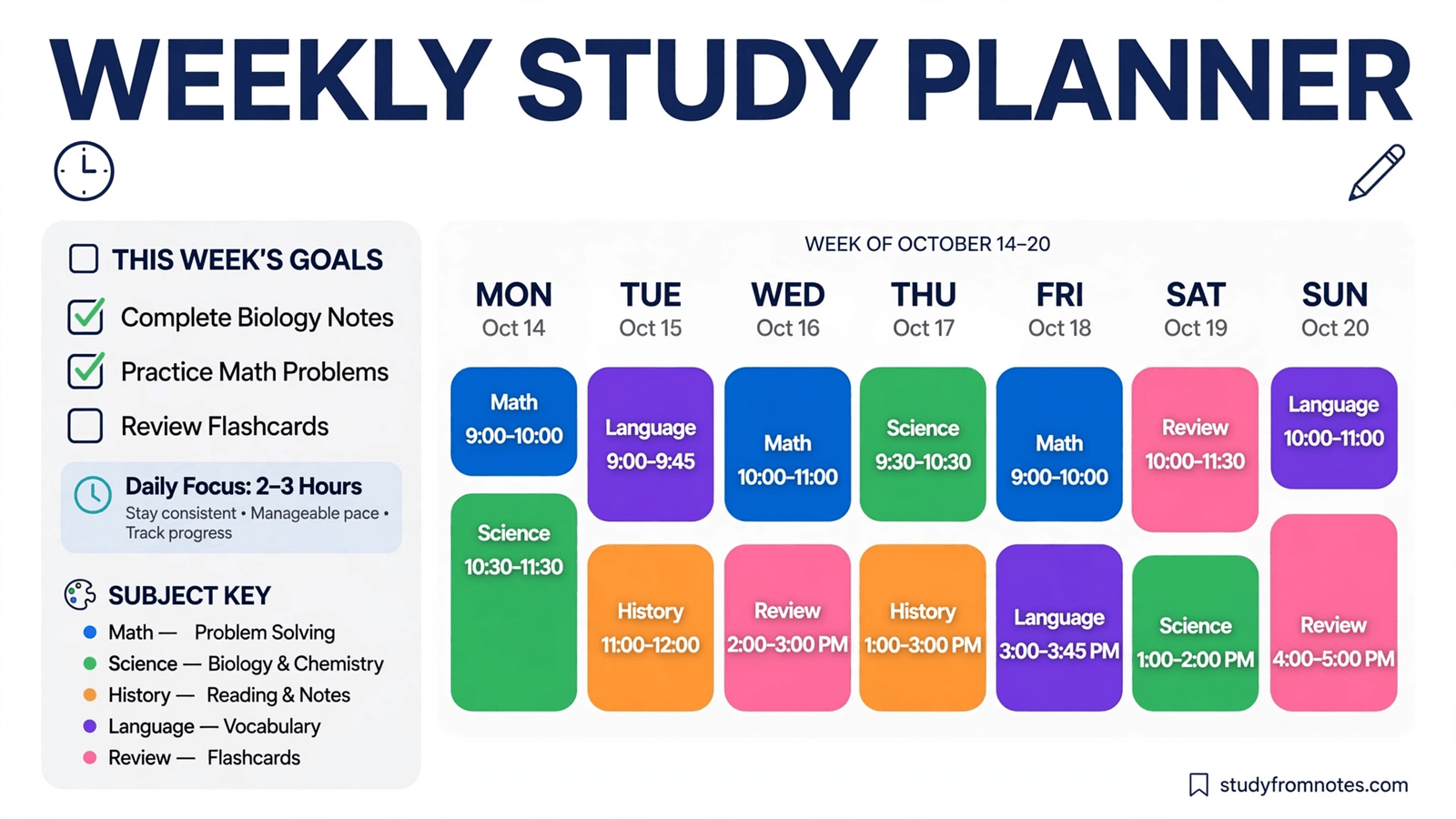
A weekly study planner is a simple grid that assigns your subjects and topics to specific time slots across the week. The method that works: list your fixed commitments first, block study sessions of 60 to 90 minutes, give every session a specific topic (never just “study biology”), and keep one buffer slot for spillover. Below is the full six-step method, a worked example for a real student week, and a free printable template.
Contents
- What Is a Weekly Study Planner?
- How to Build Your Weekly Study Plan in 6 Steps
- Worked Example: A College Student’s Week
- Free Weekly Study Planner Template
- Generate Your Full Exam Timetable
- 5 Tips to Actually Follow Your Planner
- Frequently Asked Questions
What Is a Weekly Study Planner?
A weekly study planner is a one-page schedule that maps your study sessions across Monday to Sunday, assigning specific subjects and topics to fixed time slots. Unlike a to-do list, it tells you what to study and when, which removes daily decision-making and makes it far more likely you will actually sit down and work.
The difference matters. A to-do list that says “revise chemistry” gets postponed because starting is ambiguous. A planner that says “Tuesday 7:00 to 8:30 pm: chemical bonding, past paper questions 4 to 9” gets started, because the decision is already made. Planning once a week buys you six days of not deciding.
How to Build Your Weekly Study Plan in 6 Steps
Step 1: List your fixed commitments
Before a single study session goes in, block out everything immovable: classes, work shifts, commute, meals, sleep. Your planner must respect your real life, or your real life will ignore your planner. Most students find 15 to 25 genuinely free hours in a week. Write the number down; it is your budget.
Step 2: Decide your total study hours honestly
Take your free hours and subtract 20 percent. That gap is friction: tasks overrun, motivation dips, life happens. A student with 20 free hours should plan 16 hours of study. A plan you complete beats an ambitious plan you abandon by Wednesday.
Step 3: Break subjects into topics, not subjects
“Study physics” is not a plan. List the actual topics: kinematics problem set, thermodynamics notes, lab report. Each study session gets one topic. If you cannot name the topic, you are not ready to schedule the session.
Step 4: Assign topics to slots, hardest first
Put your hardest subject in your freshest slot. For most students that means mornings or the first evening session. Alternate heavy and light subjects so two brutal sessions never sit back to back. Keep sessions to 60 to 90 minutes; beyond that, retention falls off a cliff.
Step 5: Add a buffer slot and a rest day
Reserve one 90-minute buffer slot midweek for anything that slipped. And take one full day, or at least one full evening, completely off. Rest is not the absence of studying; it is what makes the other six days possible.
Step 6: Review every Sunday, ten minutes
Each Sunday, tick off what you completed, move what you missed into the buffer or next week, and plan the coming week. Ten minutes of review is the difference between a planner and a wish.
Worked Example: A College Student’s Week
Meet Alex, a second-year student with four subjects and exams in six weeks. She has classes until 4 pm on weekdays, works Saturday mornings, and keeps Sunday evenings free. Her honest budget: 16 study hours.
| Day | Session | Topic |
|---|---|---|
| Monday | 6:00 – 7:30 pm | Accounting: depreciation methods, problem set 5 |
| Monday | 8:00 – 9:00 pm | Economics: read demand and supply chapter, Cornell notes |
| Tuesday | 6:00 – 7:30 pm | Statistics: hypothesis testing, past paper Q1-Q5 |
| Wednesday | 6:00 – 7:30 pm | Accounting: bank reconciliation, blurt method revision |
| Wednesday | 8:00 – 9:00 pm | Business law: offer and acceptance, flashcards |
| Thursday | 6:00 – 7:30 pm | Buffer slot: unfinished topics from Mon-Wed |
| Friday | 6:00 – 7:30 pm | Economics: elasticity numericals, timed practice |
| Saturday | 2:00 – 4:00 pm | Mock test: statistics full paper, exam conditions |
| Saturday | 4:30 – 5:30 pm | Review mock, log mistakes in error notebook |
| Sunday | 10:00 – 11:30 am | Weekly revision: blurting all four subjects |
| Sunday | 11:30 – 11:40 am | Plan next week |
Total: 16 hours. Notice every session names a topic and a method, the hardest subject (accounting) sits in the fresh Monday slot, and Sunday evening stays free. This is what a finished planner looks like.
Free Weekly Study Planner Template
We have made a free printable weekly study planner: a clean one-page grid, Monday to Sunday, with space for topics, time slots, and a weekly review checkbox. Print one each Sunday and fill it in ten minutes.
Download the free weekly study planner template (PDF)
Generate Your Full Exam Timetable
A weekly planner handles one week. For a full exam season, use our free study timetable generator: enter your subjects, topics remaining, daily study hours, and exam date, and it builds a complete day-by-day timetable with revision days and mock tests built in. No account needed, and you can print the result.
5 Tips to Actually Follow Your Planner
- Plan at the same time every week. Sunday morning, ten minutes, same chair. Rituals beat motivation.
- Name topics, never subjects. “Study chemistry” is a wish. “Chemical bonding, textbook pages 44 to 61” is a task.
- Protect the first session of the day. If the first session slips, the whole day tends to follow. Start on time even if you start small.
- Track completion, not hours. Sitting at a desk for three distracted hours is not studying. Tick off topics finished; that is the metric that predicts grades.
- When you miss a session, reschedule it. Do not double up. Doubling up punishes you for slipping and guarantees burnout. Move the session to the buffer slot and carry on.
Frequently Asked Questions
How many hours should I study per day?
For most school and college students, 2 to 4 focused hours on weekdays plus longer weekend sessions is sustainable. Quality beats quantity: four distracted hours lose to two focused ones.
Should I study one subject per day or mix them?
Mix. Studying two or three subjects a day (interleaving) produces better long-term retention than blocking a whole day on one subject, because your brain has to work harder to switch contexts.
What if my exam is less than a month away?
Shorten the cycle: drop new learning, switch to past papers and blurting, and use the study timetable generator to compress your remaining topics into the days you have left.
Paper planner or an app?
Whichever you will look at. A paper planner on your desk beats a perfect app you never open. Many students use both: the app for reminders, the paper for the actual plan.
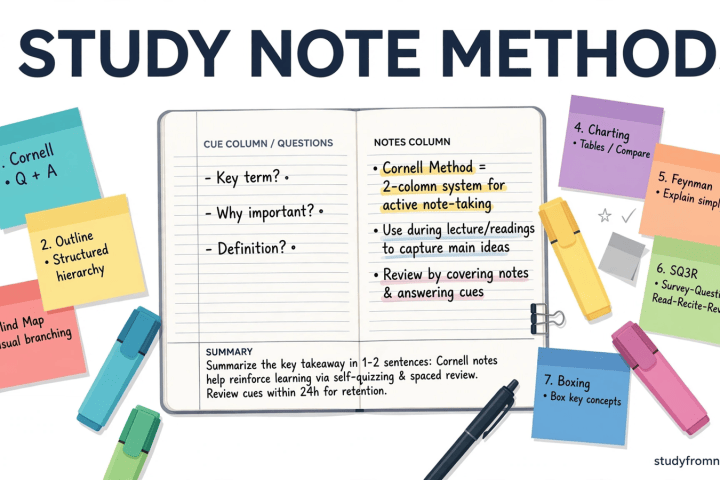
Pair your planner with good notes and the system compounds: learn how to make effective study notes so every planned session produces material you can actually revise from.

CA L Awrak is a Chartered Accountant writing on CA exams, tax and finance careers.
Leave a Reply