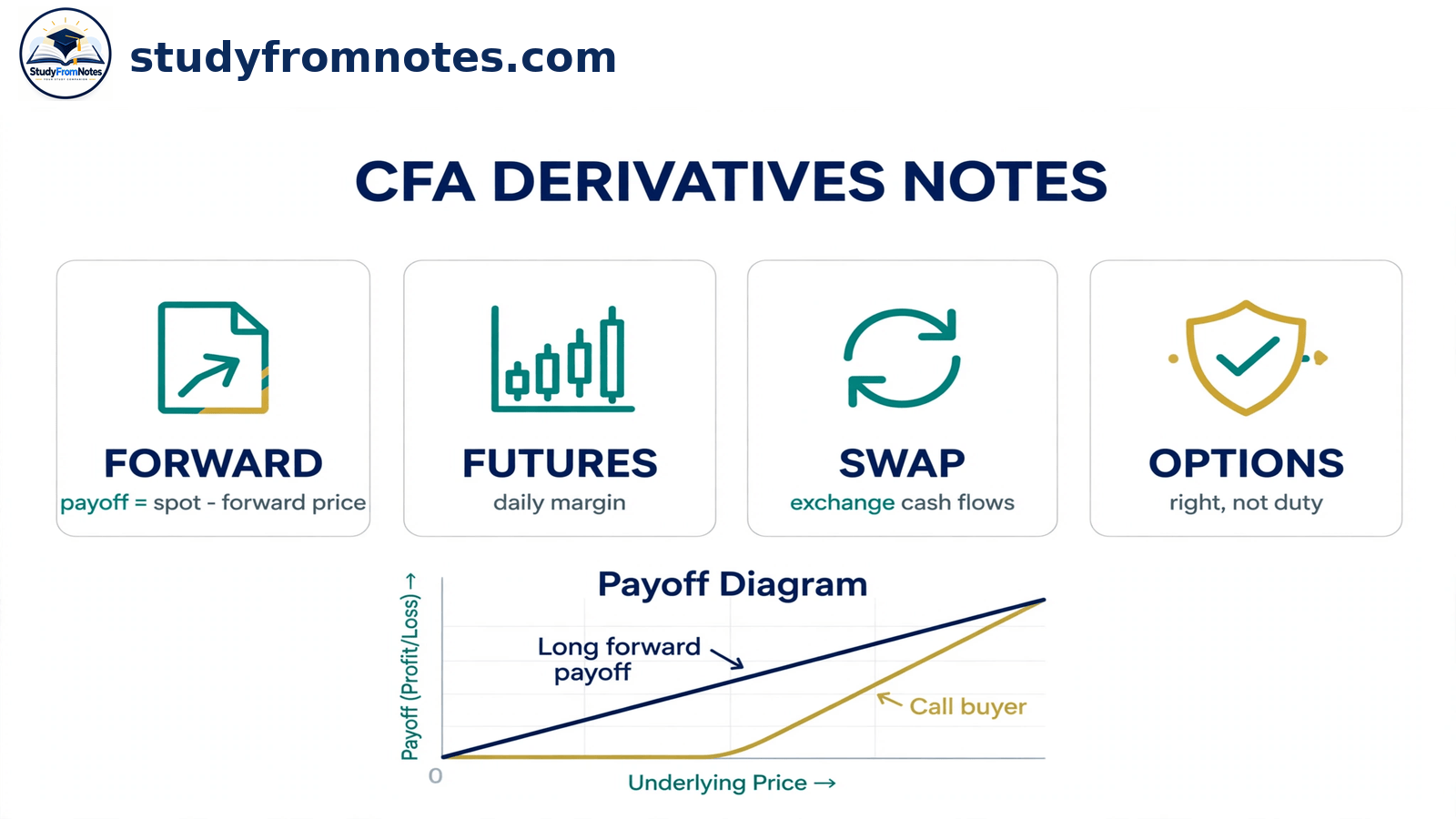
These CFA derivatives notes cover the four contract types that Level 1 candidates must master: forwards, futures, swaps and options. Derivatives carries a 5 to 8 percent weight in the 2026 Level 1 exam, according to CFA Institute. That range equals roughly 9 to 14 questions, so a focused revision session here protects easy marks. This note gives you the payoff formulas, two fully worked examples and the traps that cost candidates marks. Pair it with the full set of notes on our CFA Level 1 notes hub as you build your revision plan.
CFA derivatives notes: the four building blocks
A derivative is a contract whose value depends on the price of an underlying asset. Forwards and futures lock in a future price and create a payoff that can gain or lose. Options give the buyer a right, not a duty, to trade, so the buyer can lose only the premium paid.
Every Level 1 derivative question starts from one of four building blocks. First, a forward contract is a private agreement between two parties to trade an asset later at a price set today. Second, a futures contract does the same job, but an exchange standardizes the terms and settles gains and losses every day. Third, a swap exchanges one set of cash flows for another, such as fixed interest payments for floating ones. Fourth, an option gives the buyer the right to buy or sell at a set strike price before or on a set date.
Two features separate these contracts from a normal purchase. One, the parties exchange little or no money at the start, so derivatives create leverage. Two, the payoff at expiry depends on the gap between the market price and the contract price. Keep those two features in mind, because most exam questions test one of them.
| Feature | Forward | Futures | Option (buyer) |
|---|---|---|---|
| Where traded | Over the counter, private | Exchange, standardized | Exchange or over the counter |
| Duty at expiry | Both parties must perform | Both parties must perform | Buyer chooses; seller must perform |
| Upfront cost | Usually zero | Margin deposit, not a cost | Premium paid to the seller |
| Settlement | At expiry (or delivery) | Daily marking to market | At exercise or expiry |
| Maximum loss | Can be large | Can be large | Limited to the premium |
Forward and futures payoffs in these CFA derivatives notes
A forward contract has a simple payoff rule. The long position gains when the spot price at expiry rises above the forward price agreed at the start. The short position gains from the exact opposite move. Nothing else matters: not the path of the price, and not the price on any day before expiry.
Worked example: forward payoff
Suppose you enter a long forward contract on one share at a forward price of $52. At expiry, the share trades at $58. Your payoff is $58 minus $52, which equals a gain of $6. Now suppose the share instead falls to $47. Your payoff is $47 minus $52, which equals a loss of $5. The short counterparty records the mirror image in both cases. Notice the symmetry: the long side gains a dollar for every dollar the price rises, and loses a dollar for every dollar the price falls.
Futures contracts add one protection on top of that payoff rule. Both sides post an initial margin when they open the position. Then the exchange marks the position to market each day and moves cash between the two margin accounts. If your balance falls below the maintenance margin, you must top it back up to the initial margin level. That top-up payment is the margin call.
Worked example: the margin call
Suppose you buy one index futures contract at 4,200, and the contract multiplier is $50 per index point. The initial margin is $12,000 and the maintenance margin is $9,000. The index then falls to 4,080. That 120 point drop costs you 120 times $50, which equals $6,000. Your margin balance falls from $12,000 to $6,000. Because $6,000 sits below the $9,000 maintenance level, the broker issues a margin call. You must deposit $6,000 to restore the balance to the initial $12,000. In contrast, a forward contract would collect that loss only at expiry, with no daily cash movement at all.
Options in these CFA derivatives notes: payoffs and parity
Options break the symmetry that forwards and futures share. A call option gives the buyer the right to buy the underlying at the strike price. A put option gives the buyer the right to sell at the strike price. The buyer pays a premium for that right, and the premium caps the buyer loss. The seller receives the premium and accepts the larger risk.
At expiry, a call has value only when the spot price exceeds the strike price. That value, called the intrinsic value, equals the spot price minus the strike price, with a floor of zero. For a put, the intrinsic value equals the strike price minus the spot price, again with a floor of zero. Profit then equals the intrinsic value minus the premium paid.
Worked example: call and put profit
Take a call option with a strike price of $50 and a premium of $4. At expiry, the underlying trades at $57. The intrinsic value is $57 minus $50, which equals $7. Your profit is $7 minus the $4 premium, which equals $3. Next, take a put option with a strike price of $50 and a premium of $3. At expiry, the underlying trades at $44. The intrinsic value is $50 minus $44, which equals $6. Your profit is $6 minus the $3 premium, which equals $3. However, if either option expires with a spot price on the wrong side of the strike, the intrinsic value is zero and the buyer loses the full premium.
One formula ties calls, puts and the underlying together: put-call parity. The parity relation states that a call price plus the present value of the strike equals the put price plus the spot price. So, if a share trades at $100, the strike is $100, the risk-free rate is 5 percent for one year, and the call trades at $8, the put must trade near $3.24. The present value of the strike is $100 divided by 1.05, which equals $95.24. Then the put price equals $8 plus $95.24 minus $100, which equals $3.24. Exam writers love parity because one rearrangement solves for any missing price.
Exam traps that these CFA derivatives notes warn you about
- Margin is not a cost and not a down payment. Margin is a performance deposit. The exam tests this wording directly, so read margin questions with care.
- The forward price is not a forecast. Arbitrage sets the forward price from the spot price and the cost of carry. With no income on the asset, the one-year forward price on a $100 asset at a 5 percent rate is $105, whether or not anyone expects that price.
- Option buyers and sellers face opposite risk profiles. The buyer risks only the premium. The call seller faces unlimited loss as the price rises, and the put seller faces loss down to a zero price.
- American and European describe exercise timing, not geography. A European option allows exercise only at expiry. An American option allows exercise at any time up to expiry, so it can never be worth less than its European twin.
- Daily settlement changes futures risk, not the final payoff logic. A futures position that stays open to expiry delivers the same total gain or loss as the matching forward, but the cash moves day by day.
One-page revision box: CFA derivatives notes
- Forward payoff (long) = spot at expiry minus forward price. Short payoff is the negative of the long payoff.
- Futures = forward payoff plus daily marking to market. A margin call restores the balance to the initial margin, not to the maintenance margin.
- Call intrinsic value = max(0, spot minus strike). Put intrinsic value = max(0, strike minus spot). Profit = intrinsic value minus premium.
- Put-call parity: call + present value of strike = put + spot. Rearrange it to solve for any one missing price.
- Forward price with no carry income = spot times (1 + risk-free rate) to the power of time.
- Buyers of options hold rights. Sellers of options hold duties. Only the premium ever changes hands at the start of an option trade.
Derivatives rewards candidates who practice payoffs until the arithmetic feels automatic. Work each example above once with the numbers changed, then test yourself against the questions in our CFA fixed income notes, where duration questions use the same careful payoff thinking. After that, return to the CFA notes hub and pick the next topic on your plan.

Daniel Mercer is a finance professional writing on professional exams, study strategies, and finance careers.


Leave a Reply