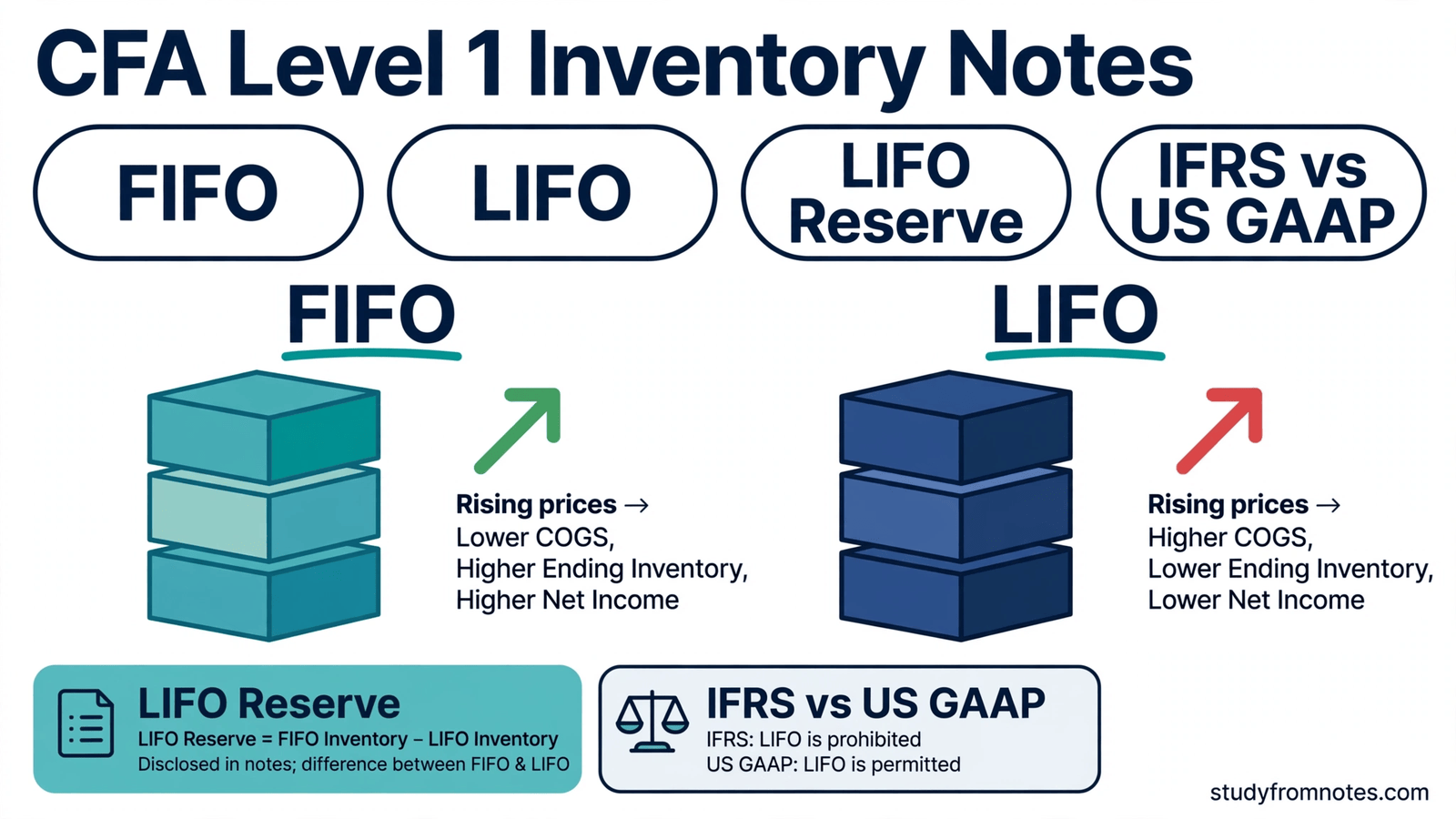
This CFA Level 1 Inventory note covers cost formulas, LIFO reserve conversions, write-downs, and long-lived asset basics in one place. Above all, remember the biggest trap first: LIFO is permitted under US GAAP only and prohibited under IFRS. An IFRS question that offers LIFO contains a wrong answer by design.
Financial Statement Analysis carries an 11-14 percent weight on the Level 1 exam. CFA Institute lists that weight on the official Level I exam page for both 2026 and 2027. The CFA 2027 curriculum changes leave that weight unchanged. You can plan the work with the study timetable generator and then drill one formula set each day.
According to CFA Institute, 45 percent of candidates passed the February 2026 Level 1 exam. Small accuracy gains on repeatable calculations can separate a pass from a near miss. In contrast, vague reading without worked practice rarely moves the score.
CFA Level 1 Inventory Rules: IFRS vs US GAAP at a Glance
Under IFRS, companies use FIFO, weighted average cost, or specific identification, and LIFO is prohibited. Under US GAAP, companies may also use LIFO. In addition, both frameworks measure FIFO and average cost inventory at the lower of cost and net realizable value.
CFA Institute states that Level 1 questions use IFRS unless a question states US GAAP explicitly. You should default to IFRS rules when a stem stays silent on the framework. However, you must switch rules at once when a stem names US GAAP clearly.
Specific identification has a narrow role under both frameworks. For example, companies use it for items that are not ordinarily interchangeable. In addition, companies use it for goods or services produced for specific projects. Interchangeable goods use FIFO or weighted average cost under IFRS.
CFA Level 1 Inventory Cost Formulas: FIFO, Weighted Average and Specific Identification
FIFO. Under FIFO, the first items purchased or produced are the first items sold. Ending inventory holds the most recent purchases or production. As a result, it sits close to current replacement cost in most cases.
Weighted average cost. Under this formula, each item cost comes from the weighted average of similar items. In particular, the average blends opening inventory cost with purchases or production during the period.
Specific identification. This method tracks the individual cost of each specific item. For example, a seller can match a segregated project item to its actual recorded cost.
LIFO. Under LIFO, the most recent items purchased or produced are the first items sold. Ending inventory holds the oldest costs under this method. Above all, remember the framework limit: US GAAP permits LIFO, and IFRS prohibits LIFO. A United States company that uses LIFO for tax must also use LIFO for financial reporting.
FIFO vs LIFO When Prices Rise
Assume rising prices and stable or rising inventory quantities for this comparison. Under those conditions, the direction of each effect stays predictable. Learn the pattern as a set, not as isolated facts.
| Item | FIFO | LIFO |
|---|---|---|
| Cost of goods sold | Lower, because earliest and lower costs flow to cost of goods sold | Higher, because most recent and higher costs flow to cost of goods sold |
| Ending inventory | Higher, because inventory holds most recent and higher costs | Lower, because inventory holds oldest and lower costs |
| Gross profit | Higher, because cost of goods sold is lower | Lower, because cost of goods sold is higher |
| Taxes payable | Higher, because pre-tax income is higher | Lower, because pre-tax income is lower |
LIFO also reports lower working capital, because LIFO reports lower inventory. In contrast, FIFO reports higher working capital under rising prices. Pre-tax cash flow does not change with the method choice. However, after-tax cash flow is higher under LIFO, because tax payments are lower.
CFA Level 1 Inventory Conversions: The LIFO Reserve
The LIFO reserve is the difference between FIFO inventory and LIFO inventory. US GAAP requires LIFO companies to disclose the reserve in notes or on the balance sheet. Therefore, analysts can restate a LIFO company onto a FIFO basis for comparison.
Above all, keep one memory rule in front of you at all times. Balance sheet conversions use the LIFO reserve itself. In contrast, income statement conversions use the change in the LIFO reserve. Mixing the reserve with its change is the classic error here.
- FIFO inventory = LIFO inventory + LIFO reserve
- FIFO cost of goods sold = LIFO cost of goods sold – (ending LIFO reserve – beginning LIFO reserve)
- FIFO income tax expense = LIFO income tax expense + (tax rate x change in LIFO reserve)
- FIFO net income = LIFO net income + [change in LIFO reserve x (1 – tax rate)]
- FIFO retained earnings = LIFO retained earnings + [LIFO reserve x (1 – tax rate)]
Worked Example With Checked Numbers
Use these inputs exactly: LIFO inventory is 500, and LIFO cost of goods sold is 900. The LIFO reserve rises from 80 to 100 during the period. Therefore, the change in the reserve equals 20, and the tax rate is 30 percent.
- FIFO inventory = 500 + 100 = 600
- FIFO cost of goods sold = 900 – 20 = 880
- FIFO income tax expense = LIFO income tax expense + 6, because 30 percent of 20 is 6
- FIFO net income = LIFO net income + 14, because 20 x (1 – 0.30) equals 14
- FIFO retained earnings = LIFO retained earnings + 70, because 100 x (1 – 0.30) equals 70
- Cumulative deferred tax effect = 30, because 100 x 30 percent equals 30
Now check the logic. Pre-tax income rises by 20, because cost of goods sold falls by 20. Tax expense rises by 6, so net income rises by 14. In addition, inventory rises by 100, retained earnings rise by 70, and deferred tax rises by 30.
The 30 in that check is a deferred tax liability in the restated balance sheet, not extra cash lost. Had the company always paid tax on FIFO income instead, its cash would be lower by that same 30. For this period alone, FIFO operating cash flow is lower than LIFO by 6, since FIFO pays 6 more tax.
CFA Level 1 Inventory Write-Downs: Lower of Cost and Net Realizable Value
Both IFRS and US GAAP now anchor most inventory measurement to net realizable value. Net realizable value means estimated selling price less completion and selling costs. Under IFRS, IAS 2 requires inventory at the lower of cost and net realizable value. Therefore, a fall in expected selling price triggers a write-down to that value.
The ASU 2015-11 Nuance You Must Not Miss
US GAAP splits the rule by cost formula after ASU 2015-11. Inventory measured under FIFO or average cost is measured at the lower of cost and net realizable value. In contrast, LIFO and retail method inventory is measured at the lower of cost or market. Above all, never describe all US GAAP inventory as lower of cost or market now.
Under IFRS, a company recognizes a write-down as an expense in the period it occurs. The company makes a fresh assessment of net realizable value each period. For example, IFRS requires a reversal when the earlier cause no longer exists. However, the reversal cannot push carrying value above original cost.
IFRS presents the reversal as a reduction in cost of sales. In contrast, US GAAP prohibits a reversal of an inventory write-down completely. Once written down, the reduced amount becomes the new cost basis under US GAAP. A later recovery in value produces no accounting gain under US GAAP.
Long-Lived Assets: Capitalizing, Depreciation, Revaluation and Impairment
Therefore, learn each contrast below as a pair, not as separate rules.
Capitalizing vs Expensing
A company capitalizes costs that benefit more than one operating cycle: invoice price, sales tax, freight, delivery insurance, and installation. Expensing writes the entire cost off in the current period income statement.
In the purchase year, capitalizing gives higher net income than expensing. Only one year of depreciation hits expense, not the full cost. In addition, assets and equity are higher in that year. The outlay is an investing outflow, so operating cash flow is higher. Total cash flow stays the same under both treatments.
Later years reverse the pattern: depreciation lowers the capitalizing company’s income each year. As a result, capitalizing smooths income, while expensing makes it more variable.
Straight-Line vs Accelerated Depreciation
Straight-line charges the same amount each year. In contrast, accelerated methods charge more in early years and less later, with the same total over the asset life. Examples are double-declining balance and the sum-of-the-years’-digits method.
In early years, accelerated depreciation gives lower net income, a lower carrying value, and lower equity than straight-line. Meanwhile, later years reverse that pattern. Always note the year before you judge any depreciation effect.
IFRS Revaluation Model
Under IFRS, a company chooses the cost model or the revaluation model by asset class. The revaluation model carries the asset at fair value less later depreciation and impairment. However, US GAAP requires the cost model and prohibits upward revaluation of plant and equipment.
An increase first reverses a prior profit-or-loss decrease on the same asset. Any excess goes to other comprehensive income as revaluation surplus. A decrease offsets an existing surplus in other comprehensive income first, with any excess going to profit or loss.
Impairment: IFRS One-Step vs US GAAP Two-Step
Under IFRS, impairment uses one step: compare carrying amount with recoverable amount. Recoverable amount is the higher of fair value less costs of disposal and value in use. Therefore, any excess of carrying amount over recoverable amount is the loss.
IFRS permits an impairment reversal when conditions improve, except for goodwill. The reversal is capped at the carrying amount that would have applied had no impairment been recognized, net of depreciation.
US GAAP uses two steps for assets held and used. Step one is a recoverability test against undiscounted expected future cash flows. Step two measures any loss as carrying amount minus fair value. Above all, reversals are prohibited for these assets.
Goodwill impairment is never reversed under either framework.
Exam Traps
Candidates lose marks on framework switches and on reserve versus change confusion. Therefore, scan this trap list in the final week before the exam.
- Trap 1: Offering LIFO under IFRS. IFRS prohibits LIFO completely, so eliminate any LIFO answer in an IFRS stem.
- Trap 2: Using the reserve on the income statement. Income statement conversions use the change in the reserve, not the reserve itself.
- Trap 3: Using the change on the balance sheet. Balance sheet conversions use the ending reserve itself, not the period change.
- Trap 4: Calling all US GAAP inventory lower of cost or market. Only LIFO and retail method inventory is measured on that basis after ASU 2015-11.
- Trap 5: Reversing a write-down under US GAAP. US GAAP prohibits inventory write-down reversals, and the reduced amount becomes new cost basis.
- Trap 6: Reversing goodwill impairment under IFRS. IFRS permits most impairment reversals, but goodwill impairment never reverses.
- Trap 7: Skipping step one under US GAAP impairment. A fair value below carrying amount alone does not create an impairment for held and used assets.
- Trap 8: Forgetting the tax effect on conversions. Reserve changes affect tax expense, so net income moves by the after-tax amount only.
One-Page Revision
Use this CFA Level 1 inventory box for a final review before a mock exam.
- IFRS: FIFO or weighted average for interchangeable items; specific identification required for non-interchangeable and project items; LIFO prohibited.
- US GAAP also permits LIFO, and IFRS prohibits LIFO completely.
- Under rising prices, FIFO gives lower COGS, higher inventory, higher gross profit, and higher taxes.
- Under rising prices, LIFO gives higher COGS, lower inventory, lower gross profit, and lower taxes.
- Weighted average results sit between FIFO and LIFO under rising prices.
- FIFO inventory equals LIFO inventory plus the LIFO reserve.
- FIFO COGS equals LIFO COGS minus the change in the LIFO reserve.
- Balance sheet conversions use the reserve, and income statement conversions use its change.
- Inventory is measured at the lower of cost and net realizable value, except LIFO and retail inventory under US GAAP.
- Only LIFO and retail method inventory under US GAAP is measured at lower of cost or market.
- IFRS permits write-down reversals up to original cost, and US GAAP prohibits reversals.
- Capitalizing raises first-year income, assets, equity, and operating cash flow versus expensing.
- Accelerated depreciation lowers early income and carrying value versus straight-line depreciation.
- IFRS permits a revaluation model, and US GAAP prohibits upward revaluation.
- IFRS impairment uses one step, and US GAAP held and used impairment uses two steps.
Keep going with the next FSA calculation topic after this review. For example, continue to the CFA Fixed Income bond valuation notes and keep the same formula-first approach. Your calculation topics will then build on each other across study sessions.
Found this useful? Share it with your study group: Share on WhatsApp | Share on Telegram

Lauren Brooks is a finance professional writing on professional exams, study strategies, and finance careers.


Leave a Reply