What Is the NextGen Bar Exam?
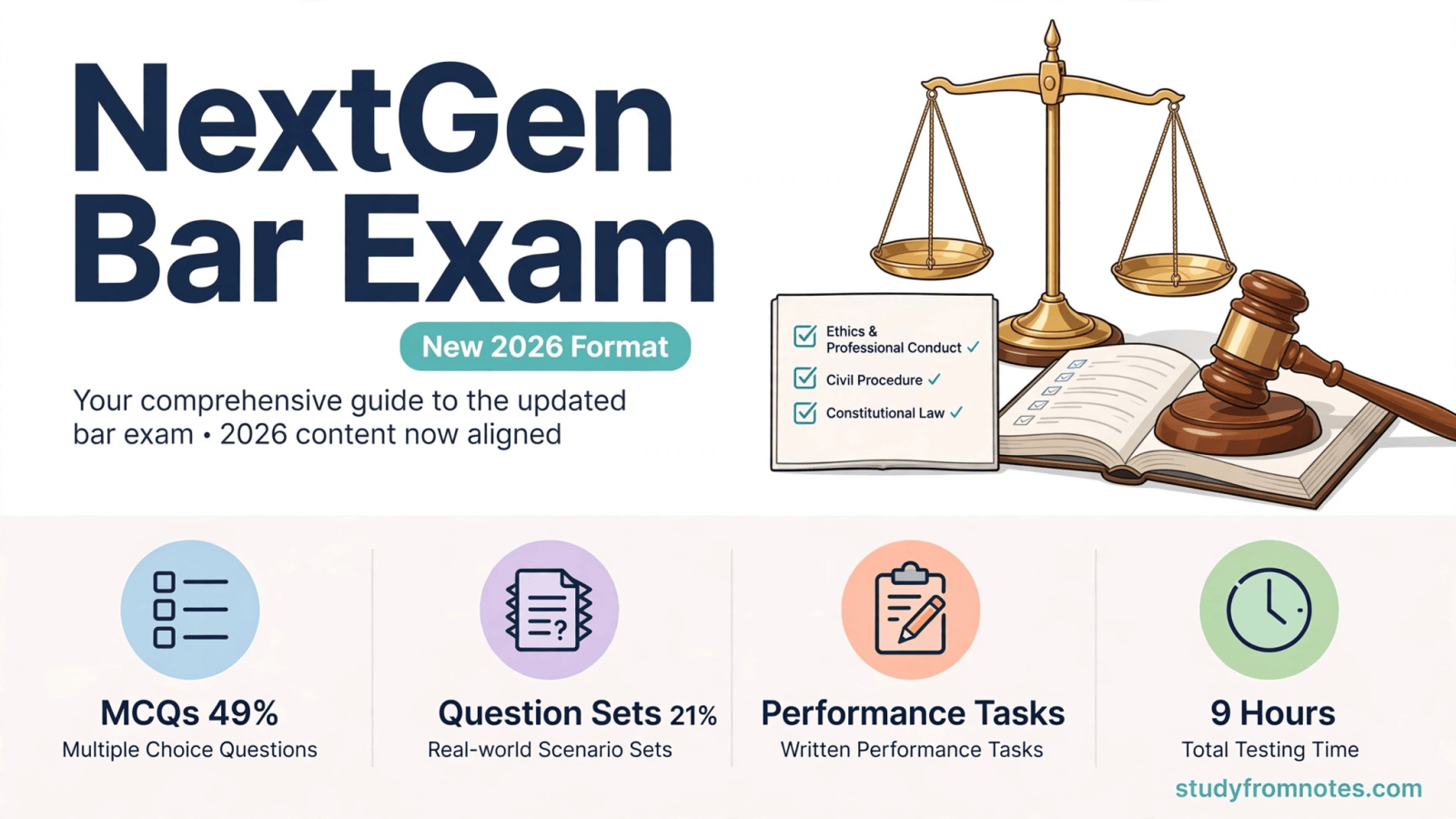
The NextGen bar exam is the new licensing test for lawyers in the United States, replacing the Uniform Bar Examination (UBE). It launched in July 2026, runs about 9 hours, and tests 8 legal subjects through three question types: multiple choice, integrated question sets, and performance tasks.
If you are finishing law school in 2026 or later, this is the exam standing between you and your license. This guide explains exactly what changed, what the new format demands, and how to build a study plan for it.
Table of Contents
- How the NextGen Bar Differs From the Old Exam
- NextGen Bar Exam Format: The Three Question Types
- The 8 Tested Subjects
- NextGen Bar Exam Rollout Timeline: Which States and When
- How to Prepare: A Study Framework
- Common Mistakes to Avoid
- Frequently Asked Questions
How the NextGen Bar Differs From the Old Exam
The old UBE had three separate components: the MBE (200 multiple-choice questions), the MEE (essay questions), and the MPT (performance test), administered over two full days. The NextGen exam compresses everything into a single integrated test of about 9 hours.
The biggest shift is philosophical. The old exam rewarded memorized black-letter law. The NextGen exam tests whether you can use legal knowledge the way a new lawyer does: reading a file, spotting issues, applying rules to facts, and writing like a practitioner. Memorization alone will not carry you.
NextGen Bar Exam Format: The Three Question Types
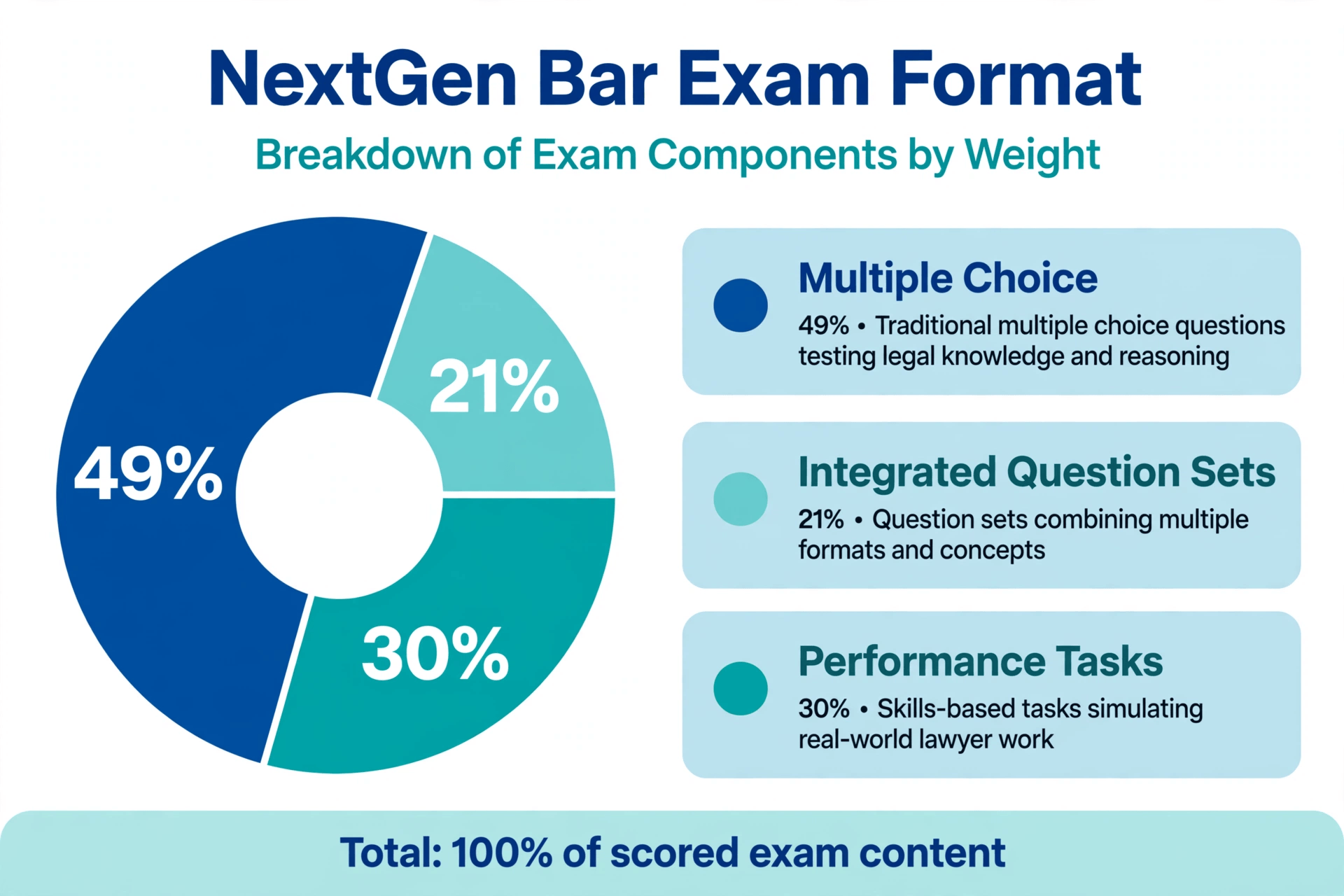
Every NextGen administration uses the same three formats, weighted as follows:
| Question Type | Share of Score | What It Tests |
|---|---|---|
| Multiple-choice questions (MCQs) | ~49% | Foundational legal knowledge across the 8 subjects |
| Integrated question sets | ~21% | A fact pattern followed by several related questions mixing MCQs and short answers |
| Performance tasks | ~30% | Realistic lawyering work: drafting a memo or argument from a provided file of documents |
The integrated question sets are the genuinely new element. Instead of isolated questions, you get a single scenario (a client file, a dispute, a transaction) and answer a cluster of questions about it. This rewards structured thinking over scattered recall.
The 8 Tested Subjects
The NextGen exam covers eight foundational subject areas, including Civil Procedure, Constitutional Law, Contracts, Criminal Law and Procedure, Evidence, Real Property, Torts, and Business Associations. Build your study schedule around all eight, but weight your time toward the ones historically tested most heavily.
Subject emphasis can shift as the exam matures. Confirm the current content outline with the National Conference of Bar Examiners (NCBE) before finalizing your plan, and treat any third-party subject list (including this one) as a starting framework, not an official syllabus.
NextGen Bar Exam Rollout Timeline: Which States and When
The first NextGen administration took place on July 28-29, 2026. A second administration is scheduled for February 2027. States are adopting the new exam on a rolling basis through July 2028, with the largest jurisdictions moving over in the later waves.
This staggered rollout matters for your preparation: study materials written for the old UBE are now partially obsolete. Prioritize resources built specifically for the NextGen format, especially for the integrated question sets and performance tasks, which have no direct UBE equivalent.
How to Prepare: A Study Framework
Step 1: Learn the format before the substance. Take one full practice performance task under timed conditions in your first week. Candidates who skip this step often discover too late that the format itself, not the law, was their weakest area.
Step 2: Build subject outlines from practice, not textbooks. For each of the 8 subjects, work through integrated question sets first, then fill knowledge gaps the questions reveal. This is active recall applied to bar prep.
Step 3: Drill the integrated sets weekly. These are worth about a fifth of your score and are the least familiar format. Treat them as the highest-leverage practice you can do.
Step 4: Write one performance task per week. The 30% weighting means writing skill directly moves your score. Get feedback on structure and issue-spotting, not just conclusions.
Step 5: Simulate the full 9 hours twice. Stamina is a tested skill. Two full timed simulations, spaced two weeks apart, in the final month.
A commonly recommended preparation window is 8 to 10 weeks of full-time study, or 14 to 16 weeks alongside work. Map your weeks on a study timetable before you begin: build your bar prep timetable here.
Common Mistakes to Avoid
- Studying from old UBE materials only. The MEE essay format is gone; integrated sets and the new performance tasks need dedicated practice.
- Memorizing without applying. The exam tests lawyering skills. If your study is all flashcards and no practice questions, rebalance immediately.
- Neglecting the performance tasks. At ~30% of the score, they deserve nearly a third of your practice time.
- Skipping timed practice. Nine hours of integrated testing punishes slow readers. Every practice set should be timed from week three onward.
Frequently Asked Questions
Is the NextGen bar exam harder than the old UBE?
It is different rather than strictly harder. It demands applied skills over memorization, which favors candidates who practice realistic question formats.
Can I still take the old UBE?
Only in states that have not yet transitioned, and only until their switchover date. Check your jurisdiction’s announced timeline.
How long should I study for the NextGen bar?
Most candidates need 8 to 10 weeks full-time or 14 to 16 weeks part-time, with heavy emphasis on practice questions and performance tasks.
What score do I need to pass?
Each jurisdiction sets its own passing score. Confirm yours with your state’s bar admissions office early in your preparation.
Keep Your Preparation Organized
Bar prep is a scheduling problem as much as a knowledge problem. Use our free study timetable generator to map your 8 subjects across your available weeks, and read 7 methods for effective study notes to build outlines that actually stick.

Lauren Brooks is a finance professional writing on professional exams, study strategies, and finance careers.
![ACCA Qualification Explained: Exams, Pass Rates and How to Pass [2026 Guide]](https://i0.wp.com/www.studyfromnotes.com/wp-content/uploads/2026/10/acca-qualification-guide-featured.webp?resize=720%2C480&ssl=1)
Leave a Reply