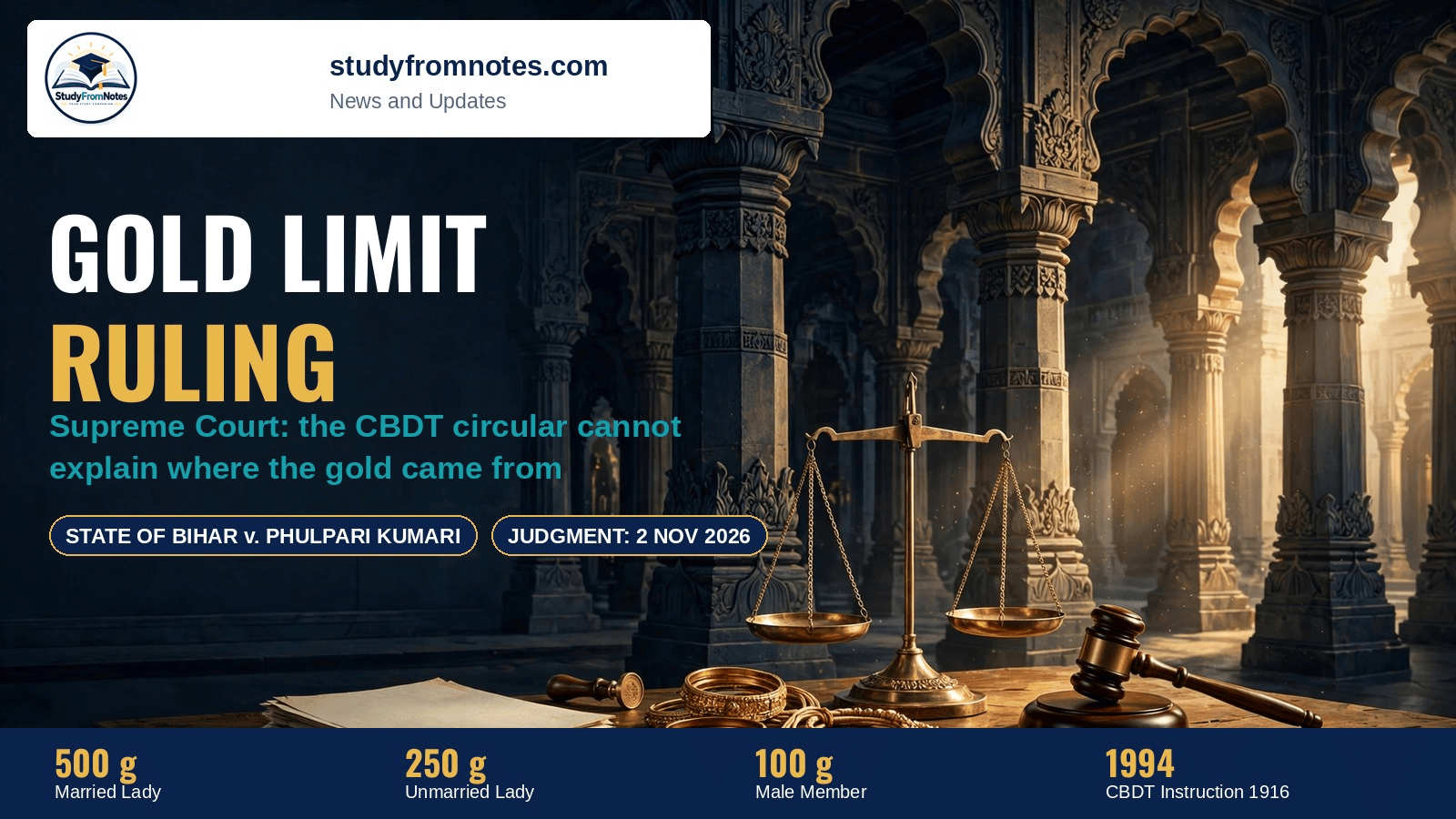
The Supreme Court has held that the Income Tax department’s gold jewellery limit cannot explain away possession of gold in a corruption case. The case is State of Bihar v. Phulpari Kumari. A bench of Justice K.V. Viswanathan and Justice Arun Palli decided it on 2 November 2026. The bench also set aside a Patna High Court order. The High Court had quashed the prosecution because the family’s gold fell within the limits in a CBDT circular.
The case concerns a former Child Development Project Officer in Bihar, a public servant. The state prosecuted her under the Prevention of Corruption Act, 1988. It alleged that she owned assets disproportionate to her known sources of income. Investigators found gold jewellery weighing 646.400 grams with her and her unmarried daughter. The High Court had relied on CBDT Instruction No. 1916 dated 11 May 1994. It had also relied on a Finance Ministry press release dated 1 December 2016. The High Court counted a family limit of 750 grams and closed the case. Therefore, the Supreme Court restored the prosecution and directed that the trial proceed.
What the Supreme Court decided
The Court drew a clear line between holding gold and accounting for it. “Merely showing certain press release and circulars permitting the holding of gold to a certain extent will not amount to accounting for the possession of the said assets,” the bench said. In a disproportionate assets case, the accused must explain the assets against known sources of income. However, a tax circular cannot do that explaining.
The circular itself is narrow. Instruction No. 1916 tells officers conducting an income tax search how much gold jewellery they need not seize. For a married lady, the limit is 500 grams. The figure for an unmarried lady is 250 grams. The figure for a male member is 100 grams. In addition, officers may spare even more after looking at the status of the family and the customs of the community. CBDT issued the instruction in 1994. Finally, the 2016 press release repeated it.
What has not changed about the gold jewellery limit
- The 500 gram, 250 gram and 100 gram figures still stand for income tax searches. The judgment does not change them.
- There is no new ceiling on how much gold a family may own, and no new offence of holding gold.
- The ruling is in a Prevention of Corruption Act case against a public servant. It is not an income tax decision.
- The trial will still test the allegations in the case. The Supreme Court has restored the prosecution, not decided guilt.
The practical takeaway is about documents. If any authority ever asks where the gold came from, the answer must come from evidence. For example, purchase bills, gift records, inheritance papers and wedding documentation can show the source. In short, the circular answers a seizure question, not a source question. Overall, social media posts claiming that the Court has banned keeping gold without bills, or changed the limits, are reading more into the judgment than it contains.
With thanks to CA Anshul Karwa, Partner at Karwa & Associates, Chartered Accountants, Jaipur, for flagging this update. For the detailed explainer on what the ruling changes, what it does not, and the documents every family should keep, read the firm’s guide: Gold Jewellery Limit After the Supreme Court Ruling: What Changed and What Did Not.

A Maheshwari is a Chartered Accountant writing on CA exams, tax, and finance careers in India.


Leave a Reply