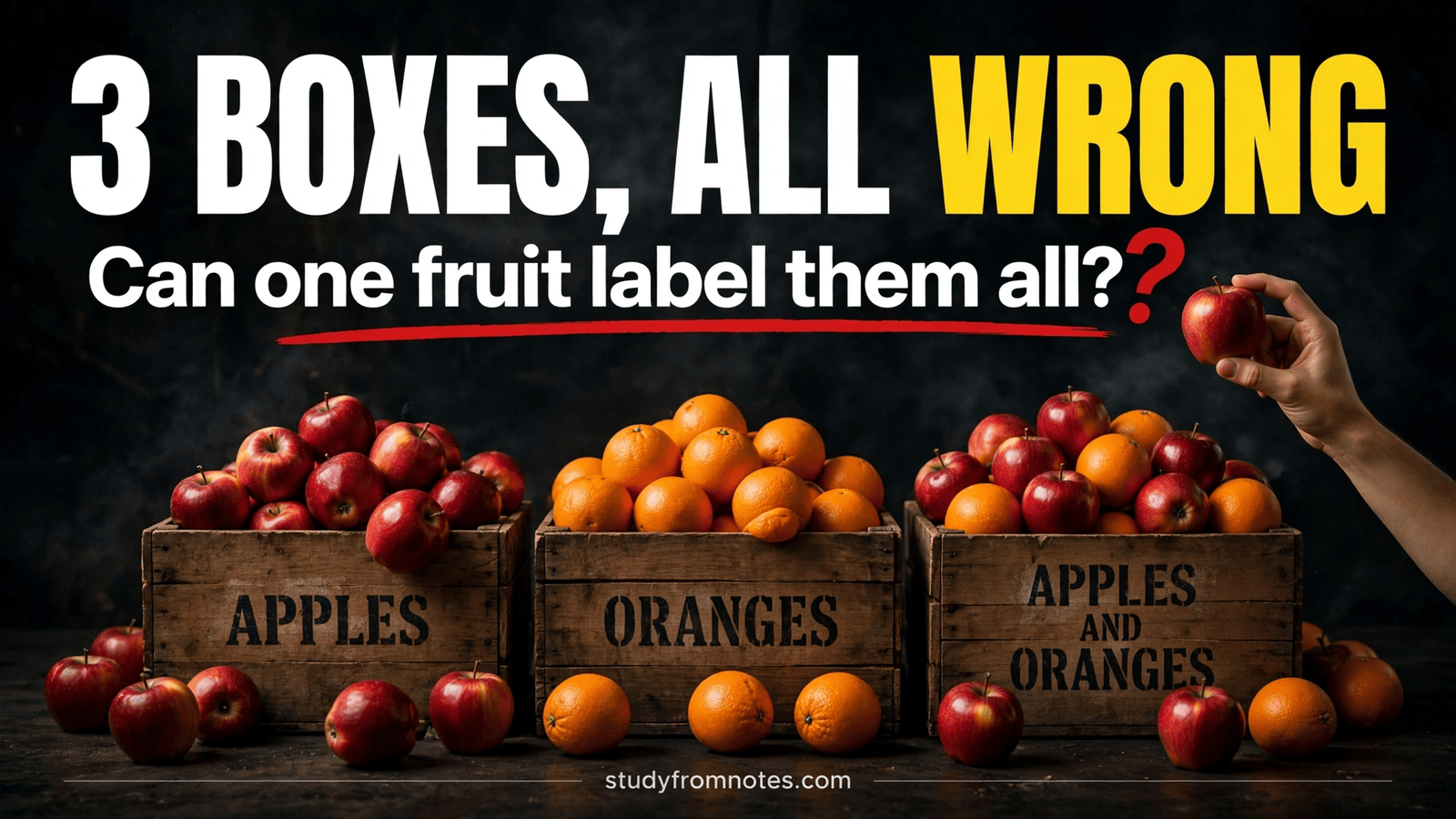
The mislabeled boxes puzzle answer: take just one fruit, and take it from the box labeled “Apples and Oranges”. If that fruit is an apple, the box holds only apples. If it is an orange, the box holds only oranges. From that one fruit, you can then label all three boxes correctly. You do not need a second fruit, and you do not need to look inside any box.
The mislabeled boxes puzzle, restated
Picture three boxes in front of you. One box holds only apples, one box holds only oranges, and one box holds a mix of apples and oranges. Each box has a label: “Apples”, “Oranges”, and “Apples and Oranges”. Here is the twist that makes the puzzle work: every label is wrong. No box holds what its label says.
You may open one box, reach in without looking inside, and take out exactly one fruit. Your task is to use that one fruit to label all three boxes correctly. Most candidates pick the wrong box first. The right box is the one whose label gives you the most information when it is wrong.
The mislabeled boxes puzzle answer, step by step
Follow these steps in order, and one fruit is enough.
Step 1: Pick the box labeled “Apples and Oranges”. This is the only box that guarantees an answer. Since every label is wrong, the mixed label cannot be on the mixed box. So this box must hold only one kind of fruit: either only apples or only oranges.
Step 2: Take one fruit from that box, without looking inside. Whatever fruit comes out tells you the whole contents of the box. An apple means the box is the apples-only box. An orange means it is the oranges-only box. There is no third option, because the mixed box is ruled out by the wrong label.
Step 3: Label the other two boxes by elimination. Once you know one box, the other two fall into place, because each remaining label is also wrong. Work through both cases below, and you will see why no second fruit is needed.
Case 1: You pull an apple from the mixed box
If the fruit is an apple, the box labeled “Apples and Oranges” is really the apples-only box. That leaves two boxes and two contents: oranges only, and the mix.
Now look at the box labeled “Oranges”. Its label is wrong, so it cannot be the oranges-only box. It also cannot be the apples-only box, because you have already found that box. So it must be the mixed box.
That leaves one box and one content. The box labeled “Apples” must be the oranges-only box. Check the result against the starting rule: every label is now different from the true contents, which fits the puzzle. The full labeling is:
| Original label | True contents |
|---|---|
| Apples and Oranges | Apples only |
| Oranges | Apples and Oranges |
| Apples | Oranges only |
Case 2: You pull an orange from the mixed box
If the fruit is an orange, the logic runs in mirror image. The box labeled “Apples and Oranges” is really the oranges-only box. That leaves apples only and the mix for the other two boxes.
Look at the box labeled “Apples” next. Its label is wrong, so it cannot be the apples-only box. It also cannot be the oranges-only box, because you have already found that box. So it must be the mixed box.
That leaves one box and one content. The box labeled “Oranges” must be the apples-only box. Again, every label ends up different from the true contents, which fits the puzzle. The full labeling is:
| Original label | True contents |
|---|---|
| Apples and Oranges | Oranges only |
| Apples | Apples and Oranges |
| Oranges | Apples only |
Why the mislabeled boxes puzzle answer works
The whole solution rests on negative information. A wrong label is not just a mistake. It is a clue. When a label says “Apples and Oranges” and you know it is wrong, you learn what the box is not. That single exclusion is powerful, because it cuts the options from three down to two, and one of those two is settled by the fruit you pull.
By contrast, the other two labels give weaker clues. Suppose you pick from the box labeled “Apples” instead. That label is wrong, so the box holds oranges only or the mix. If you pull an orange, you learn nothing certain. The box could be oranges only, or it could be the mix, and an orange comes out of both. You would need another fruit to tell them apart, and the puzzle allows only one.
That is the key difference between the boxes. Picking from the mixed box always gives a certain answer, no matter which fruit comes out. Picking from a single-fruit box gives a certain answer only half the time, when the fruit contradicts the single-fruit reading in a useful way.
The trap most candidates fall into
The most common wrong answer is to pick from the box labeled “Apples” or the box labeled “Oranges”, because those boxes feel simpler. Candidates reason that a single fruit from a single-fruit box will name that box. But as shown above, an orange from the “Apples” box could mean oranges only or the mix, so the answer stays open.
A second trap is to say you need two or three fruits, one from each box. That answer is safe, but it misses the point. The puzzle asks for the smallest number that always works, and that number is one. A candidate who asks for three fruits has not used the wrong-label clue at all.
A third trap is to look inside a box, or to shake a box and guess from the weight. The rules rule those moves out. You take one fruit, without looking inside, and you must explain the rest from logic. A strong answer states the rule it relies on, names the box it picks, and walks through both outcomes, apple and orange, without skipping a step.
What the interviewer is testing in the mislabeled boxes puzzle
This puzzle tests four skills at once. First, it tests whether you use all the information in the question, including negative information. The fact that every label is wrong is not background color. It is the main tool.
Second, it tests whether you look for a guaranteed method rather than a lucky one. A good candidate checks both outcomes before choosing a box, and picks the box that works in both cases.
Third, it tests clear, step-by-step reasoning. State the box, state the fruit, state what follows, and state the final labels. A candidate who jumps straight to the answer, without the two cases, leaves the interviewer unsure whether the logic is solid.
Fourth, it tests whether you can explain a simple idea without overcomplicating it. The solution takes one sentence to state and two short cases to prove. If your explanation needs a diagram with six branches, you have probably picked the wrong box.
When you answer, start with the one-fruit answer, then give the two cases. A natural follow-up is: what if only one label were wrong, instead of all three? Then the method breaks, because the mixed box could really hold the mix. Naming that limit shows you understand why the puzzle works, not just how it ends.
Frequently asked questions
How many fruits do you need in the mislabeled boxes puzzle?
One fruit is enough, as long as you take it from the box labeled “Apples and Oranges” and every label is wrong. That is the maximum and the minimum: one fruit always works, and zero fruits cannot work, because you would have no new information.
Why can you not pick from the box labeled “Apples”?
You can pick from it, but it does not guarantee an answer. An orange from that box could come from the oranges-only box or from the mixed box, so one fruit leaves two options open. The mixed box is the only pick that gives a certain answer for both possible fruits.
Is this puzzle really asked at Apple?
Candidates have reported this three-boxes question in Apple interview reports on Glassdoor, with the apples, oranges, and mixed setup exactly as stated here. Reports are candidate-shared, so treat them as evidence of the question style, not as a promise for any single interview round.
Does the puzzle work if the boxes are not all mislabeled?
No. The solution depends on every label being wrong. If even one label could be right, the mixed box might really hold the mix, and a single apple or orange would not settle the other two boxes. Always state the all-wrong rule when you give the answer.
More interview puzzles in this series: Apple 100 Coins Blindfolded Puzzle Answer, Goldman Sachs Trapping Rain Water Answer, and Poisoned Wine Puzzle Answer.

Lauren Brooks is a finance professional writing on professional exams, study strategies, and finance careers.


[…] another classic next: Mislabeled Boxes Puzzle Answer: One Fruit, or test the coin trick in Apple 100 Coins Blindfolded Puzzle Answer, or work through Goldman Sachs […]