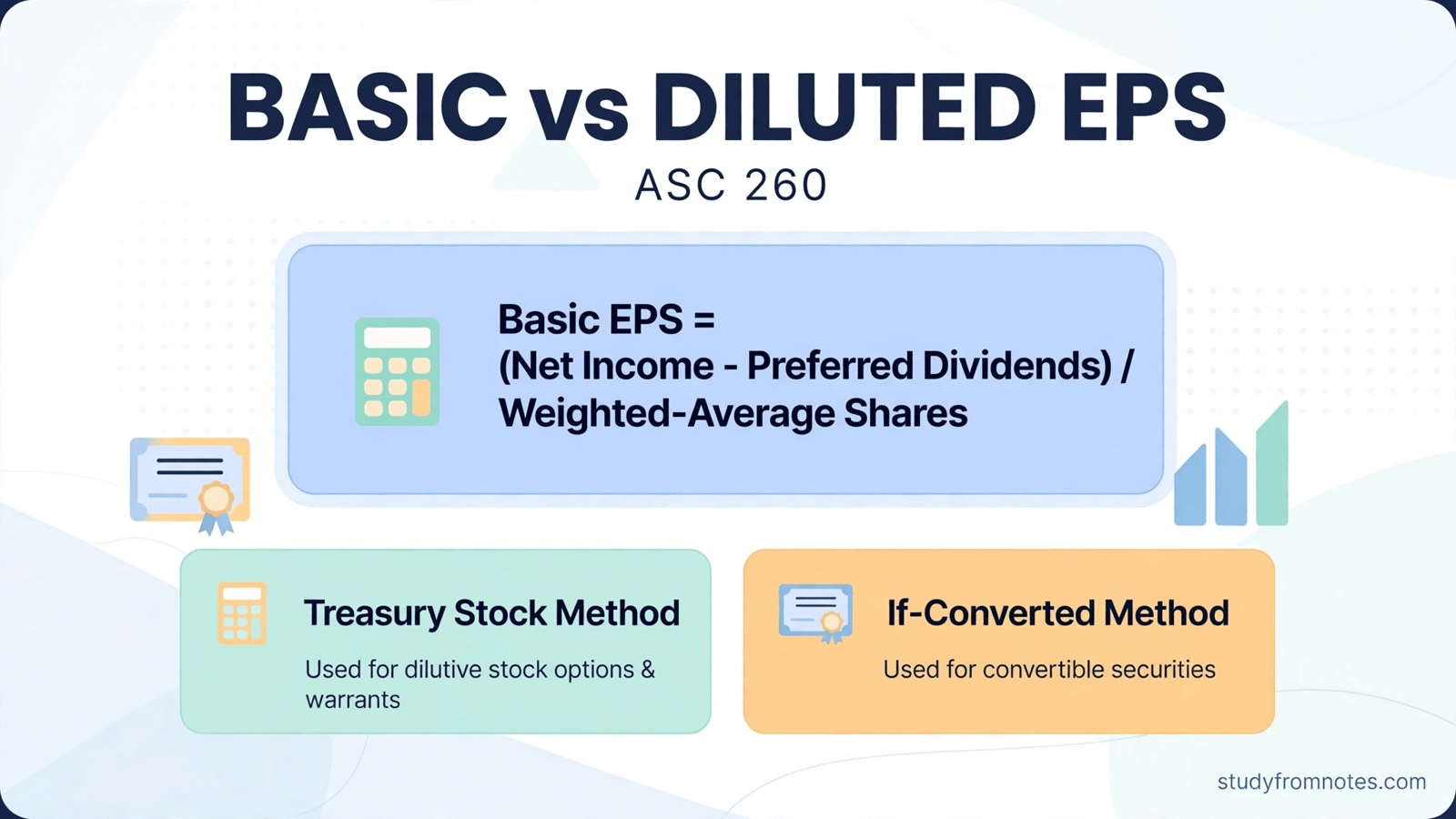
Basic EPS is income available to common stockholders divided by weighted-average common shares outstanding. Diluted EPS takes the same starting point and then adds every dilutive potential common share, with the numerator adjusted for what conversion would change. This note works one company from basic EPS all the way to diluted EPS under FASB ASC 260, with every number shown, so you can reuse the method on any CPA FAR question.
Related reading on this site: Bonds Payable CPA Notes: Discount, Premium and Effective Interest. That note covers bond mechanics; this note covers what convertible bonds do to EPS.
CPA EPS Notes: The Basic Formula
CPA EPS notes start here: basic EPS equals net income minus preferred dividends, divided by weighted-average common shares outstanding, and diluted EPS adds only dilutive potential shares with after-tax adjustments. Work the weighted average first, test each security separately, and never add an antidilutive share.
ASC 260, Earnings Per Share, is the US GAAP home for this topic. It requires basic EPS and diluted EPS for income from continuing operations, discontinued operations, and net income, for each class of common stock, for each period presented. A company with a simple capital structure, meaning no dilutive potential common shares, presents basic EPS only. A company with a complex capital structure presents both. Do not skip that distinction: if a question lists options, warrants, or convertibles, it is testing diluted EPS, even if the final answer excludes some of them as antidilutive.
The numerator is income available to common stockholders, not raw net income. Start with net income, then subtract preferred dividends. For cumulative preferred stock, subtract the dividend for the period whether or not it was declared, because that claim on earnings exists regardless of declaration. For noncumulative preferred stock, subtract only dividends declared in the period. That one sentence is worth marks on its own, because many candidates subtract declared dividends for cumulative stock and understate the deduction.
The denominator is weighted-average common shares outstanding, not shares outstanding at year end. Shares issued during the period count only for the part of the period they were outstanding. Shares repurchased as treasury stock stop counting from the repurchase date. Stock dividends and stock splits are different: they are applied retroactively to all periods presented, because they change the number of shares without changing total capital. A 2-for-1 split in the current year means prior year share counts are doubled for comparison.
CPA EPS Notes: Worked Basic EPS Example
Use one company for the whole note, so the diluted section builds on numbers you already trust. Meridian Corp reports net income of $480,000 for the year. It has 10,000 shares of 6 percent cumulative preferred stock, $50 par value. Its common share movements are: 100,000 shares outstanding on January 1; 20,000 new shares issued on April 1; 12,000 shares repurchased on October 1.
Step 1, preferred dividends: 10,000 shares times $50 par times 6 percent equals $30,000. Because the stock is cumulative, deduct the full $30,000 even if the question does not say a dividend was declared.
Step 2, weighted-average shares:
| Share movement | Shares | Fraction of year | Weighted shares |
|---|---|---|---|
| January 1 balance | 100,000 | 12/12 | 100,000 |
| April 1 issue | 20,000 | 9/12 | 15,000 |
| October 1 repurchase | (12,000) | 3/12 | (3,000) |
| Weighted-average shares | 112,000 |
Step 3, basic EPS: ($480,000 minus $30,000) divided by 112,000 equals $450,000 divided by 112,000 equals $4.02 per share, rounded to cents. Keep the unrounded $4.0179 in your working paper for the dilution tests below, because rounding early can flip a close test.
Diluted EPS: The Test Before You Add Anything
Diluted EPS answers a what-if question: if every dilutive potential common share became a real share, how low would EPS go? Potential common shares include stock options, warrants, convertible bonds, convertible preferred stock, and contingently issuable shares. The rule is strict: include a potential share only if it decreases EPS, meaning it is dilutive. If including it would increase EPS, or decrease a loss per share, it is antidilutive and you exclude it.
Test each security separately, most dilutive first. That ordering matters when several securities are present, because a security that looks dilutive on its own can become antidilutive after more dilutive securities are added. The practical test is incremental EPS: the numerator effect of that security divided by its share effect. If incremental EPS is below basic EPS, the security is dilutive. If it is above basic EPS, exclude it.
Two methods cover most FAR questions. The treasury stock method applies to options and warrants. The if-converted method applies to convertible bonds and convertible preferred stock. Learn them as separate tools, because mixing them is the most common error: options never get an interest add-back, and convertible bonds never get a treasury stock repurchase.
The Treasury Stock Method, Step by Step
Assume options are exercised at the start of the period, or at grant if later, and assume the company uses the exercise proceeds to buy back its own shares at the average market price for the period. Only the net new shares count. The formula for incremental shares is: shares issuable minus shares repurchased, where shares repurchased equals total exercise proceeds divided by average market price. Equivalently, incremental shares equal options times (market price minus exercise price) divided by market price.
Apply it to Meridian. Meridian has 12,000 stock options outstanding all year, exercise price $20, average market price $30.
- Exercise proceeds: 12,000 times $20 equals $240,000.
- Shares repurchased: $240,000 divided by $30 equals 8,000 shares.
- Incremental shares: 12,000 minus 8,000 equals 4,000 shares.
- Numerator effect: none. Options add no income, so incremental EPS is $0, which is below basic EPS of $4.02. The options are dilutive.
Use the average market price, not the year-end price. If the exercise price is at or above the average market price, the options are out of the money and antidilutive: exercise would repurchase at least as many shares as it issues, so the net share effect is zero or negative, and you exclude them. In a loss year, every potential share is antidilutive, because adding shares would shrink the loss per share, so diluted EPS equals basic EPS.
The If-Converted Method: Convertible Bonds
Assume convertible bonds were converted at the start of the period, or at issue if later. Add the conversion shares to the denominator. Add back the interest that would not have been paid, after tax, to the numerator. The tax effect is essential: interest is tax deductible, so the saving is interest times (1 minus tax rate), not gross interest.
Meridian has $200,000 of 5 percent convertible bonds outstanding all year, convertible into 10,000 common shares, tax rate 25 percent.
- Interest: $200,000 times 5 percent equals $10,000.
- After-tax add-back: $10,000 times (1 minus 0.25) equals $7,500.
- Conversion shares: 10,000.
- Incremental EPS: $7,500 divided by 10,000 equals $0.75, below basic EPS of $4.02. The bonds are dilutive.
Do not add back interest on bonds that were actually converted during the period in a way that double counts, and do not forget that original issue discount amortization, if the question gives it, is part of interest for this adjustment. For convertible preferred stock, the adjustment is different in one respect: preferred dividends are not tax deductible, so you add back the full dividend with no tax effect.
The If-Converted Method: Convertible Preferred Stock
Meridian preferred stock, the same 10,000 shares used in basic EPS, is convertible into 15,000 common shares. If converted, the $30,000 preferred dividend would not be deducted at all, so the numerator goes back to full net income for this test.
- Numerator effect: add back $30,000, with no tax adjustment, because dividends are not deductible.
- Share effect: 15,000 shares.
- Incremental EPS: $30,000 divided by 15,000 equals $2.00, below basic EPS of $4.02. The preferred stock is dilutive.
Notice the order of testing. Options have incremental EPS of $0, bonds $0.75, preferred stock $2.00. Most dilutive first means options, then bonds, then preferred stock. Test in that order, and recheck after each addition, because EPS falls at each step here, confirming every security stays dilutive.
Putting It Together: Meridian Diluted EPS
| Step | Numerator | Denominator | EPS |
|---|---|---|---|
| Basic EPS | $450,000 | 112,000 | $4.02 |
| Add options (treasury stock method) | $450,000 | 116,000 | $3.88 |
| Add convertible bonds (if-converted, after tax) | $457,500 | 126,000 | $3.63 |
| Add convertible preferred (if-converted, no tax effect) | $487,500 | 141,000 | $3.46 |
Check the arithmetic: $450,000 divided by 116,000 equals $3.8793; $457,500 divided by 126,000 equals $3.6310; $487,500 divided by 141,000 equals $3.4574, which rounds to $3.46. Diluted EPS of $3.46 is below basic EPS of $4.02, as it must be when dilutive securities exist. If your diluted EPS ever comes out above basic EPS, you have included an antidilutive security or made a numerator error. Stop and retest.
Antidilutive Examples You Must Spot
First, out-of-the-money options. If Meridian options had an exercise price of $40 and an average market price of $30, exercise proceeds of $480,000 would repurchase 16,000 shares against only 12,000 issued, a net effect of negative 4,000 shares. You do not subtract shares in diluted EPS. You exclude the options entirely.
Second, a high incremental EPS convertible. Suppose a separate $100,000 bond at 8 percent, tax rate 25 percent, convertible into 1,000 shares. After-tax interest is $100,000 times 8 percent times 0.75, which equals $6,000. Incremental EPS is $6,000 divided by 1,000, which equals $6.00, above basic EPS of $4.02. Including it would raise EPS, so exclude it, even though it is convertible. Convertibility alone never guarantees inclusion.
Third, a loss year. If Meridian reported a net loss, adding any potential shares would reduce the loss per share, which is antidilutive by definition. Diluted EPS then equals basic EPS, and the question expects you to state that, not to compute a lower loss per share.
Exam Traps in EPS Questions
Trap 1: Using shares outstanding at year end instead of the weighted average. Always weight by months outstanding, and restate for splits and stock dividends.
Trap 2: Subtracting only declared dividends for cumulative preferred stock. Cumulative means deduct the period amount whether declared or not.
Trap 3: Using year-end market price in the treasury stock method. ASC 260 uses the average market price for the period.
Trap 4: Adding back gross interest on convertible bonds. Only the after-tax amount belongs in the numerator.
Trap 5: Tax-effecting a preferred dividend add-back. Preferred dividends are not deductible, so there is no tax effect.
Trap 6: Adding shares from every listed security without testing. Test each one, most dilutive first, and stop adding when the next security would raise EPS.
Trap 7: Forgetting presentation. A complex capital structure presents both basic and diluted EPS for continuing operations, discontinued operations, and net income. A simple capital structure presents basic EPS only.
One-Page Revision Box: EPS Under ASC 260
- Basic EPS: (net income minus preferred dividends) divided by weighted-average common shares.
- Cumulative preferred: deduct the period dividend whether declared or not. Noncumulative: deduct only dividends declared.
- Weighted shares: weight by months outstanding. Restate retroactively for stock splits and stock dividends.
- Treasury stock method (options and warrants): proceeds divided by average market price equals shares repurchased; incremental shares equal shares issuable minus shares repurchased.
- If-converted (bonds): add back interest times (1 minus tax rate); add conversion shares. If-converted (preferred): add back the full dividend, no tax effect; add conversion shares.
- Test each security: incremental EPS below basic EPS means dilutive, include it. Above basic EPS means antidilutive, exclude it. Test most dilutive first.
- Loss year: all potential shares are antidilutive, so diluted EPS equals basic EPS.
- Meridian check figures: basic $4.02 on 112,000 shares; diluted $3.46 on 141,000 shares.
Frequently Asked Questions
Does diluted EPS always fall below basic EPS?
Yes, when dilutive securities exist, diluted EPS is lower than basic EPS. If no dilutive security exists, diluted EPS equals basic EPS. It never exceeds basic EPS in a correct calculation.
Are unvested shares counted in basic EPS?
Generally no. Unvested equity awards are not included in basic EPS unless they are participating securities under the two-class method. They normally affect only diluted EPS, if dilutive. Do not add them to basic shares by default.
What if a security is issued mid-year?
Weight it like any other share change. Options, warrants, and convertibles outstanding for only part of the period are weighted for the period they were outstanding, and conversion is assumed from the later of the start of the period or the issue date.
Do contingently issuable shares always count?
No. They count in diluted EPS only when the conditions for issuance are met as of the reporting date, based on conditions at that date. If the target is not yet met, exclude them.
Sources
Deloitte, Earnings Per Share Roadmap (ASC 260 overview): basic EPS as income available to common stockholders divided by weighted-average shares, diluted EPS including dilutive potential common stock. RSM, Earnings Per Share Primer (November 2023): ASC 260-10-45-10 basic EPS computation and share weighting. FreeFellow CPA FAR Formula Sheet: basic EPS formula, stock dividend and split retroactivity, and the antidilution rule that a security is included only if it decreases EPS.
According to Deloitte Roadmap summary of ASC 260, entities present or disclose basic and diluted EPS for income from continuing operations, discontinued operations, and net income for each class of common stock for each period presented. All worked examples in this note are original calculations by the author, checked in the gates file, and are not copied from any source.

Lauren Brooks is a finance professional writing on professional exams, study strategies, and finance careers.


Leave a Reply