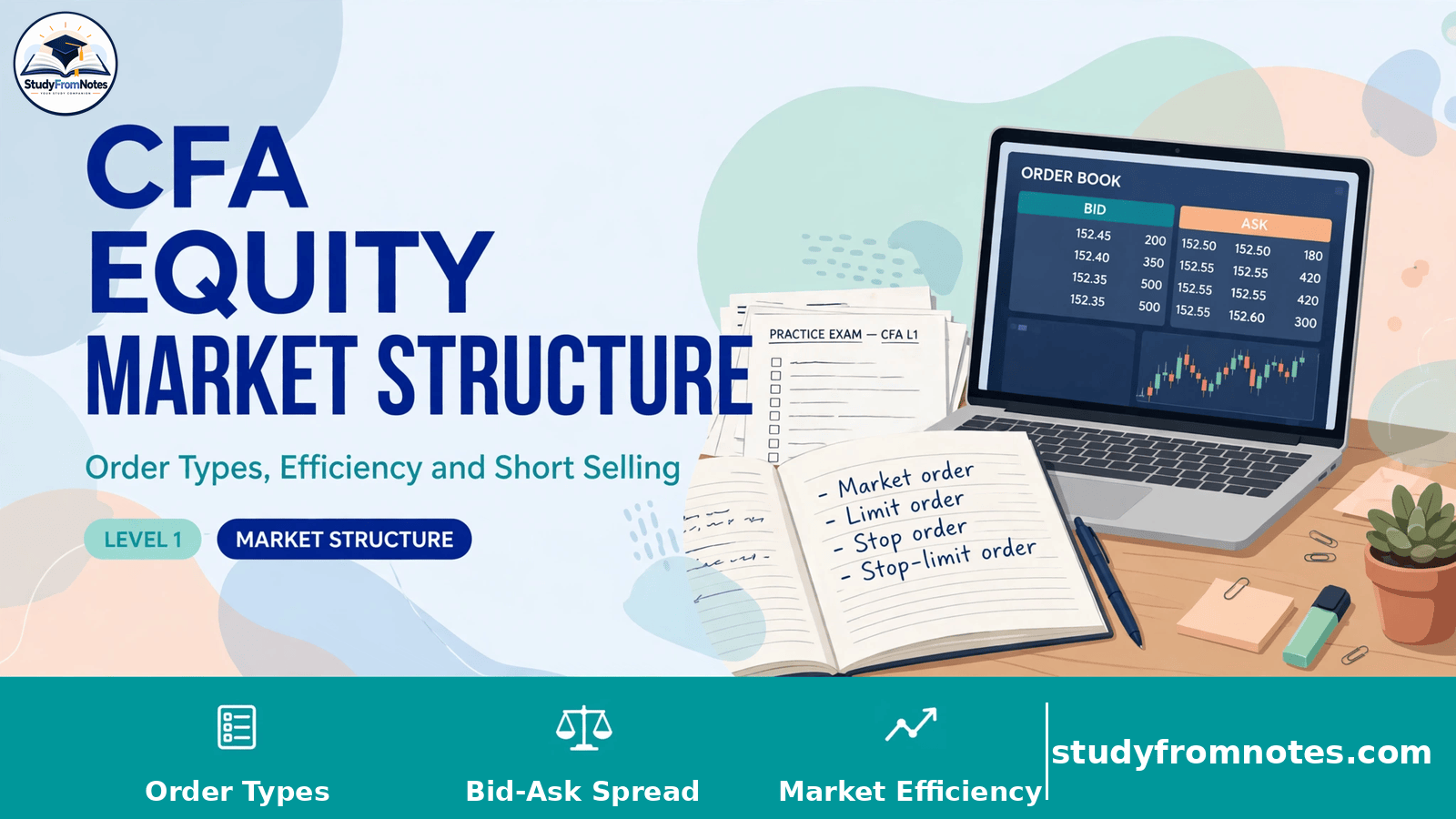
CFA equity market structure answers one question: how do buyers and sellers actually meet, and what does each trade cost? A market is the rules and systems that turn an order into a trade. Those rules decide who quotes prices, how orders match, and what a trade costs. This note covers the market organization and structure outcomes in the CFA Level 1 Equities topic, weighted 11 to 14 percent in the 2027 exam, about 20 to 25 of the 180 questions, according to CFA Institute. Find the full topic set in our CFA notes hub. For valuation models, start with our CFA equity valuation notes.
CFA equity market structure in one view
CFA equity market structure rests on four ideas: the market type that sets who quotes prices, the order type that controls how a trade fills, the bid-ask spread that prices immediacy, and market efficiency that tests whether information is already in the price.
Every market collects order information, routes orders, matches buyers with sellers, and settles the trade.
CFA equity market structure: primary and secondary markets
The primary market is where a security is first issued and sold by the issuer, which receives the proceeds. The secondary market is where previously issued securities trade among investors, and the issuer receives nothing. A listing day issue is a primary market event. Call markets trade only when called; continuous markets trade all day.
CFA equity market structure: quote-driven, order-driven and brokered markets
In a quote-driven market, customers trade at prices quoted by dealers. The dealer buys at the bid and sells at the ask, and the spread is the dealer compensation for providing liquidity. Most bonds and currencies trade this way.
In an order-driven market, rules match buy orders to sell orders. Almost all exchanges use order-driven systems. In a brokered market, brokers arrange trades for unique instruments with limited liquidity, such as art.
Order matching follows a precedence hierarchy: price first, then display, then time. Call markets use the uniform pricing rule: all trades execute at the same price, the price that maximizes the quantity traded. Continuous markets use the discriminatory pricing rule, based on the limit price of the first order. Crossing networks use the derivative pricing rule, the midpoint of the best bid and ask.
CFA equity market structure: order types and validity instructions
A market order tells the broker to buy or sell immediately at the best price available. It guarantees execution, not price.
A limit order fills only at the specified limit price or better. A buy limit caps what the buyer pays; a sell limit floors what the seller accepts. A limit order guarantees price, not execution.
A stop order has a trigger price. When the stock trades at or through the stop, the order is elected and converts into a market order. A stop guarantees neither price nor execution until elected, and after election it guarantees execution, not price.
A stop-limit order becomes a limit order when triggered, so it can fail to fill. Fill-or-kill fills the whole order now or cancels it; immediate-or-cancel fills what it can and cancels the rest. A hidden (iceberg) order shows only part of its size. A market-on-close order executes near the close. Day orders expire at the close; good-till-cancelled orders stay open until filled or cancelled.
The limit order book and the bid-ask spread
The limit order book is a record of all outstanding limit orders, sorted by price-time priority. Bids run from the highest price down; asks run from the lowest price up. The best bid and ask form the inside quote.
The bid-ask spread is the difference between the best ask and the best bid: the cost of immediacy. Its three components are order processing, the fixed cost of making a market; inventory, compensation for holding a risky position; and adverse selection, the loss to informed traders.
A resting limit order is a free option for the market. Posting one collects the spread but carries adverse selection risk; a market order pays the spread but buys certainty. The effective spread is twice the distance between the execution price and the midpoint.
CFA equity market structure: short selling and margin
A short sale means sell first, buy back later. The short seller borrows shares, sells them, and later buys the same number to return to the lender. Profit equals the sale price minus the buy-back price, times the number of shares, less borrowing costs and dividends. The broker holds the proceeds as collateral.
Short selling requires a margin account. The short seller posts an initial margin deposit, a percentage of the short sale value, in addition to the proceeds held as collateral. Under Regulation T, the initial margin requirement is 150 percent of the short sale value.
When the price rises, the buy-back liability grows, equity falls, and the broker issues a margin call. The margin call price is the short sale price times one plus the initial margin, divided by one plus the maintenance margin. The maximum gain is 100 percent of the sale price; the maximum loss is unbounded. The lender invests the proceeds and pays the short rebate rate.
Market efficiency: weak, semi-strong and strong forms
An informationally efficient market is one in which the current price fully, quickly and rationally reflects all available information. The efficient market hypothesis, developed by Eugene Fama, comes in three forms.
In a weak-form efficient market, current prices fully reflect all past market data: historical prices and trading volumes. Past price and volume information has no predictive power, so technical analysis cannot consistently earn positive risk-adjusted returns.
In a semi-strong-form efficient market, prices rapidly adjust to all new public information, so current prices fully reflect all public information. The testable implication is that fundamental analysis of public information cannot consistently earn positive risk-adjusted returns. Event studies are the standard test of this form.
In a strong-form efficient market, prices fully reflect all information, public and private, so even insiders should not earn abnormal returns. Empirical evidence supports the view that markets are not strong-form efficient: insiders can earn abnormal returns. Weak sits inside semi-strong, which sits inside strong.
More participants and wider information raise efficiency; limits to trading and high costs lower it. Momentum and value anomalies challenge the hypothesis.
Worked examples: CFA equity market structure in numbers
Example 1: short sale, profit, return on equity and margin call price
Short 100 shares at $50.00, with initial margin of 50 percent and maintenance margin of 30 percent. Ignore dividends, borrowing cost and commission. Proceeds are 100 x $50.00 = $5,000.00. The margin deposit is 50 percent x $5,000.00 = $2,500.00, so the account holds $7,500.00. The price falls to $40.00. You buy back 100 shares for 100 x $40.00 = $4,000.00, so gross profit is $5,000.00 minus $4,000.00 = $1,000.00. Return on equity is $1,000.00 / $2,500.00 = 40.00 percent. The margin call price is $50.00 x (1 + 0.50) / (1 + 0.30) = $50.00 x 1.50 / 1.30 = $57.69. At $57.69 the position is worth $5,769.23, equity is $7,500.00 minus $5,769.23 = $1,730.77, and 30 percent of $5,769.23 is $1,730.77, so equity sits exactly at the maintenance requirement. A rise of only about 15 percent triggers the call.
Example 2: bid-ask spread, market buy cost and effective spread
A stock is quoted bid $40.00 for 500 shares, ask $40.10 for 300 shares. The quoted spread is $40.10 minus $40.00 = $0.10. The midpoint is ($40.00 + $40.10) / 2 = $40.05, so the quoted spread as a percent of the midpoint is $0.10 / $40.05 = 0.25 percent. A market buy of 100 shares costs 100 x $40.10 = $4,010.00, against a midpoint value of 100 x $40.05 = $4,005.00, so the cost of immediacy is $5.00, or $0.05 per share, half the quoted spread. If a buy executes at $40.08, the effective spread is 2 x ($40.08 minus $40.05) = $0.06, narrower than the $0.10 quoted spread.
Exam traps
- Market order: execution, not price. Limit order: price, not execution.
- A stop is not a limit. A stop becomes a market order; a stop-limit can fail to fill.
- Buy stops above, sell stops below.
- Fill-or-kill: no partial fill. Immediate-or-cancel: partial fills allowed.
- A market buy pays the ask; a market sell receives the bid.
- Short gain capped at 100 percent; short loss unbounded.
- Short sale proceeds are collateral, not cash to spend.
- Weak form kills technical analysis; semi-strong kills fundamental analysis.
- Strong form does not hold in practice. Insiders can earn abnormal returns.
- Time pressure: about 90 seconds per question.
One page revision box: CFA equity market structure
| Topic | Rule or formula | Key point |
|---|---|---|
| Market types | Dealers quote / rules match / broker arranges; precedence: price, display, time | Almost all exchanges are order-driven |
| Market vs limit order | Market: execution; limit: price | No order guarantees both |
| Stop vs stop-limit | Stop becomes market; stop-limit becomes limit | Stop-limit can fail to fill |
| Bid-ask spread | Spread = ask minus bid; midpoint = (bid + ask) / 2 | Processing, inventory, adverse selection |
| Short sale | Profit = (sale minus buy-back) x shares, less costs | Gain capped; loss unbounded |
| Short margin call price | P = P0 x (1 + IM) / (1 + MM) | Equity equals maintenance margin |
| Market efficiency | Weak: past; semi-strong: public; strong: all | Weak kills technical; semi-strong kills fundamental |
Equities is 11 to 14 percent of the Level 1 exam from February 2027. Successful candidates report over 300 hours on average per level, according to CFA Institute. Keep this note in our CFA notes hub and redo the examples before your next mock exam.
Enjoying this? Add StudyFromNotes as a preferred source on Google to see our latest notes and updates more often:

Lauren Brooks is a finance professional writing on professional exams, study strategies, and finance careers.



Leave a Reply