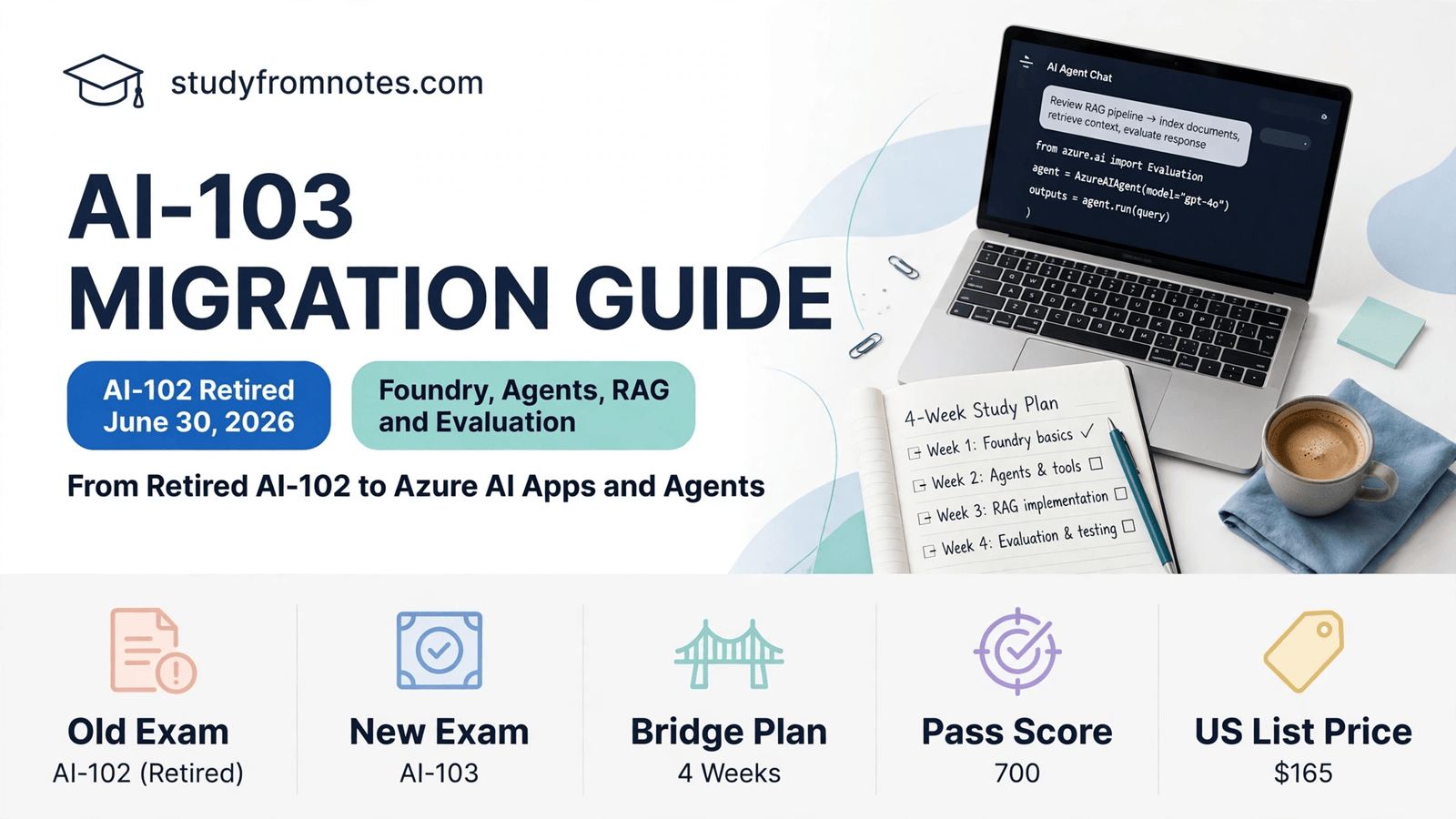
Microsoft retired AI-102 on 30 June 2026, and AI-103 is the exam that replaces it. There is no transfer of an AI-102 result, no upgrade exam, and no shortcut route in the official study guide: every candidate earns the new credential by sitting the full AI-103 exam. The good news is that much of your AI-102 knowledge still counts, but the exam itself has a new center. This AI-103 migration guide maps exactly what carries over, what is new, who should switch now, and how to bridge the gap in four weeks.
Also, read this guide alongside our full Microsoft AI-103 exam guide, which covers the complete syllabus, domain weights, and a six-week study plan for new candidates. This page covers only the migration angle: the decisions and study changes that matter if you come from AI-102.
AI-103 Migration at a Glance
AI-103 migration means starting fresh on a new exam, not transferring an old result. AI-102 retired on 30 June 2026, and AI-103 tests Foundry, retrieval grounding, agents, and evaluation, with a pass score of 700 and a United States list price of 165 dollars.
Three facts set the tone for everything below. First, AI-103 is a different credential, not a renamed AI-102: the new title is Microsoft Certified: Azure AI Apps and Agents Developer Associate. Second, the heaviest domain is now generative AI and agentic solutions at 30 to 35 percent, followed by planning and managing an Azure AI solution at 25 to 30 percent. Third, the official audience profile assumes Python, so candidates who worked in C# under AI-102 need a Python bridge before they book.
What Happens to Your AI-102 Credential
However, if you already hold AI-102, your credential does not vanish on retirement day. It stays on your transcript until its expiry date, and it still proves the work you did. What you lose is the renewal path: Microsoft does not renew a retired certification through the usual free assessment, so once it expires, AI-103 offers the only way back to a current Azure AI credential.
In addition, if you were studying for AI-102 but had not sat it, that plan is now closed. New candidates cannot book AI-102, and study time spent on the old outline only pays off where the topics overlap with AI-103. That overlap is real, and the next section maps it, but it is not a reason to delay. Every month spent polishing retired material is a month not spent on agents, retrieval grounding, and evaluation, which decide the new exam.
For example, one practical point for job seekers: if a posting still asks for AI-102, treat it as shorthand for the role, not the live exam code. List AI-102 on your resume while it is valid, and add AI-103 once you pass it, so recruiters see both the experience and the current credential.
AI-103 Migration: What Carries Over from AI-102
Moreover, your AI-102 study was not wasted. The foundations transfer cleanly, and they cover a large share of the smaller AI-103 domains.
Core services knowledge still counts
Vision, language, speech, and document skills all appear in AI-103, and AI-103 frames them inside agent workflows rather than as standalone services. If you know how image analysis, entity extraction, translation, speech conversion, and document extraction work, you already own the concepts behind three domains worth 10 to 15 percent each. The shift is in application: AI-103 asks how these services feed an agent or a retrieval pipeline, not just how each service is configured.
Responsible AI and Azure fundamentals transfer
Moreover, responsible AI principles, content safety, and auditing carry over directly, and they now sit inside the planning domain at 25 to 30 percent. Azure fundamentals also transfer: resource groups, identity, networking basics, storage, monitoring, quotas, and cost control all appear in AI-103 scenarios. AI-103 tests security habits from AI-102 again, such as managed identity and keyless credentials, and applies them to Foundry projects and agent tool access.
Python and API skills are your strongest asset
Similarly, if you built AI-102 solutions in Python, you are already aligned with the AI-103 audience profile. The AI-103 audience profile assumes reading functions, handling JSON, calling APIs, and wiring an SDK, and these skills offer the fastest route into Foundry development. Candidates who used C# should budget extra time here: learn enough Python to read and write small Foundry scripts before tackling agents.
AI-103 Migration: What Is New and What to Unlearn
Therefore, the new material is concentrated, and it is where AI-102 candidates most often underprepare. Treat these four areas as new study, not revision.
Microsoft Foundry is now the platform, not one topic among many
For example, under AI-102, you integrated individual Azure AI services into applications. Under AI-103, Microsoft Foundry is the workspace where you choose models, ground them in your own data, build agents, and run them in production. Learn the Foundry project model, model catalog choices, deployment options, and CI/CD integration by doing them, not by reading about them. Deploy a model, connect a data source, and run an agent through the portal and the SDK.
Agents, retrieval grounding, and evaluation decide the exam
Moreover, agent design is the single biggest change. You need agent roles, tool schemas, function calling, conversation memory, multi-agent orchestration, safeguards, and approval flows. Retrieval-augmented generation is equally central: indexing, retrieval methods, grounding quality, and search health all appear, and they connect directly to agent tools. Evaluation is the third new pillar: detecting fabrications, checking relevance and safety, tracing runs, and reading token analytics. These topics were a small slice of AI-102; in AI-103 they form the core.
Unlearn the old study balance
However, the most common migration mistake is keeping the old timetable. AI-102 rewarded deep knowledge of individual services and knowledge mining workflows. AI-103 rewards design judgment: which model, which retrieval method, which security control, and which evaluation catches a weak answer. If you organized your notes service by service, reorganize them around workflows: a grounded agent answering from company documents, end to end, with safety checks and tracing attached.
AI-102 vs AI-103: The Migration Table
In addition, use this table to audit your own notes. Anything in the right column that you cannot yet explain is a gap to close before booking.
| Point of comparison | AI-102 (retired 30 June 2026) | AI-103 (current) |
|---|---|---|
| Credential earned | Azure AI Engineer Associate | Azure AI Apps and Agents Developer Associate |
| Status | Retired; cannot be booked or renewed | Current exam; skills measured as of 16 April 2026 |
| Platform focus | Individual Azure AI services in applications | Microsoft Foundry first: models, grounding, agents, production operations |
| Language profile | C# or Python workflows | Python development experience assumed |
| Heaviest topic | Spread across service domains and knowledge mining | Generative AI and agentic solutions, 30 to 35 percent |
| Second heaviest topic | Planning and service design | Plan and manage an Azure AI solution, 25 to 30 percent |
| Smaller domains | Vision, language, knowledge mining as separate areas | Vision, text analysis, information extraction at 10 to 15 percent each |
| What you build | Apps calling prebuilt AI services | Grounded agents, RAG pipelines, orchestrated multi-agent systems |
| Transfer route | None to AI-103; old credential stays valid until expiry | Full exam required for every candidate |
AI-103 Migration: Who Should Switch Now
Similarly, not every AI-102 candidate is in the same position. Match yourself to one of these cases and act on it.
AI-102 holders with a current credential
Therefore, switch when your expiry date comes into view, and start the bridge plan at least a month before it. You have the foundations, so your work is Foundry, agents, and evaluation. Do not wait until the credential lapses and you are explaining a gap to a hiring manager.
Candidates mid-study for AI-102
Therefore, switch now. Stop buying AI-102 question banks and courses, and audit any paid resource against the official AI-103 study guide before you trust it. Publishers aimed third-party material published before spring 2026 at a retired exam, and its gaps sit exactly where AI-103 is heaviest.
Developers new to Azure AI
For example, skip the migration question entirely and start with AI-103. Read the full AI-103 guide for the syllabus and six-week plan, and use this page only to understand why older material you find online looks different. If Foundry is unfamiliar, the official learning path and the exam sandbox are the right first steps.
C# developers and non-Azure engineers
Moreover, C# developers should add a short Python bridge, one or two weekends of small Foundry scripts, before the agent weeks. Engineers whose stack sits outside Azure should weigh the switch honestly: AI-103 proves Azure expertise, and its scenarios assume Foundry throughout. If your daily work is not on Azure, a general AI credential may serve you better than a migration.
AI-103 Migration: Your 4-Week Bridge Plan
In addition, this plan assumes you already hold AI-102 knowledge and can study 8 to 10 hours a week. It is a bridge, not a full course: it spends almost no time re-teaching services you know, and it spends most of its hours on Foundry, agents, and evaluation. Turn it into a weekly schedule with our free study timetable generator if you want dated tasks.
| Week | Focus | Build or finish |
|---|---|---|
| Week 1 | Foundry foundations: project model, model catalog, deployment, Python SDK, managed identity, keyless credentials | Deploy one model and call it from a Python script |
| Week 2 | Retrieval grounding: indexing, retrieval methods, grounding quality, search health, RAG evaluation | Build a RAG app over your own documents and test its answers |
| Week 3 | Agents: roles, tool schemas, function calling, memory, multi-agent orchestration, safeguards, approval flows, tracing | Build a two-agent workflow with an approval step and full tracing |
| Week 4 | Rehearsal: planning domain drills, vision and text workflows as agent tools, official practice assessment, timed question sets | Two timed practice runs, then book while the material is fresh |
Therefore, stretch week 3 across two weeks if agents are new to you, and compress week 1 if you already deploy models daily. Do not cut week 4: timed practice is where migration candidates discover that they know the concepts but answer too slowly, or that they still reach for AI-102 service answers in agent scenarios.
AI-103 Migration Checklist
Finally, work through this checklist in order. Book only when every row is honestly checked.
| Migration task | Why it matters | Done |
|---|---|---|
| Confirm your AI-102 status and expiry date | Decides your deadline and whether you switch now or later | ☐ |
| Stop AI-102-only courses and question banks | Old material under-covers agents, Foundry, and evaluation | ☐ |
| Audit notes against the official AI-103 study guide | Reveals gaps instead of letting you guess at them | ☐ |
| Close the Python gap if you worked in C# | Python is assumed in the AI-103 audience profile | ☐ |
| Build one RAG app and one two-agent workflow | Hands-on work is what scenario questions test | ☐ |
| Practice evaluation: fabrications, relevance, safety, tracing | Evaluation runs through the heaviest domains | ☐ |
| Take the official practice assessment | Closest free preview of question style and timing | ☐ |
| Book with a personal Microsoft account | Records tied to a work account are lost when you leave | ☐ |
Booking, Cost and Exam Facts for AI-103 Migrants
Moreover, you book AI-103, an Associate-level exam, through your Microsoft Learn certification profile, and Pearson VUE delivers it at a test center or online with a proctor. The United States list price is 165 dollars, and the price varies by the country where you sit the exam, so confirm the figure at booking. The pass mark is a scaled score of 700 or greater, and Microsoft associate certifications expire annually and renew through a free online assessment on Microsoft Learn.
However, two facts need a hedge, stated plainly. Microsoft does not publish a question count for AI-103, so any fixed number comes from a third party, not from Microsoft. The official study guide also does not state the exam duration; prep guides commonly list 120 minutes, so confirm the duration on your booking confirmation rather than planning around an unofficial figure. The official practice assessment now runs through AI Skills Navigator and requires sign-in to launch, and the exam sandbox lets you explore the real interface before test day.
Therefore, retakes follow Microsoft’s standard role-based policy, so read the current policy on the exam page before you book. The standard pattern allows a retake 24 hours after a first failed attempt, with longer waits after later attempts, but the exam page is the authority if that policy changes.
One-Page Migration Summary
- AI-102 retired on 30 June 2026; its certification stays valid until expiry but cannot be renewed.
- AI-103 is a new credential, not a rename, and every candidate sits the full exam.
- Carries over: service concepts, responsible AI, Azure fundamentals, Python and API skills.
- New and heaviest: Foundry, RAG, agents, orchestration, evaluation, tracing.
- Pass mark 700 or greater; United States list price 165 dollars, varies by country.
- Bridge plan: 4 weeks at 8 to 10 hours a week, built around two working projects.
Frequently Asked Questions
Can I transfer my AI-102 result to AI-103?
No. The official study guide publishes no transfer route and no upgrade exam. Moreover, AI-103 awards a separate credential, and earning it means sitting the full exam, whether or not you hold AI-102.
Does my AI-102 certification disappear now?
No. In addition, it stays on your transcript until its expiry date. What ends is renewal: once a retired certification expires, you cannot renew it, and AI-103 is the route back to a current credential.
How long does migration take if I already know AI-102?
Therefore, plan four weeks at 8 to 10 hours a week if your Python and Azure foundations are solid, and stretch the agent week if Foundry is new to you. Candidates starting from near-zero Azure knowledge should follow the full six-week plan in the main AI-103 guide instead.
Is AI-103 harder than AI-102?
However, it is different rather than simply harder. AI-102 rewarded service knowledge; AI-103 rewards building and operating agents end to end, with evaluation and safety checks attached. Builders who practice in Foundry find it fair; readers who only memorize service features find it steep.
Should I wait for more AI-103 practice material?
No. Therefore, the official study guide, learning path, exam sandbox, and practice assessment already exist, and waiting only lengthens the gap while your AI-102 credential ages. Use the official material first and check any paid bank against the study guide before you trust it.
Sources
In conclusion, exam facts and domain weights in this guide come from the official AI-103 study guide on Microsoft Learn, skills measured as of 16 April 2026. Independent certification coverage corroborates retirement and renewal status, and the full syllabus and six-week plan for new candidates sit in our Microsoft AI-103 exam guide.

Daniel Mercer is a finance professional writing on professional exams, study strategies, and finance careers.

Leave a Reply