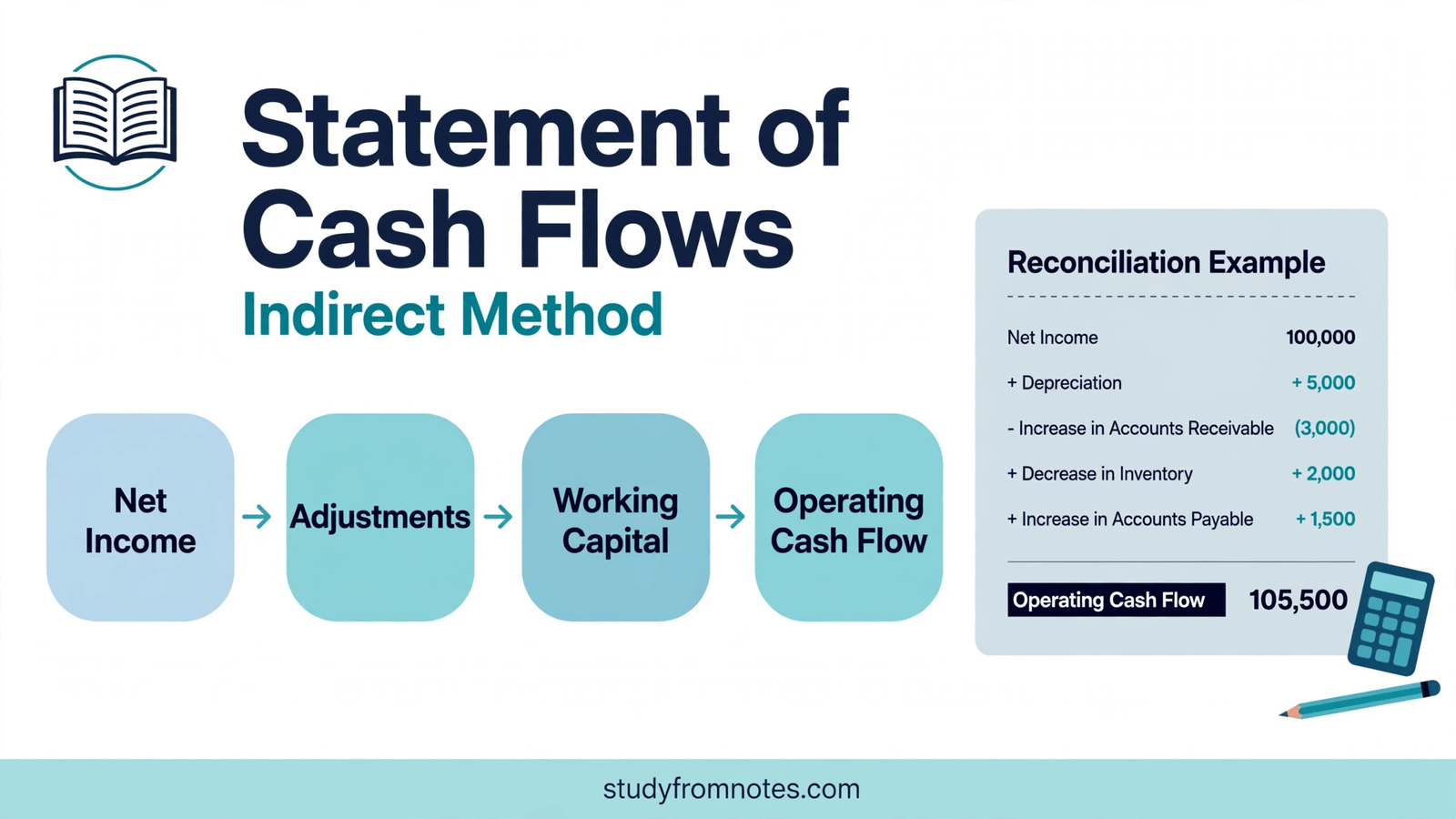
The statement of cash flows answers one question: where did the cash actually go? Net income cannot answer it, because net income is accrual-based. Specifically, it includes revenue you have not collected and expenses you have not paid. Indirect method cash flow starts with net income and adjusts it for noncash items and working capital changes to arrive at cash from operations. These notes also give you the full mechanics, plus the direction rules that students mix up most.
In fact, cash flow questions reward drilled mechanics more than rereading. If you are scheduling FAR revision, block one focused session for this topic with the free study timetable generator and work the example below twice: once with the notes open, and once from memory.
Indirect method cash flow: the 3 sections
Indirect method cash flow is the operating section built backwards from net income. You add back noncash expenses, remove gains and losses on asset sales, then adjust for changes in operating current assets and liabilities to reach net cash provided by operating activities.
First, every cash flow statement has three sections. However, only the operating section differs between methods; investing and financing are identical either way.
- Operating: cash from the core business, meaning customers, suppliers, employees, interest, and taxes.
- Investing: buying and selling long-term assets, such as equipment, investments, and loans made to others.
- Financing: borrowing, repaying debt, issuing stock, and paying dividends.
The direct method builds the operating section from gross cash receipts and payments, such as cash collected from customers and cash paid to suppliers. In contrast, the indirect method reaches the same total by reconciling net income. US GAAP still requires that reconciliation from direct method reporters: ASC 230 (ASC 230-10-45-28) makes it a required supplement. Indeed, that requirement is one reason the indirect method dominates in practice.
Indirect method cash flow reconciliation steps
Start with net income, then work through three steps in order.
Step 1: Add back noncash expenses
Depreciation, amortization, and depletion reduced net income but never touched cash. Therefore, you add them back. Stock compensation works the same way, because it is an expense with no cash behind it. The provision for bad debts, however, needs one caveat. Add it back only when the receivables change in Step 3 is measured gross of the allowance for doubtful accounts. Balance sheets present receivables net of that allowance, and the net change already contains the bad debt effect. If you adjust for the net change and also add back the provision, you count the same item twice.
Step 2: Remove gains and losses on asset disposals
For example, a gain on selling equipment inflated net income, but the actual cash from that sale belongs in investing, not operations. So subtract gains and add back losses. This step exists to avoid double counting. The full sale proceeds will appear in the investing section. Therefore, the book gain or loss must leave the operating section completely.
Step 3: Adjust for changes in operating current assets and liabilities
This is the step that decides exam scores. The direction rules apply to operating items only:
| Change during the year | Operating current asset | Operating current liability |
|---|---|---|
| Increase | Subtract | Add |
| Decrease | Add | Subtract |
Here is why the rules work. For example, an increase in accounts receivable means you recorded revenue without collecting cash, so net income overstates cash and you subtract the difference. Similarly, an increase in accounts payable means you recorded an expense without paying cash, so net income understates cash and you add the difference. In short, every rule is just accrual accounting being unwound.
Financing items stay out of this step, even when they are current. An increase in short-term notes payable to a bank is a financing inflow, not an operating adjustment. Dividends payable and the current portion of long-term debt are financing items too. Therefore, none of their changes enter the operating reconciliation.
Indirect method cash flow worked example
Given:
- Net income: $60,000
- Depreciation expense: $12,000
- Gain on sale of equipment: $5,000
- Loss on sale of land: $3,000
- Accounts receivable increased $8,000
- Inventory decreased $4,000
- Accounts payable increased $6,000
- Salaries payable decreased $2,000
| Reconciliation | Amount ($) |
|---|---|
| Net income | 60,000 |
| Add: depreciation expense (noncash) | +12,000 |
| Subtract: gain on sale of equipment | -5,000 |
| Add: loss on sale of land | +3,000 |
| Subtract: increase in accounts receivable | -8,000 |
| Add: decrease in inventory | +4,000 |
| Add: increase in accounts payable | +6,000 |
| Subtract: decrease in salaries payable | -2,000 |
| Net cash provided by operating activities | 70,000 |
Next, walk the arithmetic yourself: 60,000 + 12,000 – 5,000 + 3,000 – 8,000 + 4,000 + 6,000 – 2,000 = 70,000. If your total does not foot, recheck each sign before you recheck the math. On the exam, the signs are where points are won and lost.
Examiners rarely present the items in this tidy order. Instead, they scatter the same changes inside comparative balance sheets, and the task stays identical: classify each change, apply the direction rule, and keep the signs disciplined.
Two lines deserve a second look. The gain and the loss never appear in the investing section. Investing reports the full cash proceeds of each sale instead. The gain sits inside net income as a book figure, so the reconciliation removes it. The loss reduced net income without any operating cash leaving, so the reconciliation adds it back.
Noncash investing and financing activities
Some big transactions move no cash at all: issuing stock to buy equipment, converting bonds into common stock, or acquiring an asset with a finance lease. These never appear in the three sections, because there is no cash to report. GAAP still requires them to be disclosed, in a separate supplemental schedule or in the footnotes. The exam likes to ask where a stock-for-equipment swap appears. The answer is the noncash schedule, not the body of the statement.
Two cash figures also get supplemental disclosure under the indirect method: interest paid and income taxes paid. Both are operating outflows. ASC 230 nevertheless requires companies to report the amounts paid during the period, either on the face of the statement or in the notes.
Exam traps
Dividends paid are a financing outflow. Students park dividends in operations because dividends feel like an expense. They are a distribution of earnings, not an expense, so ASC 230 puts the outflow in financing.
Interest paid stays in operating activities under US GAAP. IFRS gives reporters a choice between operating and financing for interest paid, but do not spend study time on that split. The CPA Exam removed IFRS versus US GAAP differences from the FAR blueprint in 2021. For FAR, interest paid is an operating outflow.
A decrease in a current asset is added. That feels backwards until you follow the expense instead of the account name. A drop in inventory means cost of goods sold ran ahead of the cash spent on replacement stock, so net income understates operating cash and you add the difference. Collection is a separate event, and it shows up in the receivables adjustment, not here.
Not every current liability belongs in Step 3. A higher short-term bank note balance is new borrowing, not an unpaid operating expense. Keep bank notes payable, dividends payable, and current maturities of long-term debt out of the operating adjustments.
Round out the accrual side of FAR with the ASC 842 lease accounting notes and the ASC 740 deferred tax notes: both topics create the noncash and timing differences that cash flow questions feed on.
One-Page Revision
Finally, here is the whole topic on one screen, ready to screenshot the night before the exam:
- 3 sections: operating, investing, financing. Only operating differs by method.
- Indirect method: net income, plus or minus noncash items, minus gains and plus losses on disposals, plus or minus changes in operating current assets and liabilities.
- Add back: depreciation, amortization, losses on asset sales, decreases in operating current assets, increases in operating current liabilities.
- Subtract: gains on asset sales, increases in operating current assets, decreases in operating current liabilities.
- Bad debt provision: add it back only with a gross receivables change. The net change already contains it.
- Financing current liabilities (bank notes payable, dividends payable, current maturities) never enter Step 3.
- Noncash investing and financing (stock for assets, bond conversions, finance lease acquisitions): supplemental schedule or footnotes, never the body.
- Dividends paid: financing. Interest paid: operating under US GAAP. Interest and income taxes paid: supplemental disclosure.
FAQ
Why do we subtract a gain on sale of equipment in operations?
Because the gain is already inside net income, but the cash from the sale is reported in investing activities. Subtracting it in operations prevents counting the same cash twice.
If a company uses the direct method, does it skip the reconciliation?
No. Under US GAAP, a company using the direct method must still present the indirect method reconciliation of net income to operating cash flow. That is why the indirect method dominates in practice.
Are prepaid expenses and unearned revenue operating items?
Yes. Prepaid expenses are operating current assets (increase = subtract), and unearned revenue is an operating current liability (increase = add). Apply the same direction rules.
Found this useful? Share it with your study group: Share on WhatsApp or Share on Telegram.

Daniel Mercer is a finance professional writing on professional exams, study strategies, and finance careers.


Leave a Reply