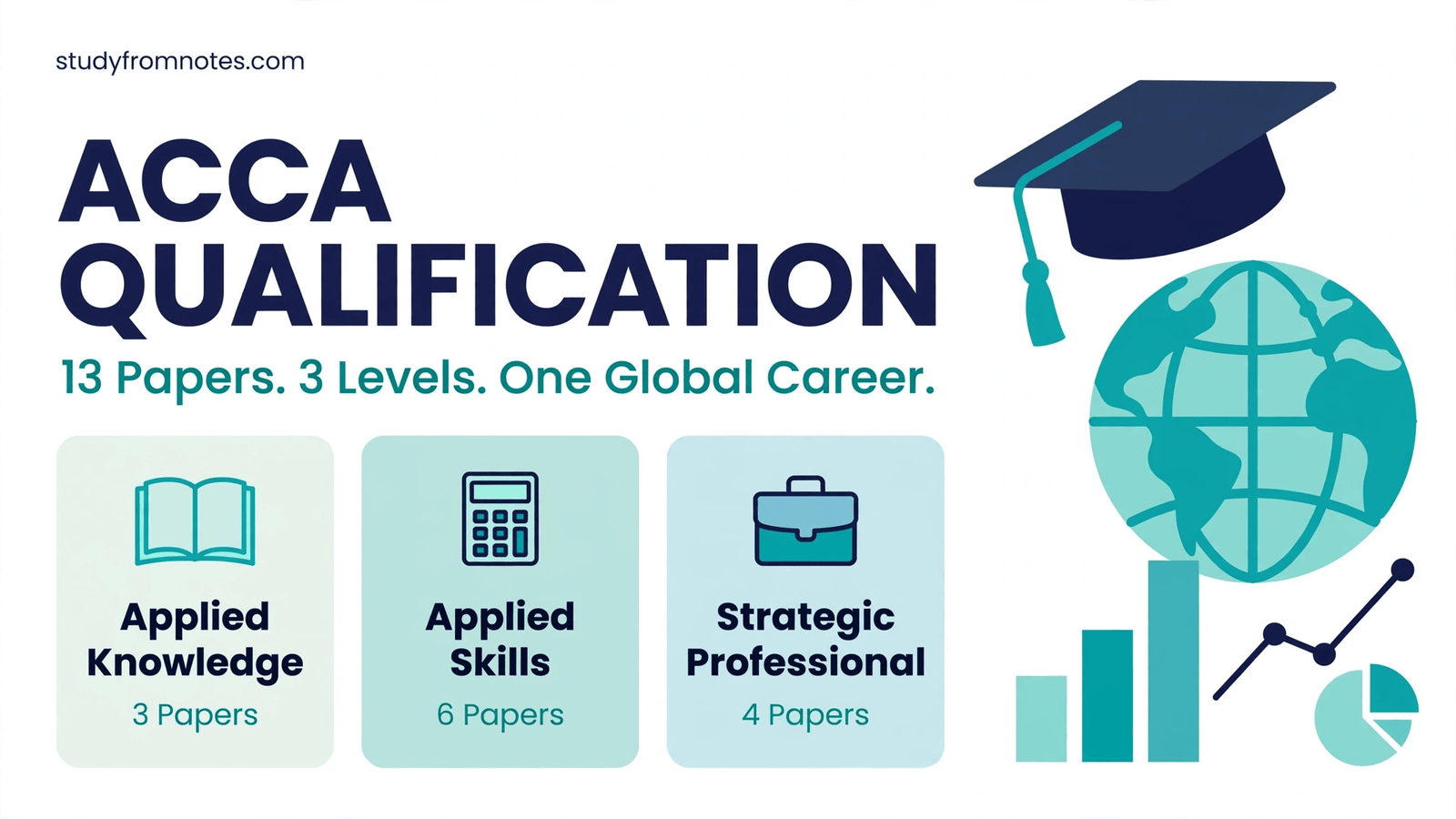
The ACCA qualification is the largest professional accountancy qualification in the world: 13 exams across three levels, recognized in 180 countries, with more than 257,900 members and 530,100 students currently in the pipeline, according to ACCA Global. If you are weighing whether to commit two to four years of your life to it, you need more than a brochure. This guide is built in three parts. Part 1 gives you the facts: every paper, the latest pass rates, and what it costs. Part 2 gives you the analysis: whether the qualification is worth it for you, and how it compares with the US CPA and CFA. Finally, Part 3 gives you the playbook: how candidates actually pass, paper by paper.
In short, the ACCA (Association of Chartered Certified Accountants) qualification is a 13-exam professional credential in accounting, audit, tax, and finance, recognized in 180 countries. Candidates clear Applied Knowledge (3 papers), Applied Skills (6 papers), and Strategic Professional (4 papers), then complete 36 months of practical experience and an ethics module to become members.
PART 1: THE FACTS
What the ACCA Qualification Actually Is
The Association of Chartered Certified Accountants was founded in London in 1904 with a specific mission: to open the accountancy profession to people regardless of background. That founding idea still shapes the qualification today, and there are no formal academic entry requirements to start. You register and begin.
In fact, the scale is what separates ACCA from national qualifications. According to ACCA Global, the body supports more than 257,900 members and 530,100 future members across 180 countries, working with over 8,000 approved employers worldwide. The syllabus is built on International Financial Reporting Standards (IFRS), which is the practical reason the qualification travels: the accounting framework you learn is the same one used from London to Dubai to Singapore.
However, passing the exams alone does not make you a member. The full journey has four components: the 13 exams, the Ethics and Professional Skills module, 36 months of relevant practical experience documented through ACCA’s Practical Experience Requirement, and then membership. Pass the exams and the ethics module first and you earn affiliate status. Add the experience and you become a member entitled to use the ACCA letters.
The ACCA Qualification: All 13 Papers and December 2025 Pass Rates
Here is the complete paper list with the official pass rates from ACCA Global’s December 2025 sitting, in which 120,633 candidates sat 137,609 exams and 4,852 completed their final papers to become affiliates, as reported by The Accountant.
| Code | Paper | Level | Dec 2025 pass rate |
|---|---|---|---|
| BT | Business and Technology | Applied Knowledge | 87% |
| MA | Management Accounting | Applied Knowledge | 64% |
| FA | Financial Accounting | Applied Knowledge | 68% |
| LW | Corporate and Business Law | Applied Skills | 82% |
| PM | Performance Management | Applied Skills | 40% |
| TX | Taxation | Applied Skills | 55% |
| FR | Financial Reporting | Applied Skills | 51% |
| AA | Audit and Assurance | Applied Skills | 46% |
| FM | Financial Management | Applied Skills | 48% |
| SBL | Strategic Business Leader | Strategic Professional (Essential) | 50% |
| SBR | Strategic Business Reporting | Strategic Professional (Essential) | 48% |
| AFM | Advanced Financial Management | Strategic Professional (Option) | 45% |
| APM | Advanced Performance Management | Strategic Professional (Option) | 41% |
| ATX | Advanced Taxation | Strategic Professional (Option) | 50% |
| AAA | Advanced Audit and Assurance | Strategic Professional (Option) | 38% |
Two patterns jump out, and Part 2 will dig into what they mean. First, the pass rate drops almost in half between the Knowledge level and the later papers, which tells you the qualification is really two different exams: one that tests whether you know the material, and one that tests whether you can think with it. Second, PM at 40% and AAA at 38% are the statistical filters of the whole qualification.
The ACCA Qualification: How Exams Work (Sessions, Format and Exemptions)
Exam sessions run four times a year, in March, June, September, and December, for all Applied Skills and Strategic Professional papers. The three Applied Knowledge papers are different: they are on-demand computer-based exams you can sit at any time at an approved center, which means you can clear the first level at your own pace before entering the session cycle.
Meanwhile, the format changes as you climb. For example, knowledge papers are objective-test questions. Skills papers mix objective questions with written tasks. In contrast, Strategic Professional papers are entirely scenario-based written exams with no multiple choice. SBL is a single four-hour integrated case study.
Exemptions deserve a clear explanation because this is where candidates lose money. ACCA grants exemptions for recognized prior qualifications, but two rules govern everything. First, you can be exempted from at most nine papers: the three Knowledge papers and the six Skills papers. Second, there are no exemptions at the Strategic Professional level. Every member sits SBL, SBR, and two option papers, regardless of what they studied before. Claim every exemption you are entitled to, but note that each exemption carries a fee, so check whether sitting the paper is cheaper than buying the exemption for subjects you could pass quickly.
One more structural fact: once you pass your first Strategic Professional exam, a seven-year clock starts. You must therefore complete the remaining Professional papers within seven years.
What the ACCA Qualification Costs in Time and Money
Time first, because it is the real price. Specifically, ACCA’s own guidance and most tuition providers converge on roughly 150 study hours per Applied Knowledge paper, 150 to 200 hours per Applied Skills paper, and 200 to 250 hours per Strategic Professional paper. As a result, across all 13 papers that is 1,500 to 2,500 hours. For a working professional studying 10 to 12 hours a week, the realistic timeline is therefore two and a half to four years.
Money has four components: the initial registration fee, an exam fee for every paper you sit, an exemption fee for every paper you skip, and an annual student subscription while you are in the system. ACCA publishes the current fee schedule on its website at accaglobal.com, and fees are revised periodically, so check the live numbers before budgeting. As a planning discipline, price the full journey, not the first paper.
PART 2: THE ANALYSIS
Reading the Pass Rates: Where Candidates Actually Fail
Look at the December 2025 numbers again and a clear story emerges. The papers that fail the most candidates, PM (40%), AAA (38%), and APM (41%), share one trait: they test professional judgment under time pressure rather than recall.
Performance Management does not fail people who cannot calculate a variance. The calculations are mechanical, and our ACCA PM variances cheat sheet compresses them into fifteen minutes. PM fails people who calculate correctly and then write nothing meaningful about what the numbers mean for the business. Advanced Audit and Assurance does not fail people who cannot list audit procedures. It fails people who describe procedures when the question asked them to evaluate risk. This is the central insight about ACCA difficulty: the qualification progressively stops rewarding what you know and starts rewarding how you think.
There is also a myth worth retiring. Strategic Business Leader has a reputation as the hardest paper, but it passed at 50% in December 2025, comfortably above AAA and APM. After all, SBL’s fearsome reputation comes from its format, a four-hour case study, not its grading. For instance, candidates who practice integrated case questions do fine. By contrast, candidates who treat it like a theory paper do not.
As ACCA executive director Alan Hatfield noted after the December 2025 results, the session drew “the largest volume of exams taken since December 2021,” which means these pass rates reflect a genuinely large global cohort, not a statistical quirk.
ACCA vs CPA vs CFA: An Honest Comparison
This is the question behind most ACCA searches, so here is the straight answer.
| Dimension | ACCA | US CPA | CFA |
|---|---|---|---|
| Professional focus | Accounting, audit, tax, finance (IFRS-based) | US accounting, audit, tax, regulation | Investment analysis, portfolio management |
| Exams | 13 papers | 4 sections | 3 levels |
| Typical duration | 2.5 to 4 years | 1 to 2 years | 3 to 4 years |
| Geographic strength | 180 countries | United States (state-licensed) | Global investment industry |
| Best for | Accountants and finance professionals seeking global mobility | Public accounting, audit, or tax careers in the US | Asset management, equity research, portfolio careers |
The decision rule is simple: choose by the work you want to do, not by prestige. If your target is a finance role in a multinational company, a Big 4 firm outside the US, or a career that crosses borders, ACCA’s IFRS foundation is the working language of that world. However, if your target is licensed public accounting practice in the United States, the CPA is the legal requirement and nothing substitutes for it. If your target is managing money, the CFA owns that lane. In other words, these are different professions that happen to share syllabus overlap, not rungs on one ladder.
Who Should Pursue the ACCA Qualification (and Who Should Not)
ACCA is a strong fit if you want your accounting career to be portable across countries, if you are targeting multinational employers or the Big 4, if you need a structured qualification you can complete while working full-time, or if you hold a prior qualification that earns you exemptions and shortens the journey.
It is a poor fit if your career will stay inside one domestic market that has its own dominant qualification, if you cannot sustain roughly 10 hours a week for several years, or if you want the letters without a plan for the work. Still, the qualification opens doors. It does not choose the rooms for you.
Before registering, answer three questions honestly. First, where do you want to be working in five years, geographically? Second, what work do you want to be doing: audit, corporate finance, tax, FP&A? Third, can you protect 10 to 12 study hours every week for three years? If the third answer is no, fix the schedule before you pay the registration fee.
PART 3: THE PLAYBOOK
The Order to Take the ACCA Papers
Start with Applied Knowledge in any order, since the exams are on-demand. Clear all three before entering the session cycle. Otherwise, starting Skills papers with Knowledge gaps is the most common self-inflicted wound in this qualification.
At Applied Skills, think in pairs. For example, each session, sit two papers that reinforce each other: Financial Reporting with Audit and Assurance (the standards overlap heavily), Performance Management with Financial Management (both quantitative and decision-oriented), Taxation with Corporate and Business Law (both rules-based). For working professionals, two papers per session across four sessions a year is the sustainable maximum. Consequently, that pace clears Skills in about 18 months.
At Strategic Professional, sit SBL and SBR before your options. Both Essentials integrate everything beneath them; moreover, the judgment skills they build transfer directly into the option papers.
How to Study at Each Level
In fact, each level demands a different method, and most failures come from using the wrong one.
First, Applied Knowledge is about learning the language. For example, flashcards, objective-test practice, and short daily sessions work. Then budget six to eight weeks per paper, and sit the on-demand exam the moment you are consistently scoring above 70% on practice questions.
Next, Applied Skills is the past-paper level. From the midpoint of your preparation, at least half of your study time should go into answering past exam questions under timed conditions, then marking yourself against the examiner’s model answers. Paper-specific notes: in FR, group accounts decide your result, so master them early. In PM, every calculation must end with business interpretation, or the marks stop. In TX, learn the proforma layouts for each tax because structure earns marks even when numbers wobble. For AA, the audit risk model is the skeleton key for half the paper. In FM, investment appraisal and working capital management carry the most weight. In LW, the pass rate is 82% for a reason, so clear it early and bank the confidence.
Finally, Strategic Professional is the judgment level. Read the examiner’s reports for your paper. ACCA publishes them after every session and they describe, in plain language, why candidates failed. Practice writing full answers against the clock, because the binding constraint is output speed, not knowledge. For SBL specifically, rehearse the discipline of planning before writing: ten minutes of structuring a four-hour case saves thirty minutes of rewriting.
Build your week-by-week schedule with our free study timetable generator, and explore our ACCA study notes hub for paper-wise revision material.
Choosing Your Two Option Papers
Choose by career direction, not by pass rate. The spread between the highest-passing option (ATX at 50%) and the lowest (AAA at 38%) is twelve points, which looks meaningful until you realize that motivation moves results by more than that. For example, an aspiring auditor who picks ATX to dodge AAA will study tax with resentment and audit with regret.
The mapping is straightforward. Audit and assurance careers point to AAA. Similarly, corporate finance and treasury point to AFM. FP&A and business partnering point to APM. Tax careers point to ATX. If you are undecided, pick the two closest to the work you are already doing. Relevant practical experience is worth more than any perceived ease.
The Final 30 Days Before Any Paper
Thirty to fifteen days out, finish the syllabus and work every topic with past questions. Fourteen to seven days out, sit two full mock exams under real exam conditions, then debrief each one against the examiner’s report, not just the answer key. In the final week, revise weak areas only; also keep a one-page formula and framework sheet, and introduce no new topics. Finally, on exam day, allocate roughly 1.8 minutes per mark and attempt every question. ACCA awards method marks, and a structured attempt at an unfamiliar question routinely earns half its marks.
Frequently Asked Questions
How long does the ACCA qualification take?
Most working professionals take two and a half to four years, studying 10 to 12 hours a week. With exemptions or full-time study, however, it can be shorter. ACCA’s own hour guidance implies 1,500 to 2,500 total study hours.
Is the ACCA qualification difficult?
The December 2025 global pass rates ran from 87% (BT) to 38% (AAA). The early papers test knowledge, while the later papers test judgment under time pressure. In fact, candidates who practice past papers under timed conditions pass at far higher rates than those who only read.
Can I complete ACCA while working full-time?
Yes. After all, the on-demand Knowledge exams and four annual sessions are designed for it. Sit a maximum of two papers per session and protect a consistent daily study slot.
How many ACCA exemptions can I claim?
Up to nine: all three Applied Knowledge papers and all six Applied Skills papers, depending on your prior qualification. However, there are no exemptions at the Strategic Professional level.
Is ACCA recognized in the United States?
Multinational employers in the US recognize ACCA, but licensed public accounting work requires the US CPA, which is state-regulated. In short, ACCA is a global credential and the CPA is a US license. They solve different problems.
What comes after passing all 13 ACCA papers?
You apply for affiliate status after completing the exams and the Ethics and Professional Skills module, then document 36 months of relevant practical experience to become a full ACCA member.
About the Author
Lauren Brooks is a finance professional writing on professional exams, study strategies, and finance careers.
If you found this guide useful, share it with someone preparing for ACCA.

Lauren Brooks is a finance professional writing on professional exams, study strategies, and finance careers.
Leave a Reply