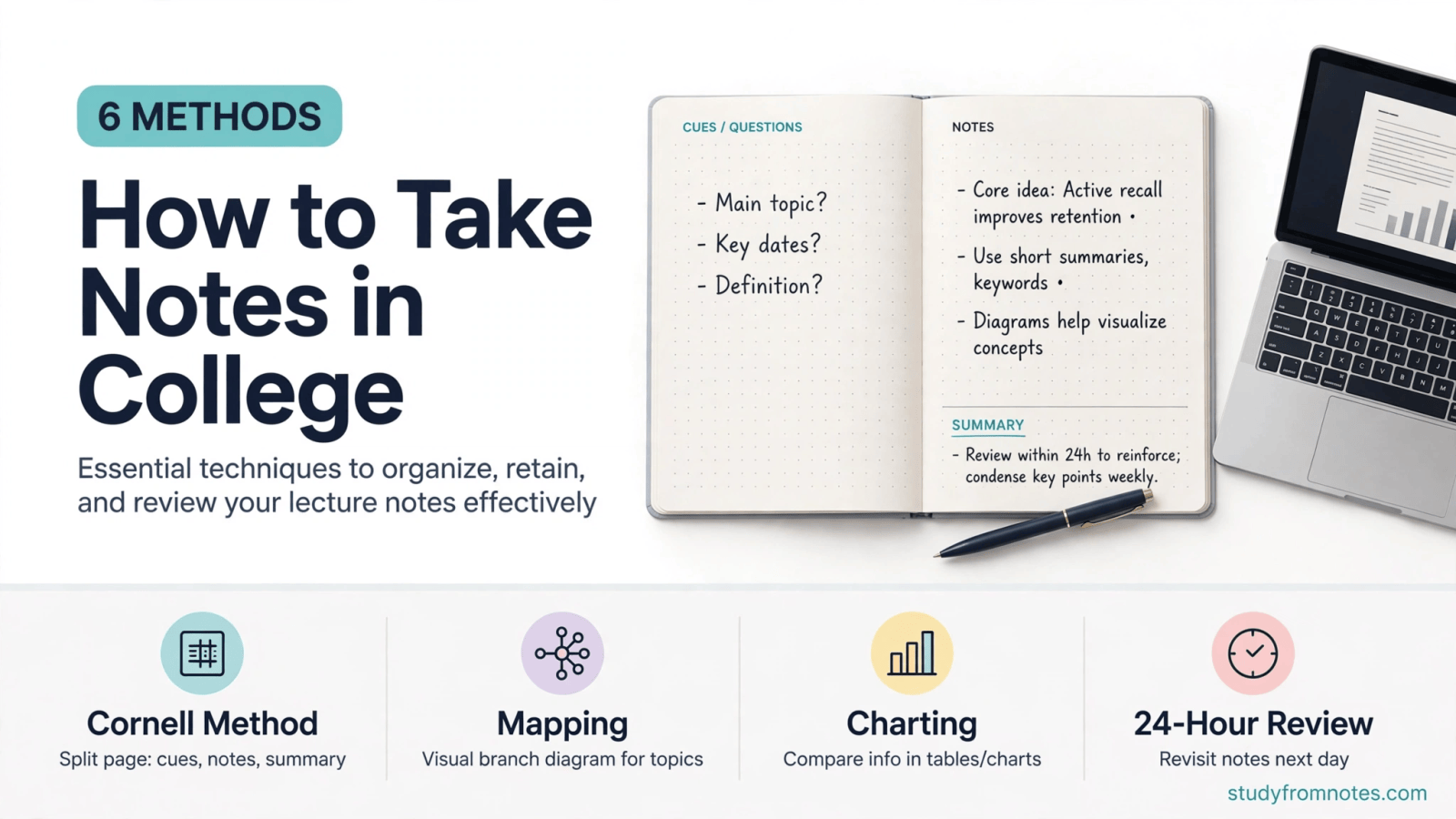
How to Take Notes in College Lectures
To take effective notes in college lectures: choose one note-taking method before class, focus on capturing ideas rather than transcribing words, mark anything the professor emphasizes, and review your notes within 24 hours. Students who review promptly retain dramatically more than those who wait until exam week.
College lectures move fast, and most students either write down everything (and understand nothing) or write down almost nothing (and remember even less). This guide gives you six methods matched to different lecture styles, plus the review habits that make notes actually useful.
Table of Contents
- Before the Lecture: 10 Minutes of Preparation
- 6 Note-Taking Methods for College Lectures
- How to Take Notes in College When the Professor Talks Fast
- What to Do in the 24 Hours After Class
- Common Mistakes
- Frequently Asked Questions
Before the Lecture: 10 Minutes of Preparation
Preview the topic for 10 minutes before class: skim the chapter headings, read the learning objectives, and write down three questions you want answered. This single habit transforms lectures from confusing to clarifying, because your brain now listens for answers instead of drowning in new information. Students who preview consistently report understanding lectures the first time rather than needing to re-teach themselves later.
6 Note-Taking Methods for College Lectures
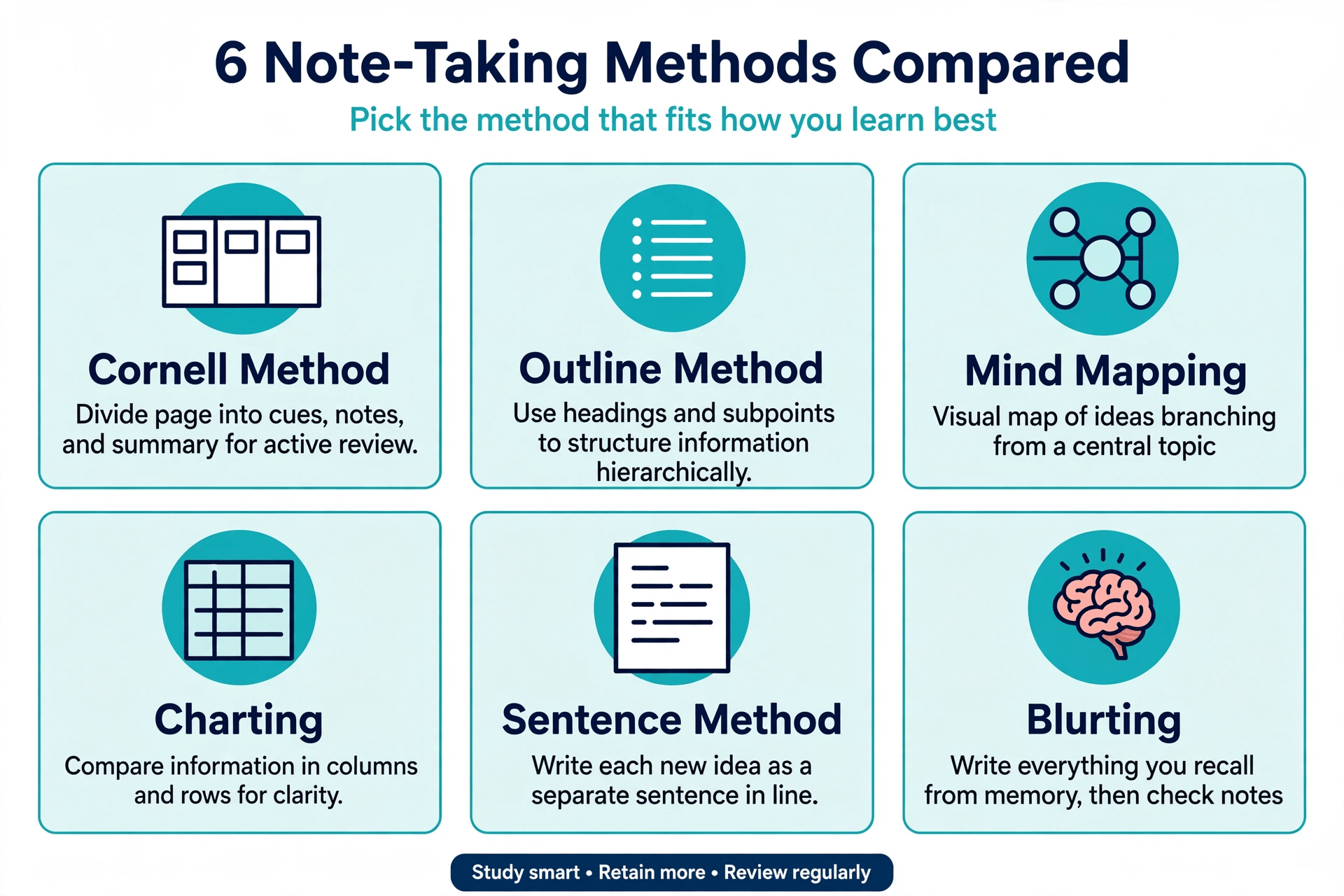
1. The Cornell Method. Divide your page into cues, notes, and summary sections. Best for: organized lectures with clear main points. Get our free Cornell template and full guide here.
2. The Outline Method. Use headings, subheadings, and bullet points in a hierarchy. Best for: structured lectures that follow the textbook. Fails when: the professor jumps between topics.
3. The Mapping Method. Draw the lecture as a visual diagram with the main topic at the center and branches for details. Best for: visual learners and lectures about processes or relationships.
4. The Charting Method. Create columns for categories the professor compares (dates, theories, pros and cons). Best for: lectures heavy on comparisons, which professors love to test.
5. The Sentence Method. Write each new point as a separate numbered sentence. Best for: fast, disorganized lectures where you cannot predict the structure. Clean it up into an outline within 24 hours.
6. The Question Method. Write every key point as a question you will answer later. Best for: exam preparation, because your notes become a built-in practice test.
How to Take Notes in College When the Professor Talks Fast
Fast lecturers defeat most methods. Switch to the sentence method and capture fragments, not sentences: key terms, numbers, names, and the professor’s examples. Mark anything repeated or emphasized with a star. Within 24 hours, expand your fragments into full notes while the lecture is still fresh in memory. A 50-minute lecture takes about 20 minutes to reconstruct the same day, versus an hour of confused guessing a week later.
Develop personal abbreviations for your major’s common terms. Write them on the inside cover of your notebook so the system stays consistent across the semester.
What to Do in the 24 Hours After Class
Review and condense (15 minutes). Read through your notes, fill in gaps, and write a 3-sentence summary at the top. This is the highest-leverage study habit in college.
Connect to the bigger picture (10 minutes). Write one paragraph linking today’s lecture to previous lectures. Professors test connections between topics more than isolated facts.
Flag confusion immediately. Mark anything you do not understand with a question mark and resolve it within 48 hours: office hours, the textbook, or a study group. Confusion compounds; a shaky week-3 concept will haunt you in week 10.
Common Mistakes
- Transcribing instead of thinking. If your hand moves but your brain does not, you are creating a transcript, not notes.
- Never reviewing. Unreviewed notes are just paper. The 24-hour review is what converts notes into knowledge.
- One method for every class. Match the method to the lecture style, not to habit.
- Skipping lectures because “the slides are online.” Slides contain what the professor shows; notes capture what the professor emphasizes, and emphasis predicts exam questions.
Frequently Asked Questions
Should I handwrite or type my notes?
Research consistently favors handwriting for conceptual understanding, because it forces you to process rather than transcribe. Typing wins for speed and organization. Choose based on the lecture: handwrite discussion-heavy classes, type fast content-heavy ones.
How do I take notes in online lectures?
The same methods apply, with one addition: pause the recording to write summaries at section breaks. The pause button is the online lecture’s greatest advantage; use it.
What if I miss a class?
Get notes from two classmates, not one, and compare them. Differences between their notes reveal what each found important, which is itself useful information.
Take Better Notes Starting Today
Master the fundamentals with our 7 study note methods guide and keep your semester organized with our free study timetable generator.

Lauren Brooks is a finance professional writing on professional exams, study strategies, and finance careers.


Leave a Reply