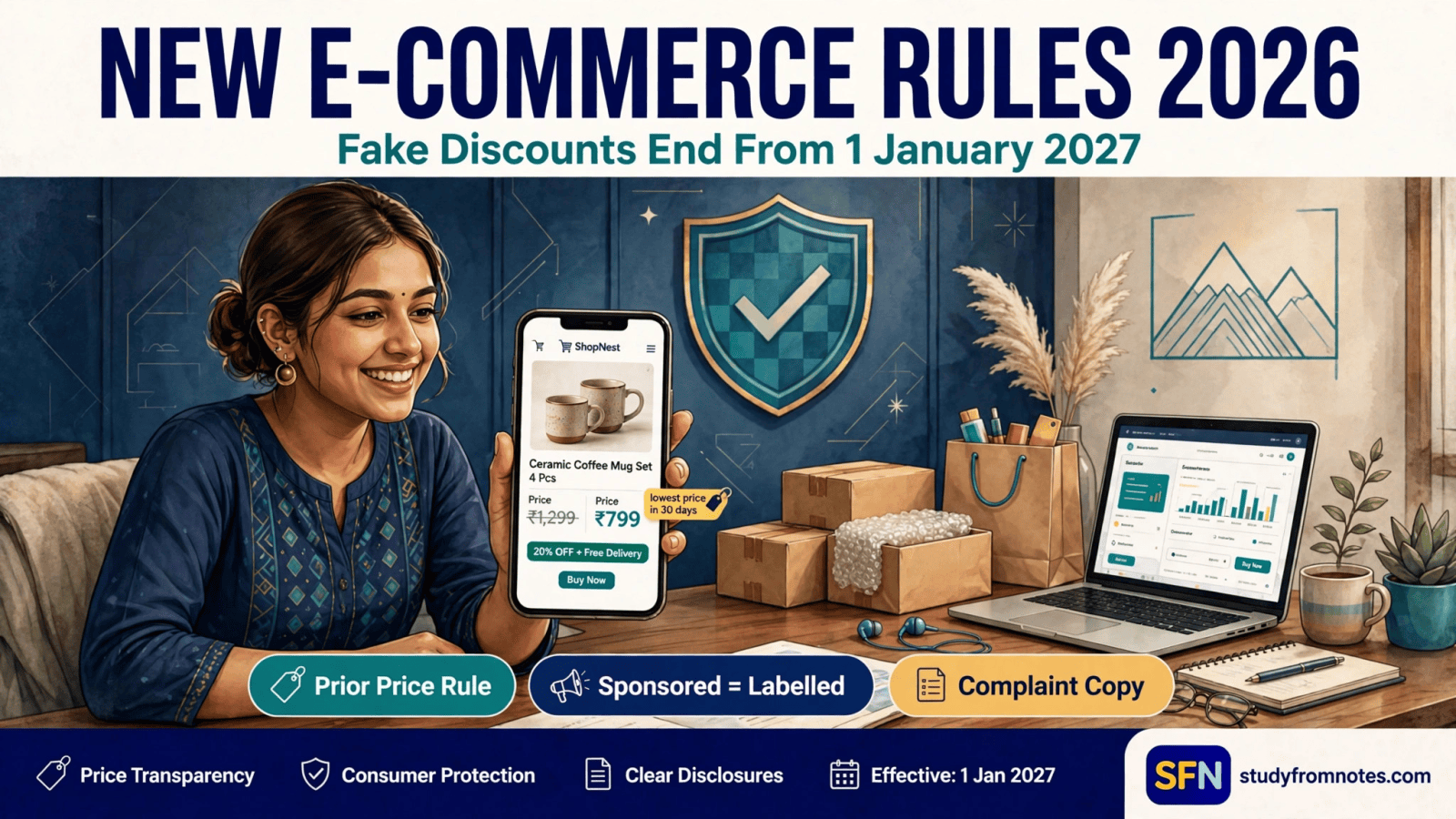
Every online shopper in India knows the trick. A jacket sold for Rs 999 all month. A day before the sale, it suddenly shows a price of Rs 1,999. The next morning it is back at Rs 999, with a bright banner calling it 50 percent off. From 1 January 2027, under the new e-commerce rules 2026, that trick becomes much harder to pull.
The Department of Consumer Affairs has notified the Consumer Protection (E-Commerce) (Amendment) Rules, 2026. The Gazette notification is G.S.R. 789(E) dated 9 September 2026. It updates the Consumer Protection (E-Commerce) Rules, 2020 and takes effect on 1 January 2027. It changes how prices, discounts, search results, advertisements and complaints must work on every e-commerce platform selling in India.
The scale of the problem explains the move. During 2025, the National Consumer Helpline received 17,71,622 grievances. Of these, 5,11,196, about 29 percent, were about e-commerce. Nearly one in three consumer complaints in the country now starts with an online order. Here is what the new rules change for you as a shopper.
The Prior Price Rule Ends the Fake Discount Game
This is the headline change. The new Rule 4(13) applies whenever a platform or a seller announces a price reduction. It must then display the reduced price and the prior price. The rule itself defines the prior price. It is the lowest price the product or service carried during the 30 days before the announcement.
Run the jacket example through this rule. Suppose the jacket sold at Rs 999 at any point in the 30 days before the sale. Then the prior price is Rs 999, and it must appear next to the sale price. A banner claiming the price fell from Rs 1,999 to Rs 999 cannot survive that disclosure. The honest reference price appears right beside it. Shoppers no longer need third party price tracker tools to catch a manufactured discount. The platform has to show its own price history.
One honest limit is worth knowing. The rule requires the platform to display the prior price alongside the reduced price. It does not, in so many words, say sellers must calculate the discount percentage from the prior price. Even so, every shopper and every regulator will see a percentage that clashes with the two prices printed next to it. That is most of the point.
New E-Commerce Rules 2026: Sponsored Listings Must Say They Are Sponsored
Search on any large marketplace today. The first few results are often paid placements or the platform’s own brands, with no clear sign of why they are on top. Two provisions attack this.
First, the new Rule 4(12) requires clear and prominent disclosures that distinctly identify sponsored listings of products and services. If a seller paid for that top slot, the listing must say so in a way you can actually see.
Second, the new Rule 4(11)(c) bars platforms from misleading users. They must not manipulate search results or search indexes against the user’s query. Alongside this, marketplaces must publish an explanation of the main parameters that decide ranking. They must write it in plain and intelligible language. A marketplace also cannot use consumer information to push goods sold under its own house brands. It cannot promote a seller as associated with the platform either. It needs the express and affirmative consent of the consumers involved.
In plain words: from January, the top of your search results should be there because it matches your search. Anything that paid to be there must carry a visible label.
Your Complaint Now Comes With a Copy and a Deadline
Under the amended Rule 4(5), the platform’s grievance officer must acknowledge your complaint within 48 hours. The officer must redress it within one month. Shoppers will feel one change most: a new right in the same rule. The platform must give you a copy of your complaint as the grievance officer recorded it.
That copy matters more than it sounds. Today, a complaint often disappears into a chat window or a ticket number. When a dispute reaches a consumer commission, the shopper has no clean record of what the shopper reported, or when. From January, you hold the platform’s own record of your complaint. It is exactly the document a consumer forum will ask for.
Every e-commerce entity must also join the convergence process of the National Consumer Helpline. Complaints from the helpline and complaints from the platform will then move through one connected system, instead of two separate black holes.
No More Forced Bundled Fees at Checkout
The amended Rule 5(7) says a marketplace cannot collect bundled fees from users. This covers services that are unrelated to the e-commerce platform. The familiar pattern is a checkout total that quietly grows with add-on charges you never chose. From January, fees bundled in for unrelated services are off the table. One exception remains: genuine loyalty or membership programmes, and the benefits that come with them, can continue.
Read your checkout screen once before paying. From January you will have the rule book on your side when an unrelated fee shows up on it.
The Seller’s Real Name, on Your Invoice, in Full Size
Two disclosures close the old problem of the anonymous seller. The new Rule 4(14) requires every invoice to carry the seller’s name clearly and prominently. It must use the same font size as the e-commerce entity’s own name. No more invoices where the platform’s brand fills the page and the actual seller is a code in small print.
Before you buy, marketplaces must also show key seller details. You will see the seller’s business name, its geographic address, and its customer care number. Ratings or aggregated feedback appear too, along with whether the seller holds a registration. If a dispute still arises after purchase, you can ask the marketplace in writing for the seller’s full details. These include its head office address and email. The marketplace must provide them for effective dispute resolution. Sellers, in turn, must give marketplaces their government identification numbers, including GSTIN or MSME registration. This ties the names on your invoice to real registrations.
New E-Commerce Rules 2026: Dark Patterns Get an Audit, and Imported Goods Get a Name Tag
The amendment makes the Guidelines for Prevention and Regulation of Dark Patterns, 2023 a hard obligation inside the e-commerce rules. Every e-commerce entity must comply with those guidelines and run a yearly self-audit. That audit checks whether its platform is free of dark patterns. The entity must also display the compliance certificate prominently. False urgency, basket sneaking, confirm shaming, subscription traps and drip pricing are the named targets of those guidelines. From January, an audit and a certificate must stand behind the promise.
For imported goods, platforms must now name the importer and state the full country of origin. A product page that hides where an item came from will no longer meet the rules. The same applies if it hides who brought the item into India.
What You Should Do Differently From 1 January 2027
- Check the prior price printed next to any sale price before you believe a discount percentage.
- Look for the sponsored label on the first few search results, and treat unlabelled top results with suspicion.
- Save the copy of every complaint the platform gives you; it is your best evidence if the dispute travels further.
- Read the final checkout screen for bundled fees that are not part of your order.
- Read the seller’s name on your invoice; it is the business you actually bought from.
The rules bind platforms and sellers, not shoppers. You need to do nothing for any of this to work. The duties sit on the other side of the screen. If you sell online, or your business supplies a marketplace, compliance with the new e-commerce rules 2026 is heavier. Price history systems, invoice formats, grievance timelines and a dark pattern audit all have to be ready before the deadline. CA Anshul Karwa of Karwa & Associates has published a detailed seller compliance guide to the E-Commerce Amendment Rules 2026. It offers a rule-by-rule checklist of what online sellers must change before 1 January 2027.
Frequently Asked Questions About the New E-Commerce Rules 2026
When do the new e-commerce rules start?
The Department of Consumer Affairs notified the Consumer Protection (E-Commerce) (Amendment) Rules, 2026 on 9 September 2026 through G.S.R. 789(E). They come into force on 1 January 2027. Sales and listings before that date follow the earlier 2020 rules.
What is the prior price in the new rules?
It is the lowest price the product or service carried during the 30 days before a platform announces a price reduction. When a platform announces a reduced price, it must display the prior price along with it.
Do the new rules ban discounts?
No. Genuine discounts remain fully legal. What changes is the disclosure. The honest 30-day reference price must appear next to the reduced price. If a seller inflates the price just before a sale to create a discount, the trick becomes visible at once.
What can I do if a platform still shows a fake discount after 1 January 2027?
Complain to the platform’s grievance officer first and keep the copy of the complaint the platform must give you. You can also file on the National Consumer Helpline. You can also report misleading pricing to the Central Consumer Protection Authority. It counts as an unfair trade practice under the Consumer Protection Act, 2019.
Do these rules apply to foreign shopping sites selling in India?
The Consumer Protection (E-Commerce) Rules apply to e-commerce entities selling goods or services to consumers in India. They also cover foreign entities that systematically offer goods or services to Indian consumers. Imported goods sold on any platform must carry the importer’s details and the country of origin.

A Maheshwari is a Chartered Accountant writing on CA exams, tax, and finance careers in India.


Leave a Reply