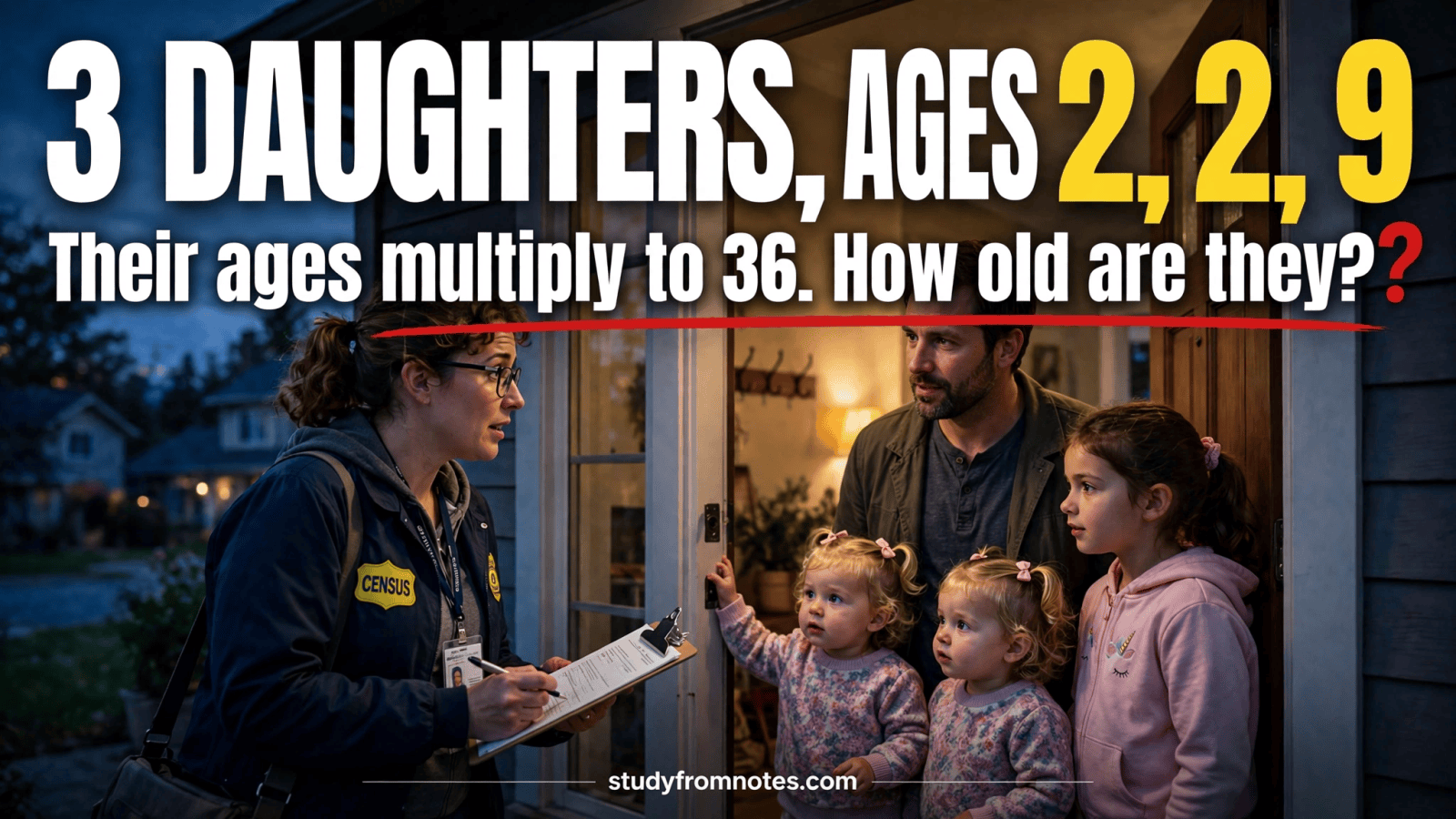
The daughters are 2, 2 and 9 years old. That is the answer to the three daughters ages puzzle. Their ages multiply to 36, they add up to 13, and the 9-year-old is the oldest. In short, the rest of this post shows how each clue narrows the answer down to exactly one set of ages.
The three daughters ages puzzle is a classic logic question from interview collections. It looks impossible at first, because the census taker gets the sum and still cannot solve it. In fact, that stuck moment is the key to the whole puzzle. Here is the question, then the step-by-step answer.
The Question
A census taker knocks on the door of a house. He asks the man who answers how old his three daughters are. The man replies with three clues:
- “The product of their ages is 36.”
- “The sum of their ages is the number on my house.”
- “My oldest daughter has just started to play the piano.”
The census taker looks at the house number, thinks for a moment, and says, “I still cannot work it out.” Then he hears the third clue and answers at once: the daughters are 2, 2 and 9.
How does he know? The answer comes from three short steps, and each step uses one clue.
How to Solve the Three Daughters Ages Puzzle
Step 1: List every set of three ages that multiplies to 36.
Start with the first clue. The ages are whole numbers, so list every triple of positive whole numbers whose product is 36. There are eight of them:
| Ages | Product | Sum |
|---|---|---|
| 1, 1, 36 | 36 | 38 |
| 1, 2, 18 | 36 | 21 |
| 1, 3, 12 | 36 | 16 |
| 1, 4, 9 | 36 | 14 |
| 1, 6, 6 | 36 | 13 |
| 2, 2, 9 | 36 | 13 |
| 2, 3, 6 | 36 | 11 |
| 3, 3, 4 | 36 | 10 |
At this point, eight answers are still possible. So the product clue alone is not enough. Next, the sum clue must cut the list down.
Step 2: Use the sum clue, and notice what “I still cannot work it out” tells you.
The census taker can see the house number. So he knows the sum. Yet he says he still cannot work out the ages. What does that tell you? It tells you the sum must match more than one triple in the table. If the house number were 38, for example, only 1, 1, 36 would fit, and he would have answered at once.
Now look at the sums in the table: 38, 21, 16, 14, 13, 13, 11, 10. Only one sum appears twice. The sum 13 matches two triples: 1, 6, 6 and 2, 2, 9. Every other sum matches exactly one triple.
So the house number must be 13. That is the only number that leaves the census taker stuck. Two candidates are left: 1, 6, 6 or 2, 2, 9.
The Oldest Daughter Clue in the Three Daughters Ages Puzzle
Step 3: Use the oldest-daughter clue.
The man says his oldest daughter has just started to play the piano. That means there is one oldest daughter. In the triple 1, 6, 6, the two oldest daughters are both 6, so there is no single oldest child. That rules it out.
In the triple 2, 2, 9, the oldest daughter is 9, and she is clearly older than her two sisters. So the answer is 2, 2 and 9.
Why the Sum Clue Matters in the Three Daughters Ages Puzzle
Most candidates handle the first step well. They list the triples and reach the table above. Then many of them stop, because they think the puzzle is missing the house number. In fact, the missing number is the point.
The puzzle never tells you the house number, and it never needs to. The census taker says he is stuck, and that statement is itself a clue. It tells you the sum is ambiguous. Then a quick scan of the table shows only one ambiguous sum, 13. So you learn the house number without ever seeing it.
This is the move interviewers want to see. Strong candidates treat every sentence as data, including the sentence where the census taker admits he cannot solve it. Weak candidates wait for a number that never comes.
There is one more detail worth noting. The puzzle assumes that two daughters with the same age are twins, so a triple with two equal oldest ages has no single oldest child. In real life, two sisters can share an age without being twins, since one can be born in January and the next in December of the same year. Interviewers accept the puzzle version, and you should too. If a follow-up asks about it, say the puzzle treats equal top ages as twins, then move on.
What the Interviewer Is Testing in the Three Daughters Ages Puzzle
This puzzle tests three skills at once, and the interviewer watches how you use each one.
First, it tests systematic listing. You must find all eight triples without missing one. Miss 1, 6, 6 or 2, 2, 9, and the whole answer falls apart. Interviewers like this because it shows whether you work cleanly under pressure.
Second, it tests whether you use negative information. The census taker failing to solve the puzzle is a fact, not a dead end. Candidates who spot that the sum must be 13 show they can reason about what someone else knows. That skill matters in real work, where you often have to infer facts from what a client or a colleague does not say.
Third, it tests whether you finish the job. After the sum clue, two answers remain. The piano clue picks one. Candidates who stop at “13” and name both triples have done most of the work, but they have not answered the question. Say the ages out loud, then show the check: 2 times 2 times 9 is 36, and 2 plus 2 plus 9 is 13.
Try the 72 Version Next
There is a famous version of this puzzle with a product of 72 instead of 36. Two old classmates meet, one says the product of his three daughters’ ages is 72, the sum is the number on a nearby building, and his oldest daughter has just started to play the piano. The same three steps solve it.
List the triples that multiply to 72, and you get twelve of them. Their sums are 74, 39, 28, 23, 19, 18, 22, 17, 15, 14, 14 and 13. Again, only one sum appears twice: 14, shared by 2, 6, 6 and 3, 3, 8. The piano clue rules out 2, 6, 6, since it has two oldest daughters. So the answer is 3, 3 and 8.
If your interviewer likes this puzzle, they may ask the 72 version as a follow-up. The method never changes: list, find the repeated sum, then use the oldest clue. Learn the method, not the answer.
Frequently Asked Questions
Is the answer to the three daughters ages puzzle always 2, 2 and 9?
Yes, for the product-36 version. The eight triples, the repeated sum of 13, and the oldest-daughter clue leave only one answer. If the product changes, the answer changes too. With a product of 72, the answer is 3, 3 and 8.
Why does the census taker need the house number at all?
He needs it to narrow the list from eight triples to two. Without the sum, he has eight options. With the sum of 13, he has two. Then the piano clue finishes the job. The puzzle hides the number from you, but you recover it from the fact that he gets stuck.
What if the oldest daughters are twins?
Then the piano clue would not help, and the puzzle would have no single answer. That is why the puzzle states that the oldest daughter has just started to play the piano. It tells you there is one oldest child, which rules out the 1, 6, 6 triple.
Where is this puzzle asked?
It appears in logic and brain teaser collections used for tech, consulting and finance interviews, such as the Daughters’ Ages question on techinterview.org. It is a thinking test, not a maths test. The arithmetic is easy, and the hard part is spotting that the census taker being stuck is a clue.
Try This One Next
If you liked the three daughters ages puzzle, try Cheryl’s Birthday Puzzle: Answer July 16 [Solved]. It uses the same trick: one person says “I don’t know,” and that statement is the clue that cracks the puzzle. It is a harder version of the same skill, and it is asked in the same interviews.

Lauren Brooks is a finance professional writing on professional exams, study strategies, and finance careers.



Leave a Reply