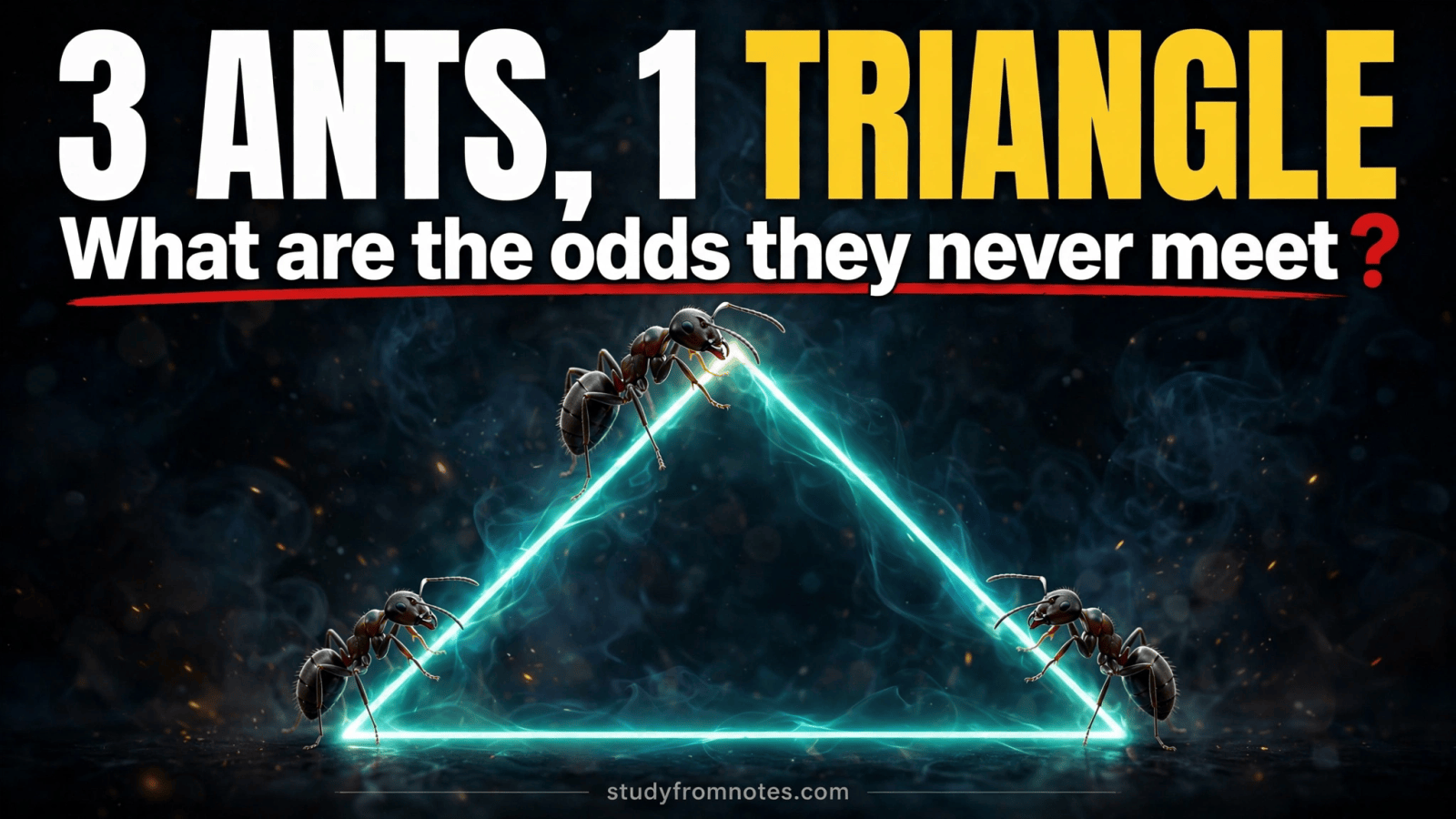
The ants triangle puzzle answer is 1 in 4. Three ants start at the three corners of a triangle, and each ant picks a direction at random. Only 2 of the 8 possible direction combos avoid a collision, so the chance that no ants meet is 2 out of 8, which is 1 in 4, or 25 percent.
This question has been reported in an Oracle interview report on Glassdoor, where it was asked as the chance that any two ants meet. That version has the complementary answer, 3 in 4, since a meeting happens in every combo except the 2 clean ones. The solution below is original, and it walks through every combo so you can defend the answer out loud.
The Question, Stated Cleanly
Picture an equilateral triangle with one ant at each corner. Call the corners A, B, and C, in clockwise order around the triangle. At the same moment, every ant sets off along an edge toward a neighboring corner. Each ant picks its direction at random, clockwise or counterclockwise, and each ant walks at the same speed.
Two rules keep the puzzle fair. First, an ant never turns around and never waits. Second, a collision counts whenever two ants meet, whether they meet head on in the middle of an edge or arrive at the same corner at the same time. Under those rules, what is the chance that no ants collide?
Ants Triangle Puzzle Answer: All 8 Direction Combos
Each ant has 2 choices, so the full count is 2 times 2 times 2, which is 8 direction combos. Label clockwise as CW and counterclockwise as CCW. Clockwise means A goes to B, B goes to C, and C goes to A. Counterclockwise means A goes to C, C goes to B, and B goes to A.
| Ant A | Ant B | Ant C | Result |
|---|---|---|---|
| CW | CW | CW | No collision: all three circle the same way |
| CW | CW | CCW | Collision on edge B to C |
| CW | CCW | CW | Collision on edge A to B |
| CW | CCW | CCW | Collision on edge A to B |
| CCW | CW | CW | Collision on edge C to A |
| CCW | CW | CCW | Collision on edge B to C |
| CCW | CCW | CW | Collision on edge C to A |
| CCW | CCW | CCW | No collision: all three circle the same way |
Read the table from top to bottom. In the first row, every ant moves clockwise, so each ant chases the next one around the triangle and nobody ever meets. In the last row, every ant moves counterclockwise, and the same thing happens in reverse. In each of the other 6 rows, at least one edge is walked in both directions at once, so two ants walk straight toward each other and meet.
Why the Ants Triangle Puzzle Answer Is 1 in 4
The counting argument is short. There are 8 combos in total, and only 2 of them are clean. Therefore the chance of no collision is 2 divided by 8, which simplifies to 1 in 4. The chance of at least one collision is the rest, 6 divided by 8, which is 3 in 4.
There is also a faster shortcut, and it is the one interviewers love to hear. Fix ant A and ignore its choice, since the triangle looks the same either way. For the run to stay clean, ant B must pick the same direction as ant A, and ant C must do the same. Each of those is a 1 in 2 chance, and the two choices are independent. So the chance is 1 in 2 times 1 in 2, which is 1 in 4. In short, the whole puzzle reduces to two coin flips that must both match.
Finally, here is why a mixed combo can never stay clean. Walk around the triangle and watch the directions change. In a mixed combo, the direction must switch somewhere, from clockwise to counterclockwise or back again. At that switch, the two ants on either side of the switch walk toward each other on the same edge. So a mixed combo always contains a head on meeting, and only the two uniform combos survive.
The Traps That Catch Good Candidates
First, do not flip the question. The chance of a collision is 3 in 4, and the chance of no collision is 1 in 4. Candidates who count the 6 messy combos and stop often hand over 3 in 4 as the answer to the wrong question. So state which event you counted before you give the number.
Second, do not count only one clean combo. Some candidates spot the all clockwise case and forget the all counterclockwise case, which gives 1 in 8. Symmetry is the fix here. If one uniform direction works, the mirror image must work too.
Third, do not change the rules mid solution. If ants could turn, wait, or walk at different speeds, the count would change completely. The puzzle fixes equal speed and a single direction choice per ant. So name those assumptions at the start, and the interviewer will see that you read the question with care.
Follow-Ups: The n-Gon Rule
Interviewers often extend this puzzle to more sides, and the same logic scales at once. For a square with 4 ants, there are 2 to the power of 4, or 16 combos, and still only 2 clean ones. So the chance of no collision is 2 divided by 16, which is 1 in 8. For a pentagon with 5 ants, it is 2 divided by 32, which is 1 in 16.
In general, for n ants on an n sided polygon, the chance of no collision is 2 divided by 2 to the power of n, which simplifies to 1 divided by 2 to the power of n minus 1. For a 10 sided polygon, that is 1 in 512. The pattern shows why the triangle case feels generous. As the polygon grows, the chance that every ant happens to pick the same direction falls fast.
Two smaller follow-ups are worth having ready. For example, with 2 ants on a triangle, there are 4 combos and 2 clean ones, so the chance of no collision is 1 in 2. Similarly, if the Oracle version asks for the chance that any two ants meet, the answer is 3 in 4, which is simply 1 minus 1 in 4.
What the Interviewer Is Testing in the Ants Triangle Puzzle Answer
This puzzle tests four things, and none of them is raw speed. First, it tests whether you enumerate a small sample space instead of guessing from gut feel. Second, it checks whether you spot symmetry, since the fix one ant shortcut turns 8 cases into 2 coin flips. Third, it looks at whether you state your assumptions, equal speed, one choice each, and no turning. Finally, it tests how you communicate, since a candidate who says the answer, shows the count, and then gives the shortcut sounds ready, while a candidate who only recites 1 in 4 sounds rehearsed.
Try It Yourself Before the Interview
To prepare, draw a triangle and label the corners A, B, and C. Write out the 8 combos from the table above without looking, and mark the collision edge in each messy row. Then say the fix one ant shortcut out loud in under a minute. If you can do that, you can also answer the square and pentagon follow-ups on the spot, since the same formula covers them.
Ants Triangle Puzzle: Quick FAQs
Does the triangle need to be equilateral?
No. The result depends only on the direction choices, not on the side lengths. Equal speed still matters, since it decides whether two ants reach a shared corner together, but the edge lengths do not change the count of clean combos.
What if the ants move at different speeds?
Then the puzzle changes, and 1 in 4 no longer follows. A faster ant could catch a slower ant from behind even in a uniform direction, so the two clean combos would no longer be safe. That is why the equal speed assumption belongs in your answer.
What if an ant is allowed to stay put?
Then each ant has 3 choices, not 2, so the total becomes 27 combos, and the clean count changes too. Interviewers rarely ask this version, but it is a good check that you noticed the original puzzle gives each ant exactly 2 choices.
One More Puzzle to Try
If you liked the counting logic here, try the 100 Doors Puzzle Answer: 10 Open Doors, where a small case plus a pairing argument does the heavy lifting. Alternatively, test your step by step reasoning with the Water Jug Puzzle Answer: Measure 4 Litres, which rewards the same kind of structural insight.
The question for this post was reported in an Oracle interview report on Glassdoor. The solution and all text above are original.

Lauren Brooks is a finance professional writing on professional exams, study strategies, and finance careers.


Leave a Reply