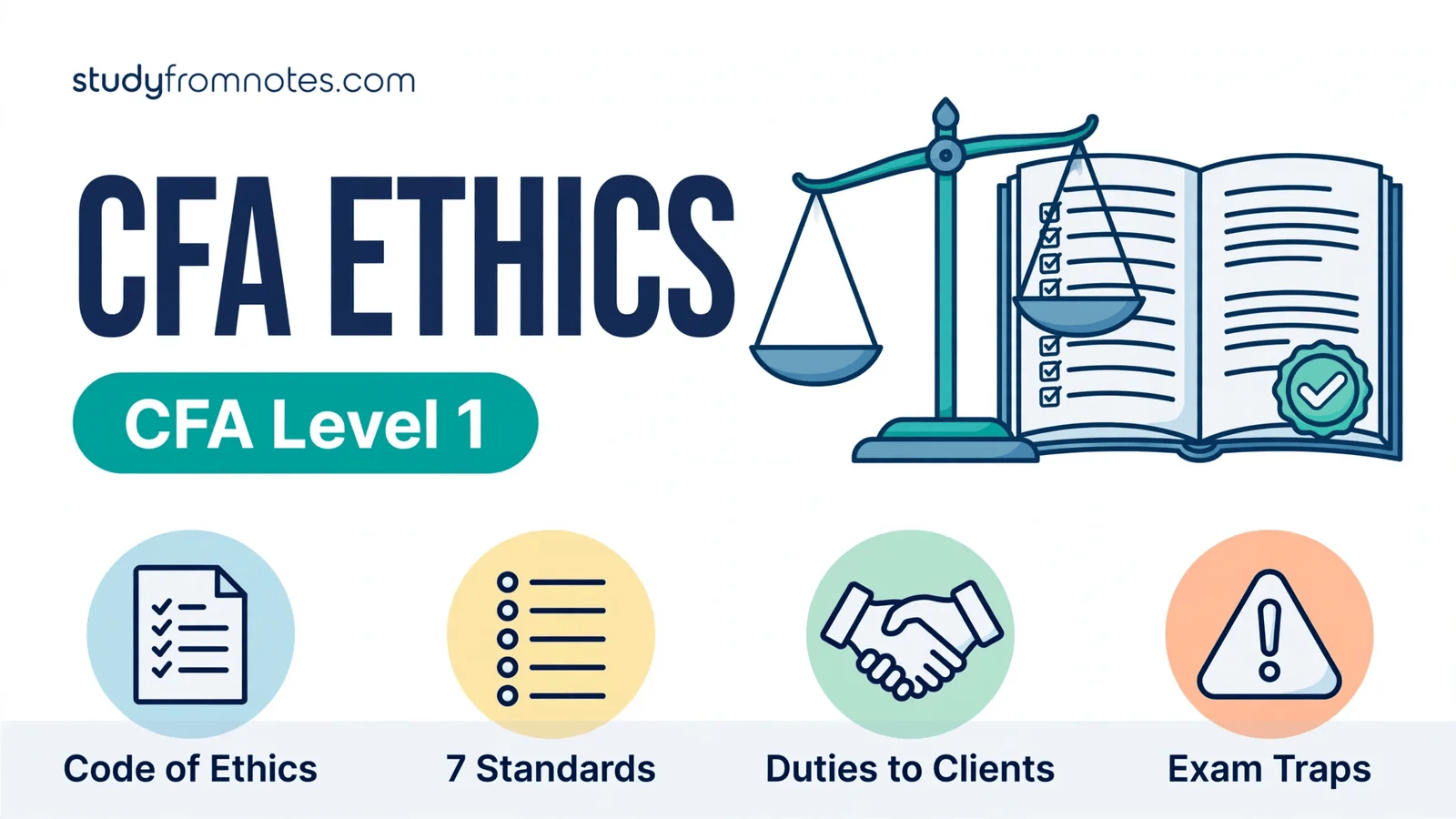
Ethics carries roughly 15 to 20 percent of the CFA Level 1 exam and is the most score-friendly topic on it: no formulas, just careful reading and sound judgment. These CFA ethics Level 1 notes cover the Code of Ethics and all seven Standards of Professional Conduct. Each standard gets a plain-English explanation plus an exam-style scenario showing the right call and the wrong call, because that is exactly what the exam tests. Finish with the traps and the one-page revision box before exam day.
CFA ethics Level 1: the six principles of the Code of Ethics
The Code of Ethics states the broad principles of professional behavior. The Standards of Professional Conduct turn those principles into enforceable rules. You must follow both, and where the law and the Code conflict, you follow whichever is stricter.
The six components, in plain language:
- Act with integrity, competence, diligence, and respect toward everyone in the markets: the public, clients, prospective clients, employers, employees, colleagues, and other participants.
- Place the integrity of the profession and clients’ interests above your own personal interests.
- Use reasonable care and independent professional judgment in analysis, recommendations, actions, and other professional work.
- Practice ethically and encourage others to do the same, in a way that reflects credit on you and the profession.
- Promote the integrity and health of global capital markets for the ultimate benefit of society.
- Keep improving your own professional competence, and help other investment professionals improve theirs.
CFA ethics Level 1: Standard I (Professionalism)
Standard I covers how you conduct yourself as a professional. It has four parts.
I(A) Knowledge of the Law
Know and comply with all applicable laws, rules, and regulations, including the Code and Standards. If the law and the Code conflict, follow the stricter one. Never knowingly take part in or assist a violation, and dissociate yourself from any violation you become aware of.
Scenario: Priya, a junior analyst in Mumbai, finds her firm backdating client trade confirmations to hide late execution. Her manager tells her to stay quiet.
- Right call: Priya refuses to take part, dissociates from the conduct, and raises it through compliance. The Code outranks her manager.
- Wrong call: She processes the confirmations anyway. Participation is itself a violation.
I(B) Independence and Objectivity
Use reasonable care to stay independent and objective. Do not offer, ask for, or accept any gift, benefit, or compensation that could reasonably be expected to compromise your independence or objectivity, or anyone else’s. Modest, token gifts are generally acceptable when disclosed; the test is whether the gift could reasonably compromise objectivity.
Scenario: A sell-side broker invites Arjun, a buy-side analyst, to an all-expenses-paid beach resort weekend, then asks him to “take another look” at the broker’s stock.
- Right call: Arjun declines. A lavish trip can reasonably be expected to compromise objectivity.
- Wrong call: He accepts, then raises his rating on the broker’s stock.
I(C) Misrepresentation
Do not misrepresent facts, services, credentials, or past performance: no guaranteed returns, no exaggerated credentials, and no plagiarism, which means presenting someone else’s research as your own, even inside your own firm.
I(D) Misconduct
Do not engage in conduct involving fraud, dishonesty, or deceit, or any act that reflects badly on your professional reputation, integrity, or competence. Exam trap: a speeding ticket is generally not misconduct. Falsifying an expense report is.
CFA ethics Level 1: Standard II (Integrity of Capital Markets)
II(A) Material Nonpublic Information
If you possess material nonpublic information that could affect a security’s value, you must not act on it and must not cause others to act on it.
Scenario: On a flight, Rahul overhears two executives discussing an unannounced takeover bid for a listed company.
- Right call: He does nothing with the information. If he received it selectively from the company, he should encourage public disclosure.
- Wrong call: He buys the shares, or tips his cousin to buy. Both acting and tipping violate II(A).
Two fine points the exam loves: information is material if a reasonable investor would want to know it before trading. And mosaic theory is permitted: you may combine public information with nonmaterial nonpublic information to reach a conclusion. Only trading on material nonpublic information is banned.
II(B) Market Manipulation
Do not engage in practices that distort prices or artificially inflate trading volume to mislead other market participants. Wash trades, painting the tape, and spreading false rumors to move a price all fail here.
CFA ethics Level 1: Standard III (Duties to Clients)
Standard III has five parts, because clients sit at the center of the Code: their interests come before your employer’s and your own.
III(A) Loyalty, Prudence, and Care
Act for your clients’ benefit with the care, skill, and diligence of a prudent professional. Follow the client’s stated mandate and investment policy statement, and vote proxies in the client’s best interest.
III(B) Fair Dealing
Deal fairly and objectively with all clients when you make recommendations, take actions, or share material. Exam trap: fair does not mean equal. Different service levels are fine if disclosed and available to all; early calls to favorite clients are not.
Scenario: Meera upgrades a stock to Buy. She calls her five largest clients first, then emails the rest an hour later.
- Right call: Release the change to all clients at the same time, or as close to simultaneously as practical.
- Wrong call: Favored clients get the head start. That is unfair dealing even though everyone eventually hears the news.
III(C) Suitability
Know your client. Before recommending or taking action, understand the client’s objectives, constraints, and risk tolerance, usually through a written investment policy statement. Then recommend only what suits the client. Suitability is judged against the portfolio as a whole, not necessarily against each holding in isolation.
Scenario: A 68-year-old retiree with a conservative written mandate holds a portfolio Meera manages. Meera adds a leveraged options strategy because “the upside is huge.”
- Right call: She skips the trade. It does not suit the client’s mandate, whatever its expected return.
- Wrong call: She adds it, arguing the overall portfolio can absorb the risk.
III(D) Performance Presentation
Present performance fairly, accurately, and completely. Do not cherry-pick winning accounts, misstate results, or hide whether returns are gross or net of fees. Disclose the sources, models, and assumptions behind your numbers.
III(E) Preservation of Confidentiality
Keep client information confidential. You may not reveal it to help another client, your employer, or anyone else. The two exceptions: disclosure concerns illegal activity, or the law requires disclosure.
CFA ethics Level 1: Standard IV (Duties to Employers)
IV(A) Loyalty
In employment matters, act for your employer’s benefit. Do not deprive your employer of the advantage of your skills, divulge confidential employer information, or harm your employer.
Scenario: Before resigning to start a competing firm, Sameer downloads the firm’s client database and solicits those clients while still employed.
- Right call: He may prepare to compete on his own time, but must not take client records or solicit clients until he has left.
- Wrong call: He takes the list and starts calling.
IV(B) Additional Compensation Arrangements
Do not accept gifts, benefits, or pay that compete with your employer’s interests unless you disclose them in writing and get written consent from everyone involved. A client offering you a personal bonus for side advice needs your employer’s written sign-off first.
IV(C) Responsibilities of Supervisors
Supervisors must make reasonable efforts to detect and prevent violations by anyone under their supervision or authority. Delegating the work does not delegate the responsibility: if your junior is cherry-picking trades, “I didn’t know” is no defense when you never checked.
CFA ethics Level 1: Standard V (Investment Analysis and Recommendations)
V(A) Diligence and Reasonable Basis
Base every recommendation on diligent, independent, thorough research. You must have a reasonable and adequate basis, supported by appropriate investigation, and you should understand the limitations of your own methods.
Scenario: Karan hears a rumor on a trading forum that a small-cap stock is about to double, and he blasts a Buy recommendation to clients within the hour.
- Right call: He researches first: financials, management, valuation, risks. Only then does he write the recommendation.
- Wrong call: He publishes on the rumor. A forum tip is not a reasonable basis.
V(B) Communication with Clients and Prospective Clients
Disclose the basic format and principles of your process, including its limitations and risks, and promptly disclose any changes that could materially affect recommendations. Separate fact from opinion so clients know which is which.
V(C) Record Retention
Develop and maintain records that support your analyses, recommendations, actions, and client communications, and keep them for as long as the law requires. Where the law is silent, CFA Institute’s recommended procedures suggest seven years: guidance, not the letter of the Standard.
CFA ethics Level 1: Standard VI (Conflicts of Interest)
VI(A) Disclosure of Conflicts
Make full and fair disclosure, in plain language, of anything that could reasonably impair your independence or objectivity or interfere with your duties. Disclose to clients, prospects, and your employer, and do it promptly: disclosure buried in fine print after the trade does not count.
Scenario: Divya covers a company whose CEO is her brother, and publishes a glowing report without mentioning the relationship.
- Right call: She discloses the relationship prominently with the recommendation, and her employer reassigns coverage if needed.
- Wrong call: She stays silent.
VI(B) Priority of Transactions
Client and employer transactions come first. Your personal transactions must never disadvantage them: no trading your own account ahead of client orders, no front-running a client block.
VI(C) Referral Fees
Disclose any compensation or benefit you receive from, or pay to, others for recommending products or services. If a broker pays you for every client you refer, your employer and your clients must both know.
CFA ethics Level 1: Standard VII (Responsibilities as a Member or Candidate)
VII(A) Conduct as Participants in CFA Institute Programs
Do not do anything that damages the reputation or integrity of CFA Institute or the CFA designation, or the integrity, validity, or security of CFA Institute programs. Sharing actual exam questions, cheating, or helping someone else cheat all fail here.
Scenario: After the exam, Tanvi posts several real exam questions in an online forum “to help next year’s candidates.”
- Right call: She discusses only general topics and her study approach, never specific questions.
- Wrong call: She posts the questions.
VII(B) Reference to CFA Institute, the CFA Designation, and the CFA Program
Refer to these accurately. Do not misrepresent what the designation means, exaggerate your competence, or promise superior performance because you hold the charter. “I passed all three levels in 2025” is fine; claiming the designation guarantees better returns violates VII(B).
CFA ethics Level 1: GIPS at a glance
GIPS stands for the Global Investment Performance Standards, created and administered by CFA Institute: voluntary standards promoting fair representation and full disclosure of investment performance, so firms can be compared like for like. Three points carry the marks:
- GIPS compliance is voluntary and claimed at the firm level, never for a single product or composite.
- A firm that claims compliance must meet all GIPS requirements. There is no partial compliance: “in compliance with GIPS except for…” is itself a violation.
- Independent third-party verification of a GIPS claim is encouraged but optional.
CFA ethics Level 1: traps that fail candidates
Read this list twice. These are the distinctions the exam uses to separate passes from fails.
- Stricter rule wins. Where the law and the Code or Standards conflict, follow the stricter one.
- Material nonpublic information bans action, not thought. You may hold the information; you may not trade on it or tip others. Mosaic theory stays legal.
- Fair is not equal. Different service tiers are fine if disclosed and available to all. Early calls to favorite clients are not.
- Suitability is portfolio-level. Judge the recommendation against the client’s objectives and constraints as a whole.
- Confidentiality has exactly two exits: suspected illegal activity, or a legal duty to disclose.
- Clients outrank employers, employers outrank you. When interests collide, that is the order.
- Disclosure must be prominent and timely. Fine print after the trade is not disclosure.
- Supervisors cannot outsource responsibility. Reasonable procedures to detect and prevent violations are your duty under IV(C).
- Personal trades go last. Client and employer orders first, always. No front-running.
- Plagiarism is misrepresentation. Copying another analyst’s model without attribution violates I(C), even inside your own firm.
CFA ethics Level 1: one-page revision (all seven standards in 60 seconds)
| Standard | Name | One-line memory hook |
|---|---|---|
| I | Professionalism | Know the law, stay independent, never misrepresent, no misconduct |
| II | Integrity of Capital Markets | No trading on material nonpublic info, no market manipulation |
| III | Duties to Clients | Clients first: loyalty, fair dealing, suitability, honest performance, confidentiality |
| IV | Duties to Employers | Loyalty to employer, disclose extra pay, supervisors must prevent violations |
| V | Investment Analysis, Recommendations, and Actions | Reasonable basis, communicate clearly, keep records |
| VI | Conflicts of Interest | Disclose conflicts, client trades first, disclose referral fees |
| VII | Responsibilities as a Member or Candidate | Protect exam integrity, never exaggerate the designation |
Plus: six Code principles (integrity, clients first, independent judgment, ethical practice, healthy markets, growing competence). GIPS: voluntary, firm-wide, all-or-nothing.
CFA ethics Level 1: quick FAQ
How much weight does CFA ethics Level 1 carry in the exam?
Ethical and Professional Standards typically account for 15 to 20 percent of the Level 1 exam, making it one of the highest-weight areas. Since questions test judgment rather than calculation, it is one of the most efficient places to earn marks.
Do I need to memorize the Code of Ethics word for word?
No. Understand the six components in plain language and recognize conduct that breaches them. Spend memorization effort on the seven Standards and sub-sections: vignettes are written around them.
What is mosaic theory, and is it allowed?
Mosaic theory means reaching an investment conclusion by combining public information with nonmaterial nonpublic information. It is permitted under Standard II(A). The ban applies only to acting on material nonpublic information.
Can a firm claim partial compliance with GIPS?
No. A firm claiming GIPS compliance must satisfy every applicable requirement, and the claim applies to the firm as a whole, not to individual products. Independent verification is optional but recommended.
Where can I read the official Code and Standards?
CFA Institute publishes the full Code of Ethics and Standards of Professional Conduct with application guidance on its website. For more notes in this series, browse our Study Notes archive.
CFA ethics Level 1: the bottom line
CFA ethics Level 1 rewards the candidate who reads carefully and thinks like a fiduciary. Learn the seven Standards until you can place any vignette in the right one, drill the traps, and keep the one-page table handy in your final week. That makes this topic the closest thing the exam offers to free marks. Share these notes with a friend preparing for CFA Level 1 on WhatsApp or Telegram.
Source for the official text: CFA Institute Code of Ethics and Standards of Professional Conduct.


Leave a Reply