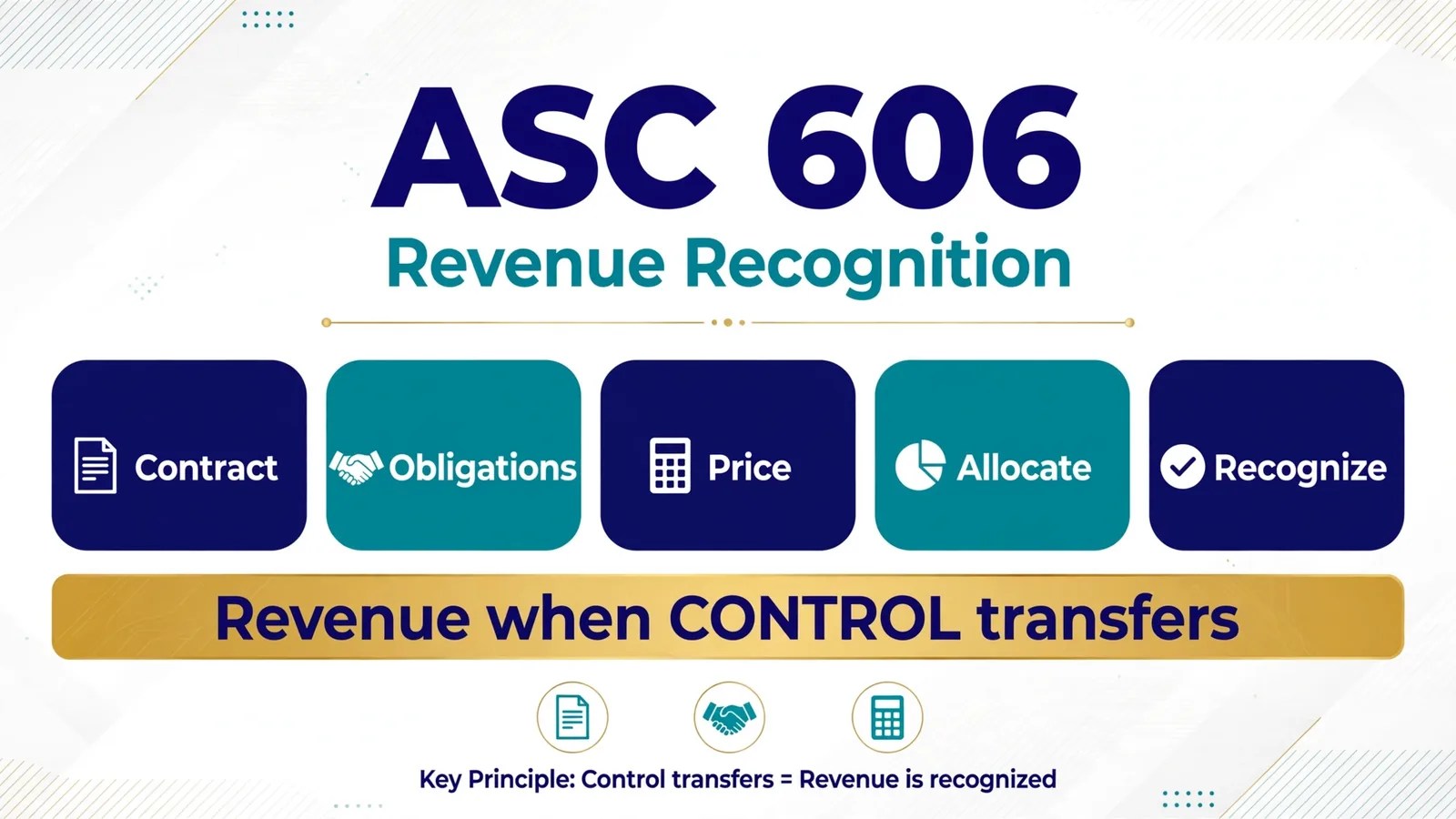
If FAR has one topic you cannot afford to get wrong, it is ASC 606 revenue recognition. Exam questions rarely test definitions. They hand you a contract and ask you to walk it through the five steps and land on the right timing and amount. These notes give you the model, the logic behind each step, and the traps examiners love.
ASC 606 Revenue Recognition: The Core Principle
The entire standard rests on one sentence: recognize revenue to depict the transfer of promised goods or services in an amount reflecting the consideration you expect to receive. Two words do the heavy lifting. Control: recognize revenue when the customer gains control, not when you ship, invoice, or feel good about it. Expected consideration: you book what you expect to be entitled to, which is why estimates and constraints matter in step 3.
Memory aid students actually use: the steps run I-I-D-A-R (Identify, Identify, Determine, Allocate, Recognize).
Steps 1 and 2: The Contract and the Obligations
Step 1: Identify the contract. Any agreement creating enforceable rights counts: written, verbal, or implied. It falls under ASC 606 only if all five criteria hold at inception:
- The parties approved it and remain committed.
- Each party’s rights to the goods or services are identifiable.
- The payment terms are identifiable.
- It has commercial substance (the contract changes the risk, timing, or amount of future cash flows).
- Collection of the consideration is probable (in US GAAP, probable means likely).
If the contract does not meet the criteria, keep reassessing. Recognize revenue only when the contract later meets them, or when the contract ends and any consideration received is nonrefundable.
Step 2: Identify the performance obligations. A performance obligation is a promise to transfer a distinct good or service. Distinct has two parts, and both must hold: the customer can benefit from the item on its own (or with readily available resources), AND the promise is separately identifiable from the other promises. A software license plus one year of support is the classic two-PO contract. A series of substantially identical services transferred the same way (monthly cleaning) is a single PO.
Exam trap: students often treat a bundled contract as one obligation. Splitting it wrong means every later step, timing included, goes wrong too.
Step 3: Determine the Transaction Price
The transaction price is the amount you expect to receive, excluding amounts collected for third parties (sales taxes are not your revenue). Three complications live here:
Variable consideration. Discounts, rebates, refunds, credits, concessions, bonuses, and penalties make the price variable. Estimate with the expected value method (probability-weighted average, best for many outcomes) or the most likely amount (the single most likely outcome, best for binary ones). Then apply the constraint: include variable consideration only if it is probable that a significant reversal of cumulative revenue will not occur once the uncertainty resolves. This constraint is the most-tested sentence in step 3.
Significant financing component. If payment timing gives either side a significant financing benefit (roughly, over a year between transfer and payment), adjust for the time value of money. Consideration payable to a customer (coupons, rebates) reduces the transaction price, unless you get a distinct good or service back.
Step 4: Allocate the Price to Each Performance Obligation
Allocate the transaction price across the POs using their relative standalone selling prices (SSP): what you would charge selling each item separately. If you never sell an item separately, estimate its SSP with the adjusted market assessment (competitor prices), expected cost plus a margin, or the residual approach (total price minus the observable SSPs of the other items), allowed only where an SSP is highly variable or uncertain. Discounts spread proportionately unless observable evidence ties a discount to specific POs.
Step 5: Recognize Revenue as Each Obligation Is Satisfied
Recognize revenue over time if the contract meets ANY ONE of these three criteria:
- The customer simultaneously receives and consumes the benefits as you perform (routine services like cleaning).
- Your performance creates or enhances an asset the customer controls (building on the customer’s land).
- Your performance does not create an asset with an alternative use to you, AND you have an enforceable right to payment for work completed to date (custom-built equipment).
Exam trap: criterion 3 combines two conditions with AND. Students constantly apply it with only one. OR links the three over-time criteria, but inside criterion 3, both halves must hold.
If the contract meets none of the three, recognize revenue at a point in time, when control transfers. Indicators: you have a present right to payment, the customer has legal title, you transferred physical possession, the customer holds the significant risks and rewards, and the customer accepted the asset. For over-time recognition, measure progress with input methods (costs incurred, labor hours) or output methods (units delivered, milestones).
ASC 606 Revenue Recognition Worked Example
A software company sells a bundle for $900: a license (standalone price $800) plus one year of support (standalone price $200). Two distinct POs. Allocate on relative SSP: total SSP is $1,000, so the license gets 800/1,000 x $900 = $720 and support gets 200/1,000 x $900 = $180. The license transfers control at delivery, so $720 hits revenue at a point in time; the support is consumed as provided, so recognize $180 over time at $15 per month. The $100 bundle discount did not vanish; it spread across both obligations in proportion to their SSPs.
ASC 606 Revenue Recognition Quick Revision
- Core principle: recognize revenue when control transfers, at the expected consideration.
- Five steps: I-I-D-A-R (Identify contract, Identify POs, Determine price, Allocate, Recognize).
- Contract needs all 5 criteria, including probable collection.
- Variable consideration: estimate (expected value or most likely amount), then apply the significant-reversal constraint.
- Allocate on relative standalone selling prices.
- Over time if the contract meets ANY of the 3 criteria; criterion 3 needs both halves. Otherwise, point in time.
Want more? Browse all CPA study notes.
FAQ
Does ASC 606 apply to leases or insurance contracts?
No. Leases are ASC 842 and insurance is ASC 944. ASC 606 covers revenue from contracts with customers for ordinary goods and services.
Contract asset vs receivable vs contract liability?
A receivable is an unconditional right to consideration (only time stands in the way). A contract asset is conditional on something else, like finishing another PO. A contract liability is your obligation to deliver for consideration already received.

Leave a Reply